

Grass-Fed Tallow Baby Balm Benefits for Soft Skin
Grass-fed tallow baby balm is defined as a skin barrier moisturizer made from rendered beef fat, rich in oleic acid, stearic acid, and vitamins A, D, and E, that closely mirrors the lipid structure of human skin. These grass-fed tallow baby balm benefits go far beyond basic hydration. The balm locks moisture into infant skin, supports the outer barrier layer, and soothes dryness without synthetic chemicals. For parents managing eczema-prone, flaky, or reactive baby skin, tallow balm offers a science-backed natural alternative to conventional lotions loaded with preservatives and fragrance.
1. How grass-fed tallow supports baby skin barrier health
Baby skin loses moisture faster than adult skin. This process, called transepidermal water loss (TEWL), is the primary driver of dryness, redness, and irritation in infants. When the skin barrier is compromised, water escapes through the outer layer and leaves skin tight, flaky, and vulnerable to irritants.
Grass-fed tallow works by forming a protective, occlusive layer on the skin surface that physically reduces TEWL. Dermatologists highlight tallow’s ultra-hydrating and barrier-protection qualities, describing it as a barrier-focused emollient that locks in moisture mechanically rather than through pharmacological effects. This means tallow does not need to penetrate deeply to work. It seals what is already there.
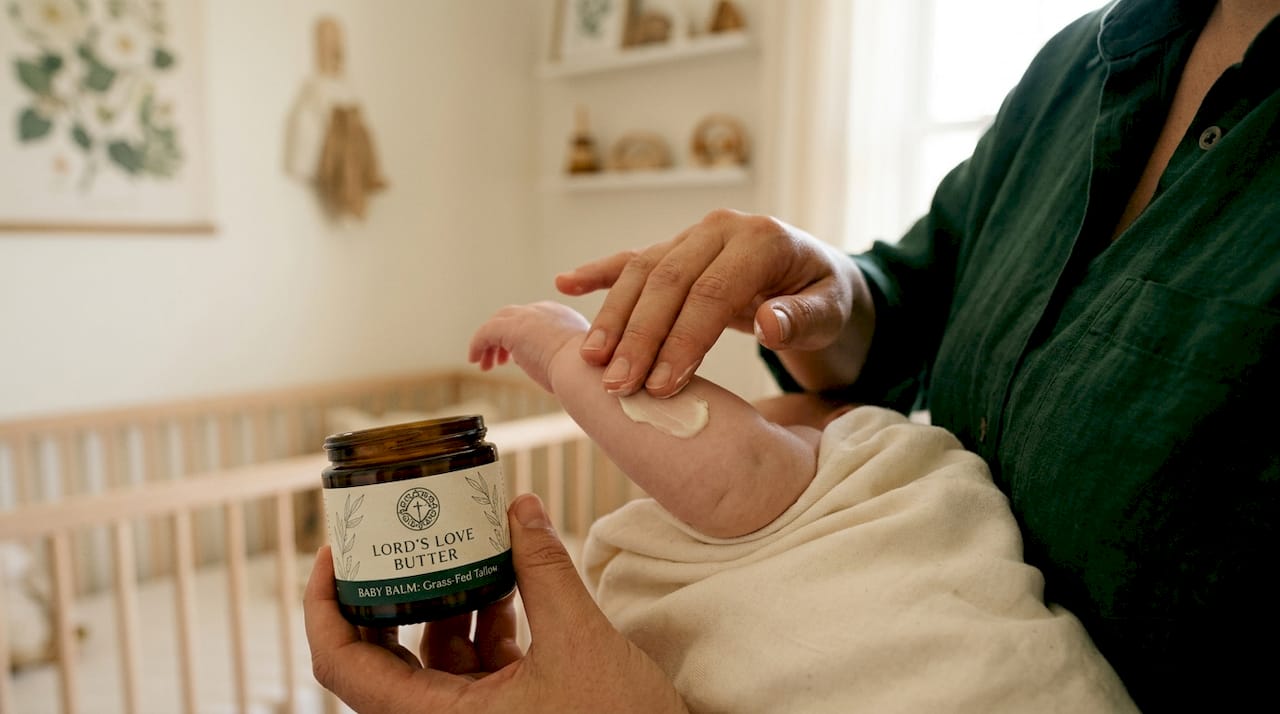
The fatty acid profile of grass-fed tallow is what makes it uniquely suited to baby skin. Oleic, stearic, and palmitoleic acids in tallow closely mimic the lipids found naturally in human sebum. This structural similarity means the skin recognizes tallow and absorbs it without resistance.
Ceramides are the lipid molecules that hold skin cells together in the outer barrier layer. Ceramide disruptions lead directly to dryness and eczema, and ceramide-based moisturizers can reduce TEWL by 30 to 50%. Tallow does not replace ceramides, but its compatible fatty acid structure complements them, supporting the barrier architecture from the outside.
“Eczema and dry sensitive skin often reflect lipid deficiencies, making lipid-rich ingredients like tallow valuable for restoring barrier function.” — MDPI, 2026
2. Intense moisture locking that lasts for hours
Tallow balm does not evaporate the way water-based lotions do. Its occlusive nature creates a physical seal over the skin that holds moisture in place for hours after application. Parents who apply it after bath time often report that their baby’s skin stays soft through the night without reapplication.
This long-lasting effect matters most for infants with dry or eczema-prone skin, where the barrier is already weakened. A single application of a well-formulated tallow balm can replace two or three applications of a lighter lotion. That is a practical advantage for nighttime routines.
3. Rich vitamin content that nourishes and regenerates
Grass-fed tallow contains vitamins A, D, and E in their natural fat-soluble forms. Vitamin A supports cell turnover and skin regeneration. Vitamin D plays a role in immune modulation at the skin surface. Vitamin E acts as an antioxidant, protecting skin cells from oxidative stress. These grass-fed tallow antioxidant skin benefits are built into the ingredient itself, not added synthetically.
The vitamin content in tallow is directly tied to the diet of the animal. Grass-fed cattle produce tallow with measurably higher concentrations of fat-soluble vitamins compared to grain-fed sources. This is why sourcing matters. A balm made from conventionally raised beef fat will not deliver the same nutrient density.
4. Gentle enough for sensitive and eczema-prone baby skin
High-quality grass-fed tallow balm is non-comedogenic and suitable for infant sensitive skin when free from fragrances and added irritants. This is the critical distinction between a well-formulated tallow balm and a poorly made one. The base ingredient is gentle. What gets added to it determines whether it stays that way.
Eczema-prone skin has a compromised lipid barrier, and lipid-rich ingredients like tallow are specifically valuable for restoring that function. Parents using tallow balm on eczema-affected patches typically see reduced redness and scaling within one to two weeks of consistent daily use. Patience matters here. Barrier repair takes time.
Pro Tip: Always patch test any new balm on a small area of your baby’s inner arm for 24 hours before full application, even with natural products.
5. Multi-use versatility across the whole body
Tallow balm is not a single-purpose product. Parents use it as a face moisturizer, a diaper rash barrier, a dry scalp treatment, and a full-body lotion. Its thick consistency makes it especially effective for high-friction areas like the diaper zone, where skin needs both moisture and physical protection from irritants.
For cradle cap, a small amount of warmed tallow balm massaged into the scalp before bath time softens flakes without stripping the skin. For chapped cheeks in winter, it creates a wind-resistant barrier that lighter creams cannot match. One product covering this many use cases simplifies the baby care routine considerably.
6. No synthetic chemicals or preservatives
Most conventional baby lotions contain parabens, synthetic fragrances, PEGs, and preservatives like phenoxyethanol. These ingredients extend shelf life and improve texture, but they introduce unnecessary chemical exposure to infant skin that absorbs substances more readily than adult skin does.
Grass-fed tallow balm in its pure form contains one ingredient. When blended with additions like manuka honey, the formula stays clean and functional without synthetic fillers. For parents who read ingredient labels carefully, this simplicity is a major advantage over conventional baby skin care products.
7. How to apply tallow balm for best results
Application method directly affects how well tallow balm performs. Dermatologists recommend warming the balm first and applying it to clean, slightly damp skin. Warmth softens the balm’s texture and makes it spread more easily. Damp skin gives the occlusive layer something to seal in, dramatically improving moisture retention.
Here is a simple application routine for infants:
- Warm a pea-sized amount between your fingertips for 10 to 15 seconds
- Apply immediately after bath time while skin is still slightly damp
- Use gentle circular motions on the face, arms, and legs
- Apply a slightly thicker layer to dry patches, elbows, or the diaper area
- Reapply once more before bedtime if skin feels tight or dry
Pro Tip: If the balm feels too thick for your baby’s skin type, mix a small amount with a lighter plant-based oil like jojoba to adjust the consistency without losing the barrier benefit.
Barrier-supporting moisturizers typically require consistent daily use over several weeks to show measurable improvements in hydration and reduction in dryness. Set a four-week baseline before evaluating results.
8. Tallow balm vs. other natural baby moisturizers
Not all natural moisturizers work the same way. Here is how grass-fed tallow compares to the most common alternatives:
| Moisturizer | Absorption | Barrier effect | Vitamin content | Risk for babies |
|---|---|---|---|---|
| Grass-fed tallow | High, mimics sebum | Strong occlusive | A, D, E naturally present | Low if unscented |
| Shea butter | Moderate | Moderate | Minimal | Low, but may cause nut allergy |
| Cocoa butter | Low, sits on surface | Moderate | Minimal | Low, but comedogenic risk |
| Synthetic baby lotion | Fast, water-based | Weak | Synthetic additives | Moderate due to preservatives |
Tallow’s similarity to human sebum gives it superior skin absorption and lipid compatibility compared to plant-based butters. Shea butter is a solid second choice for parents who prefer plant-based options, but it does not replicate the fatty acid profile of human skin the way tallow does. Cocoa butter sits heavily on the surface and can clog pores in babies prone to baby acne.
Tallow balm is the strongest choice for dry, eczema-prone, or barrier-compromised infant skin. Shea butter works well as a complementary product for lighter daily use. Synthetic creams are the weakest option for parents prioritizing clean ingredients.
Key takeaways
Grass-fed tallow baby balm is the most effective natural moisturizer for infant skin because its fatty acid profile mirrors human sebum, its vitamins A, D, and E nourish skin at the cellular level, and its occlusive barrier function reduces moisture loss better than plant-based alternatives.
| Point | Details |
|---|---|
| Barrier support | Tallow reduces transepidermal water loss by forming an occlusive seal that mimics skin’s own lipids. |
| Vitamin nourishment | Grass-fed tallow delivers fat-soluble vitamins A, D, and E that support skin regeneration and antioxidant protection. |
| Gentle formulation | Unscented, chemical-free tallow balm is non-comedogenic and safe for sensitive and eczema-prone infant skin. |
| Application method | Warm the balm and apply to slightly damp skin after bath time for maximum moisture retention. |
| Realistic timeline | Consistent daily use over four weeks produces measurable improvements in hydration and reduction in dryness. |
Why I think tallow balm is underrated in baby skincare
I have watched parents cycle through five or six conventional baby lotions before landing on tallow balm, and the pattern is almost always the same. The lotions work briefly, the dryness returns, and the ingredient list gets longer with each new product they try. Tallow balm breaks that cycle because it addresses the root issue: a compromised lipid barrier, not just surface dryness.
What surprises most parents is how quickly the texture wins them over. They expect something greasy and heavy. What they get, when the balm is properly whipped and applied warm to damp skin, is a product that absorbs cleanly and leaves skin soft without residue. That experience changes their relationship with natural baby skin care products entirely.
My honest advice: give it four weeks before judging. Barrier repair does not happen overnight. The parents who stick with it consistently are the ones who come back and say their baby’s skin has not looked this good since birth. That is not marketing. That is what lipid-compatible skincare does when you give it time to work.
One thing I want to be direct about: not all tallow balms are equal. Sourcing from grass-fed cattle matters for vitamin density. Keeping the formula free of fragrance matters for infant safety. Effective tallow balms must be properly formulated and applied to support skin barrier architecture. The grass-fed label alone is not enough. Look at the full ingredient list and the sourcing transparency of the brand before you buy.
— Michael
Try Lordslovebutter for your baby’s sensitive skin
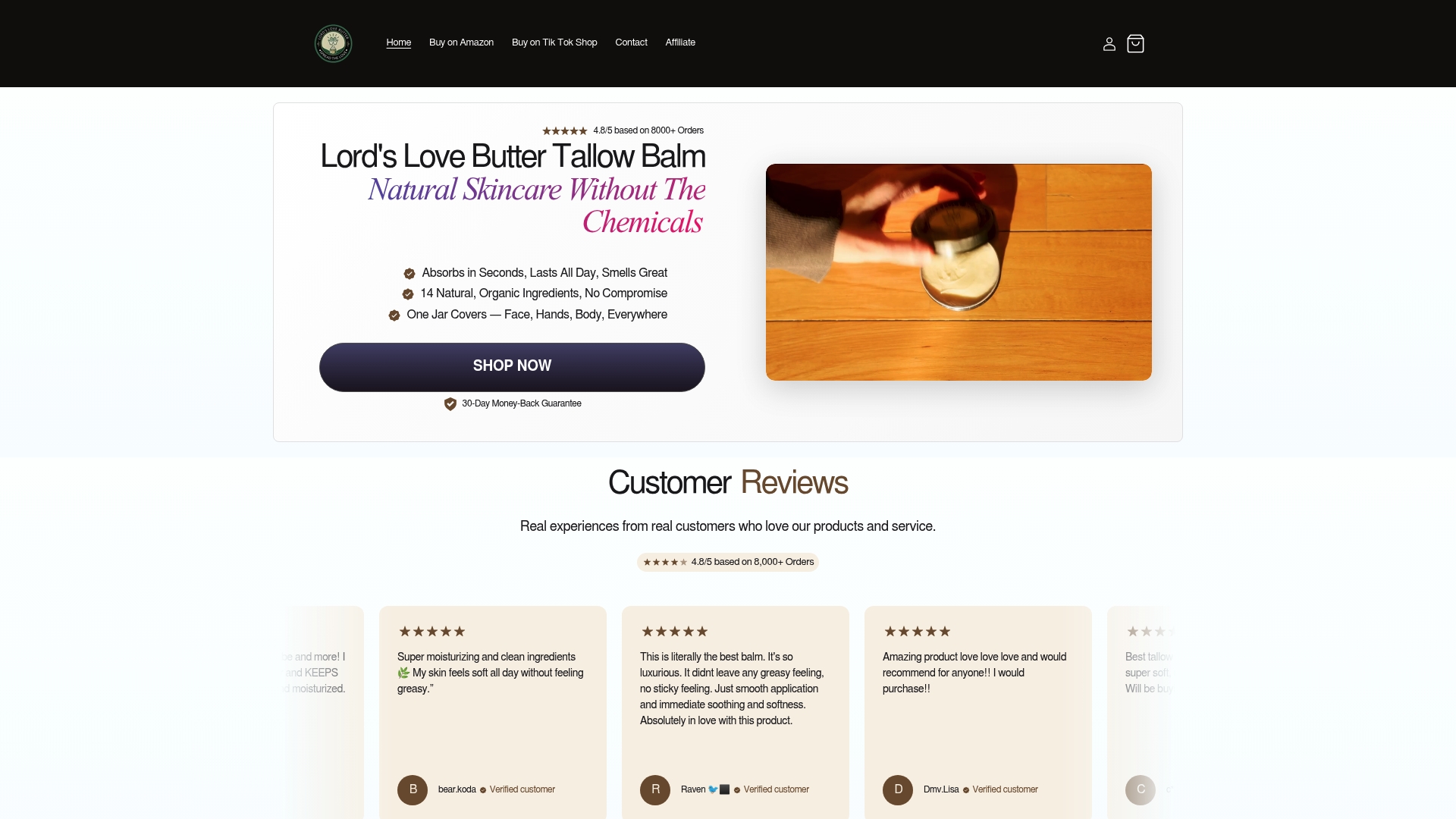
Lordslovebutter makes a whipped tallow balm from 100% grass-fed beef tallow, blended with manuka honey and completely free of synthetic chemicals, fragrances, and preservatives. The formula is designed specifically for sensitive skin, including infants and toddlers with eczema or chronic dryness. It absorbs without a greasy feel and works across the whole body, from dry cheeks to the diaper area. Lordslovebutter is a veteran-owned business that puts ingredient transparency first. If you are ready to simplify your baby’s skincare routine with one clean, effective product, the 2.4 oz tin is the ideal starting point.
FAQ
What makes grass-fed tallow better than regular tallow for babies?
Grass-fed tallow contains significantly higher concentrations of fat-soluble vitamins A, D, and E compared to grain-fed sources, because the animal’s diet directly determines the nutrient density of the fat. For infant skin, this means more nourishing, regenerative properties in every application.
Can I use tallow balm on a newborn?
Yes, provided the balm is unscented, free from synthetic additives, and sourced from grass-fed beef. Newborn skin is highly permeable, so purity of ingredients is the top priority. Patch test on the inner arm first and monitor for any reaction over 24 hours.
How long before I see results on dry or eczema-prone baby skin?
Consistent daily application over four weeks is the standard baseline for seeing measurable improvements in hydration and reduction in scaling. Some parents report softer skin within the first week, but barrier repair takes sustained use to show full results.
Is tallow balm safe for the diaper area?
Tallow balm is well-suited for the diaper area because its occlusive barrier protects skin from moisture and irritants while its fatty acids support healing. Use a clean application each diaper change on affected or dry skin.
Does grass-fed tallow balm clog pores on baby skin?
High-quality, unscented grass-fed tallow balm is considered non-comedogenic, meaning it does not block pores when properly formulated. Baby acne is caused by maternal hormones, not by occlusive moisturizers, so tallow balm is generally safe even on the face.

