

Noticeable Hydration in Days: Manuka Honey Balm Paired With Tallow
Manuka honey balm delivers real, measurable hydration, antibacterial support, and wound-healing help when applied topically. Dry, irritated, or barrier-compromised skin sees the biggest gains, along with mild acne and minor cuts or abrasions. Patch test first, and treat serious wounds or diabetic skin issues with actual medical care, not a jar from your bathroom shelf.
TL;DR:
- Manuka honey’s MGO content and UMF rating influence its antibacterial strength, but formulation and co-ingredients also impact skin performance.
- The balm is most effective for daily barrier repair, minor wounds, and mild skin inflammation, not for deep infections or chronic wounds.
- Proper usage involves cleansing, applying a thin or thick layer depending on the need, and leaving it on for continuous contact, ideally twice daily.
- Patch testing for allergies is essential, especially for sensitive skin or allergy-prone individuals, and serious wounds require medical attention.
- The balm offers active humectant and antimicrobial benefits that plain moisturizers lack, making it suitable for reactive, irritated, or compromised skin.
Table of Contents
- Manuka Honey Balm Benefits: The Full Skin-Level Breakdown
- What’s Actually Happening: MGO, Hydrogen Peroxide, and Osmolarity
- Clinical Evidence: What Studies and Reviews Actually Found
- How to Use Manuka Honey Balm for the Best Results
- Safety, Allergies, and When to Call a Doctor
- Manuka Honey Balm vs. Plain Moisturizer: What’s Actually Different
- Why We Built Our Formula Around Manuka Honey and Tallow
- Which Lord’s Love Butter Balm Fits Your Skin Routine
- Sources
Manuka Honey Balm Benefits: The Full Skin-Level Breakdown
The claim that Manuka honey balm helps skin isn’t marketing shorthand. It’s a compound built on hydration chemistry, antimicrobial activity, and anti-inflammatory action, all working at once in a single application. Here’s what each benefit actually looks like on real skin, not in a lab beaker.
Hydration and barrier repair. Manuka honey is a natural humectant, meaning it pulls water into the skin and holds it there. That’s different from an occlusive like petroleum jelly, which just seals moisture in without adding any. When honey is suspended in a fat base like whipped tallow, you get both mechanisms at once: humectant pull plus occlusive seal. That combination matters for barrier repair, because a damaged barrier needs water retained at the surface while the lipid layer rebuilds underneath.
Wound-healing support. Honey has been used clinically for wound care for decades, and modern reviews back that history up. A frequently cited review of honey’s therapeutic role in skin disorders documents antimicrobial and wound-healing properties strong enough that honey shows up in actual medical wound dressings, not just skincare aisles. The evidence is strongest for partial-thickness burns and weaker for chronic or non-burn wounds, which is a distinction worth remembering before you assume it fixes every scrape the same way.
Antibacterial effects for acne-prone skin. This is where methylglyoxal, or MGO, does its work. MGO gives Manuka honey antimicrobial, anti-inflammatory, and antioxidant properties that help manage acne by fighting the bacteria that colonize clogged pores while calming the inflammation around them. That’s a two-front approach most single-ingredient acne treatments don’t offer.
Anti-inflammatory and antioxidant action. Redness, irritation, and the low-grade oxidative stress that ages skin faster all respond to the same phenolic compounds that give Manuka honey its color and its bite. This is also where the evidence for eczema and psoriasis gets interesting, though it’s not a slam dunk.
The limits worth knowing:
- Deep, infected, or non-healing wounds need a clinician, not a balm.
- Chronic wound evidence is mixed, not conclusive, according to the same PMC review.
- Small trial sizes mean eczema and psoriasis claims deserve cautious optimism, not certainty.
- Balm alone won’t replace prescribed topical medication for diagnosed skin disease.
None of that undercuts the core case. It just means Manuka honey balm works best as a daily-use ally for common, mild skin stress, not a replacement for medicine when something’s seriously wrong.
What’s Actually Happening: MGO, Hydrogen Peroxide, and Osmolarity
Manuka honey’s benefits trace back to four things happening simultaneously at the molecular level, and understanding them explains why potency varies so much between jars on a shelf.
Methylglyoxal (MGO) is the headline compound. It converts from dihydroxyacetone found naturally in the nectar of the Manuka plant, and it’s what gives this honey type antibacterial power that regular honey doesn’t match. The Unique Manuka Factor, or UMF, is a separate rating system that correlates with MGO content and other markers to grade overall potency. Higher MGO or UMF numbers generally mean stronger antibacterial activity, though formulation and co-ingredients still shape how that potency performs on actual skin.
Hydrogen peroxide adds a secondary antimicrobial layer. Most honey types produce small amounts of hydrogen peroxide through an enzyme reaction, giving even non-Manuka honey some antibacterial punch. Manuka’s advantage is that its MGO-driven activity holds up even when the hydrogen peroxide breaks down, which happens with heat or light exposure.
Osmolarity does quiet, mechanical work. Honey’s high sugar concentration draws water out of bacterial cells through osmosis, essentially dehydrating microbes on contact. That’s a physical mechanism, not a chemical one, and it works alongside MGO rather than replacing it.
Phenolic compounds bring the antioxidant and anti-inflammatory effects. These plant-derived compounds neutralize free radicals and calm inflammatory signaling, which is the mechanism behind reduced redness and calmer, less reactive skin over time.
Why potency labels vary so much:
- Floral source and harvest region change the MGO baseline before processing even starts.
- Heat exposure during manufacturing can degrade hydrogen peroxide activity.
- UMF or MGO numbers on packaging reflect raw honey potency, not the finished balm’s overall performance.
- Co-ingredients like tallow, oils, or humectants change how the honey’s compounds actually reach and interact with skin.
A jar labeled MGO 100+ isn’t automatically better for your skin than one labeled MGO 30+ if the rest of the formulation is weaker. Potency numbers describe the honey, not the product built around it, and that distinction gets lost in a lot of marketing copy.
Clinical Evidence: What Studies and Reviews Actually Found
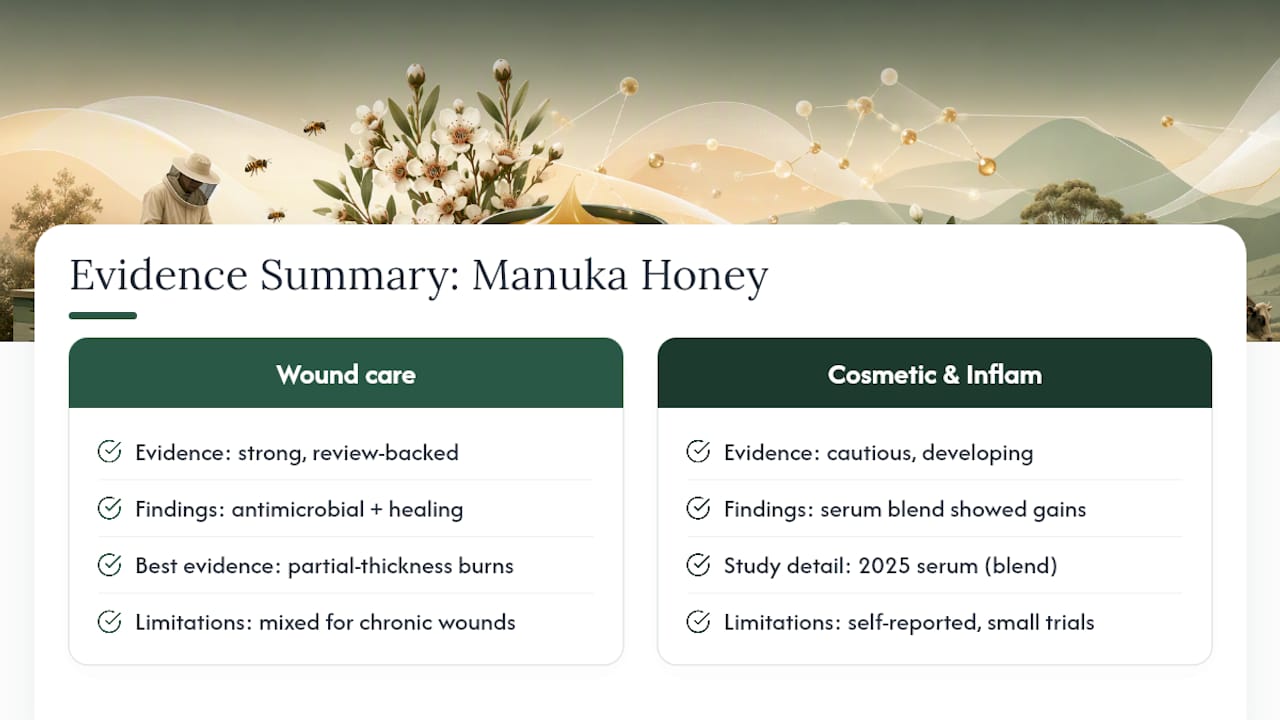
The evidence for topical Manuka honey splits cleanly into two tiers: strong support for wound care and antimicrobial action, and more cautious, still-developing support for cosmetic and inflammatory skin outcomes.
On the wound care side, the picture is fairly settled. Systematic reviews find honey has demonstrated antimicrobial and wound-healing properties strong enough that medical-grade honey dressings are an established clinical tool, not a fringe remedy. That review also flags where the evidence thins out: honey performs best in partial-thickness burns, and the data for chronic wounds or non-burn acute wounds is mixed rather than conclusive.
That’s the practical takeaway from clinical resources reviewing the medicinal uses of Manuka honey: treat it as a legitimate adjunct with real backing, not a proven cure-all.
On the cosmetic side, a 2025 study offers one of the more concrete data points available for a Manuka-containing skincare product. Participants using a face serum blending Manuka honey with royal jelly and bee venom over several weeks self-reported improvements in 12 of 17 measured skin parameters within the first two weeks, and by Week 8, a substantial majority reported improved perceived skin glow. Those numbers are worth reading carefully. The serum wasn’t Manuka honey alone. It was a blend, and the improvements were self-reported rather than measured with clinical instruments like a corneometer or colorimeter. Sample size and study design details matter here, and the results speak to the formulation’s overall performance more than to Manuka honey as an isolated ingredient. Still, an 8-week window showing sustained rather than fading improvement is a meaningfully different result than a one-week novelty effect, and it lines up with what dermatologic reporting on honey-based skincare generally observes.
Smaller trials looking at inflammatory conditions like atopic dermatitis have reported symptom reduction with topical honey treatments, but those studies tend to run with limited participant pools, and researchers reviewing this area consistently flag the need for larger studies before drawing firm conclusions about eczema specifically.
So where does that leave a realistic reader? Manuka honey balm has solid, review-backed support for minor wound care, antimicrobial action, and general barrier and hydration support. The evidence for chronic wounds, diagnosed eczema, and psoriasis is promising but not settled science yet. That’s not a weak position, it’s an honest one, and it’s a lot more evidence than most skincare ingredients on the market can actually point to.
How to Use Manuka Honey Balm for the Best Results
Getting results from a Manuka honey balm depends less on the product and more on how consistently and correctly you apply it. Here’s the routine that actually works.
- Cleanse first. Wash the area with a gentle, non-stripping cleanser and pat dry. Applying balm over dirt or oil residue blocks absorption.
- Apply a thin layer. For daily moisturizing, a small amount rubbed into slightly damp skin locks in more water than applying to bone-dry skin.
- For spot treatment, go thicker. On a minor cut, abrasion, or blemish, apply a slightly heavier layer and consider a light bandage or covering if the area is prone to friction.
- Leave it on. Manuka honey works through direct, sustained skin contact, and dermatologists point to leave-on formats like balms and masks as the format that lets humectant and antibacterial action actually happen, rather than a rinse-off product that removes the honey before it can work.
- Repeat once or twice daily. Morning and night works for general hydration; spot treatments can go up to three times daily if skin tolerates it.
Which format for which need: a rich balm suits whole-body dryness and barrier repair; a lighter serum suits daily facial use under makeup; a lip balm variant handles chapped or cracked lips specifically; and honey-infused masks work well as a weekly deep-treatment add-on rather than a daily step.
Layering matters too. Manuka honey balm pairs well underneath a hyaluronic acid and niacinamide serum, since the serum’s humectants add moisture-binding power while the balm seals it in. If you use retinoids, apply them first on clean skin and let them absorb before layering balm on top to avoid diluting the retinoid’s effect.
Pro Tip: Hydration improvements often show up within a few days of consistent use, but wound-healing and inflammation changes take longer. Give any minor cut or irritated patch a full one to two weeks before deciding whether the balm is working.
Safety, Allergies, and When to Call a Doctor
Manuka honey is a bee product, and bee products can trigger allergic reactions, so skipping the patch test is the single most common mistake people make with any new honey-based skincare product.
How to patch test properly:
- Apply a small amount to the inner forearm or behind the ear.
- Wait 24 to 48 hours without washing the area.
- Check for redness, swelling, itching, or bumps before applying anywhere else.
- Dermatology sources consistently recommend this step before regular use, specifically because Manuka honey can cause contact allergies in sensitive individuals.
If you notice hives, spreading redness, swelling, or any difficulty breathing after applying honey topically, stop immediately and seek medical attention. That combination points to a systemic allergic reaction, not simple irritation.
Skip topical Manuka honey, or check with a provider first, if:
- The wound is deep, infected, or shows red streaking spreading outward.
- You have uncontrolled diabetes, which affects wound healing and infection risk.
- You’re currently using a prescription topical medication, since combining products can change absorption or cause irritation.
Coordinate with your dermatologist or physician before adding Manuka honey balm to an existing prescribed regimen, especially for diagnosed skin conditions like acne that already involve a treatment plan.
Manuka Honey Balm vs. Plain Moisturizer: What’s Actually Different
A plain emollient like petroleum jelly or a basic oil blend does one job well: it seals existing moisture in through occlusion. Manuka honey balm does that plus two things a plain moisturizer can’t touch: active humectant pull and genuine antimicrobial action from MGO.
That distinction decides when each one makes sense.
- Choose a basic moisturizer for straightforward, non-irritated dry skin with no acne, wounds, or inflammation involved.
- Choose a Manuka honey balm when skin is irritated, prone to breakouts, healing from a minor scrape, or dealing with a compromised barrier that needs more than a passive seal.
- Formulation changes everything. A Manuka balm blended with occlusive fats like tallow performs differently than one in a lightweight lotion base, since the fat content extends how long the honey stays in contact with skin.
- Read potency labels with context. An MGO or UMF number tells you about the honey’s raw strength, not the finished product’s real-world performance, which depends just as much on what it’s mixed with.
The practical rule: if your skin issue involves bacteria, inflammation, or active healing, the antimicrobial layer earns its place. If it’s just dryness with nothing else going on, either option works fine.
Why We Built Our Formula Around Manuka Honey and Tallow
Sensitive, eczema-prone, and barrier-compromised skin doesn’t need more ingredients thrown at it. It needs fewer, better ones working together, which is why we paired Manuka honey’s antimicrobial and humectant properties with whipped grass-fed beef tallow instead of synthetic emulsifiers or filler oils. Tallow’s lipid profile closely mirrors skin’s own natural oils, which helps the Manuka honey stay in contact with skin longer, the leave-on effect that dermatology reporting consistently links to better outcomes. This combination isn’t a substitute for medical treatment on serious wounds or diagnosed disease. It’s a practical, whole-body option for the dry, reactive, and irritated skin most people actually deal with day to day.
— Michael
Which Lord’s Love Butter Balm Fits Your Skin Routine
Most plain moisturizers stop at sealing in water. This balm combines occlusive barrier support with Manuka honey’s antimicrobial and humectant properties in a whipped, chemical-free tallow base built for whole-body use, including sensitive, eczema-prone skin.
If you want the classic formula in a format built for the medicine cabinet, the Whipped Beef Tallow Balm with Manuka Honey Tin travels well and holds up outside a bathroom shelf. Prefer scooping from a wider container at your sink? The Jar version has the same formula in a shape that’s easier to scoop with a full hand for whole-body application. If you’re stocking both a travel and home version, the Tin & Jar Bundle covers that without buying twice at full price. And for anyone who wants lip care and sun protection alongside body hydration in one order, the Tin, Lip Balm & Sun Shield Tallow Bundle rounds out a full routine in one checkout.
Pick the format that matches how you’ll actually use it daily, and start with the tin or jar if you’re new to the formula.
Sources
The clinical and dermatological claims in this guide draw on peer-reviewed research and reporting worth reading directly if you want to go deeper.
- Manuka Honey: Medicinal Uses, Benefits, and Side Effects
- Honey: A Therapeutic Agent for Disorders of the Skin
- Study evaluating face serum with honey-derived ingredients (2025)
For wound care specifically, always defer to a licensed clinician for anything beyond minor cuts or abrasions. Topical honey products, however well studied, are not a substitute for professional wound management.

