

Acne Safe Balm Trial for Sensitive Skin: 2 Weeks with Lord's Love Butter
A whipped beef tallow balm with Manuka honey is a reasonable, chemical-free option for many people with dry, sensitive, or barrier-compromised skin, including eczema and psoriasis, when the product is patch-tested first and used with a light hand. Tallow’s fatty acids mimic parts of human sebum and support the skin barrier, while Manuka honey brings anti-inflammatory activity that can calm irritation. Anyone with moderate to severe flares, open or oozing skin, or a known allergy should patch test carefully and loop in a clinician before making this part of a regular routine.
TL;DR:
- Patch testing with a small amount of whipped beef tallow balm with Manuka honey helps reduce allergy and contamination risks before broader use.
- Using a thin, lighter balm version or applying to damp skin maximizes tolerability and absorption on sensitive or reactive areas.
- Expect skin improvements within one to two weeks of consistent nightly application, not immediate results.
- Look for balms with grass-fed, properly rendered tallow, minimal ingredients, and high-quality, sterilized Manuka honey for best safety and effectiveness.
- Avoid products with unclear sourcing, synthetic fillers, or long ingredient lists to reduce the risk of irritation or adverse reactions.
Table of Contents
- Which Acne Safe Balm Options From Lord’s Love Butter Should You Try First?
- How Tallow and Manuka Honey Actually Work on Skin
- Patch Testing and Reducing Contamination Risk
- How to Apply an Acne Safe Balm for Best Results
- What to Look for in an Acne-Friendly Moisturizer
- An Editorial Take on Trialing Tallow for Sensitive Skin
- Where to Start Your Trial on Lordslovebutter
- Sources
Which Acne Safe Balm Options From Lord’s Love Butter Should You Try First?
Choosing the right starting point matters more than people think. A balm that’s perfect for a forearm patch test isn’t necessarily the one you want smeared across your cheeks on night one, and Lordslovebutter builds its lineup with that distinction in mind.
- Whipped Beef Tallow Balm with Manuka Honey, 2.4 oz Tin. This is the trial-size format, built for exactly the kind of cautious, patch-test-first approach sensitive skin needs. It’s small enough to test on one forearm patch without committing to a full jar.
- Original Beef Tallow Balm Lite with Manuka Honey. A thinner, lighter version of the flagship formula, better suited to the face or other thin-skinned, reactive areas where a heavier balm can feel occlusive or sit too long.
- Whipped Beef Tallow Balm with Manuka Honey, 2.4 oz Jar. The full-size version once you’ve confirmed tolerance. This is the one people reach for on elbows, knees, and other classic dry-patch or eczema-prone zones.
- Tallow Face Duo, Vitamin C, Squalane and Rosehip Oil. Built for people who want antioxidant support layered into their facial routine alongside the base balm.
- Vitamin C Whipped Beef Tallow Balm with Manuka Honey and Squalane. A single-jar version of that same vitamin C plus squalane combination, for anyone who wants brightening support without managing two separate products.
- Tallow Lite Double, with double Manuka honey and propolis. A lighter lite formula that doubles down on Manuka honey and adds propolis, another bee-derived ingredient with its own antimicrobial reputation, for people who tolerated the standard Lite well and want more of the honey-driven benefit.
Every one of these is formulated as a whole-body moisturizer and barrier balm, not a facial acne-cleansing product. If your search started with “acne safe balm” because you’re worried about breakouts on the face specifically, that’s a related but different question than what these balms are built to answer, and worth separating clearly in your head before you shop.
How Tallow and Manuka Honey Actually Work on Skin
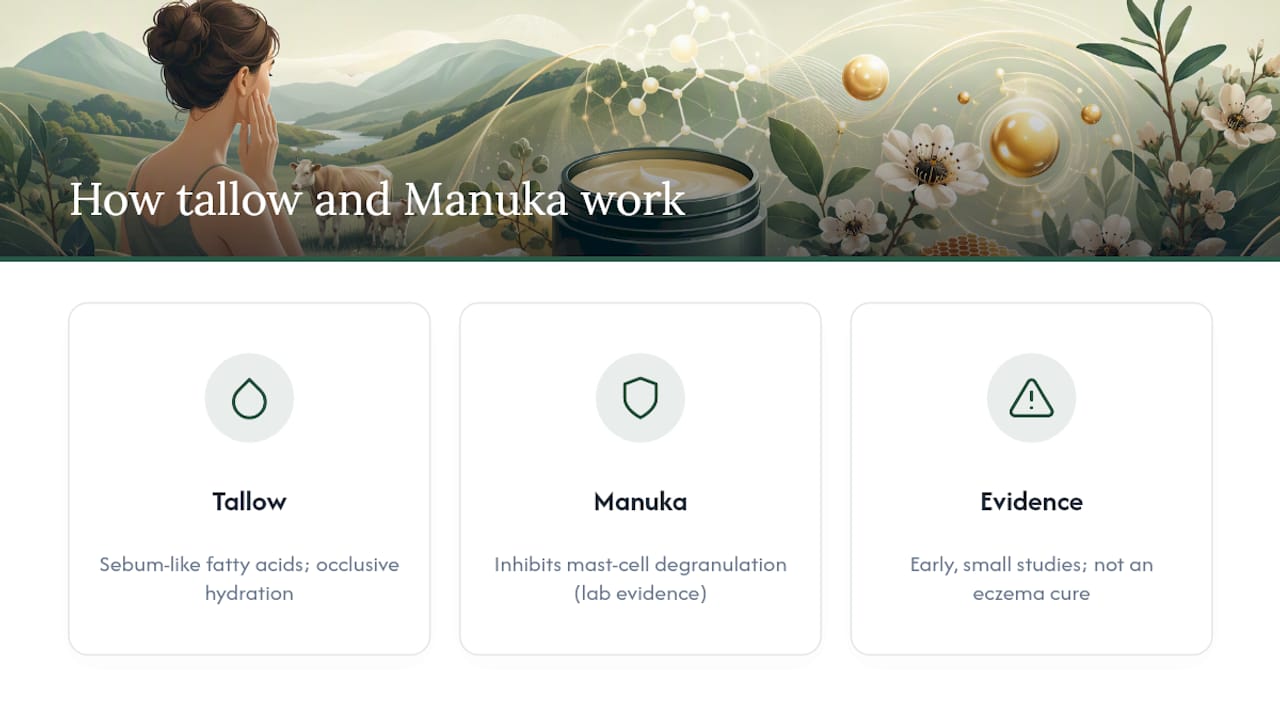
Tallow’s case rests on chemistry, not folklore. Rendered beef fat contains oleic, palmitic, and stearic acids, the same fatty acids that make up a meaningful share of human sebum, which is part of why so many people with dry skin describe it as feeling less “foreign” than mineral-oil-based products. A scoping review of tallow’s biocompatibility with skin a scoping review concluded the fat can support hydration and barrier function through this occlusive, sebum-like action.
The evidence gap: that same review is blunt about its limits. Human clinical trials on tallow specifically are scarce, and reported side effects across the included studies were inconsistent rather than uniformly reassuring.
Manuka honey’s mechanism is better documented at the lab level. Mechanistic and clinical research on honey and atopic dermatitis has linked topical Manuka honey to reduced lesion severity in small pilot studies, alongside inhibition of mast-cell degranulation, the cellular process that drives allergic inflammation and itch. A related lab study found that medical-grade Manuka honey and its extracts inhibited IgE-induced mast-cell degranulation in a dose-dependent way, at some concentrations blocking the response almost entirely. That’s a plausible biological reason honey calms irritated skin, though it’s mechanistic and small-scale evidence, not proof the finished balm will replicate those results on your particular skin.
Put together, you get an emollient that behaves like a supportive layer over your existing barrier, paired with an ingredient that has real, if early, anti-inflammatory credentials. Neither claim rises to “cures eczema.” Both are honest reasons to try it cautiously.
Patch Testing and Reducing Contamination Risk
Sensitive and barrier-compromised skin reacts to more than just the star ingredients, so the testing protocol matters as much as the formula.
Apply a small amount to your inner forearm and leave it alone for several days, typically two to three. Redness, swelling, or itching within that window means stop and don’t move it to your face or body. No reaction after three days is a reasonable green light to expand use gradually. Pediatric guidance from Children’s Hospital of Philadelphia is explicit that animal-derived fats carry allergy and contamination risk if poorly rendered or stored, and it recommends clinician consultation before use in children or anyone with severe eczema.
- Store balm away from heat and direct sunlight, and use clean hands or a spatula rather than fingers straight from the jar repeatedly.
- Favor products that state medical-grade or sterilized Manuka honey rather than raw, unprocessed honey of unknown origin.
- Watch for oozing, cracked, or actively infected skin. That presentation calls for a clinician visit before any new topical, tallow-based or otherwise.
Pro Tip: Keep a one-line log on your phone each night: date, where you applied it, and how skin looked the next morning. Two weeks of that log tells you more than a week of guessing.
How to Apply an Acne Safe Balm for Best Results
The routine matters almost as much as the ingredients. Applying tallow balm to soaking-wet skin dilutes it; applying it to bone-dry skin makes it harder to spread evenly. Damp, towel-patted skin right after a shower is the sweet spot most people land on.
- Pat skin dry after bathing so the skin is damp but not wet, then apply within a few minutes while pores are still slightly open.
- Use a small amount for the face and a modest amount per limb for the body. Less is genuinely more with an occlusive balm.
- Apply nightly at first rather than twice daily, since barrier-compromised skin benefits more from consistency than volume.
- Layer it last, after any water-based serums or prescribed treatments have absorbed, and skip it entirely under sunscreen during the day unless you’ve confirmed compatibility.
- Give it 7 to 14 consecutive nights before judging results, and compare photos or your tracking notes from day one to day fourteen rather than trusting memory alone.
What to Look for in an Acne-Friendly Moisturizer
Not every tallow product on the market is formulated the same way, and the differences matter for reactive skin.
- Grass-fed, properly rendered tallow as the base, ideally with a visible sourcing statement rather than a vague “natural fats” label.
- A short ingredient list. Balms loaded with a dozen botanical extracts give barrier-compromised skin more chances to react to something unrelated to the tallow itself.
- Medical-grade Manuka honey rather than raw honey of unstated origin, since processing standards affect both potency and contamination risk.
- No added fragrance or essential oils in your first jar. Save those combination formulas for after you’ve confirmed the base tolerates well.
- Batch transparency and visible customer feedback, since a brand willing to show sourcing and real testimonials has less to hide than one hiding behind stock photography.
Red flags run the other direction: unclear sourcing, oils prone to oxidizing quickly, or an ingredient list so long you can’t identify what’s actually doing the work.
An Editorial Take on Trialing Tallow for Sensitive Skin
Most of the noise around tallow skincare treats it like a miracle or a scam, and both framings miss what the research on biocompatibility actually supports: a fat that resembles sebum, paired with a honey that has real, if early, anti-inflammatory data behind it. That’s not nothing, and it’s not a cure either.
What tends to get skipped in customer reviews is the timeline. Improvement, when it happens, usually shows up within one to two weeks of consistent nightly use, not overnight. Skip the patch test and you’re gambling on skin that’s already compromised. Do it right, and you’re running a small, controlled experiment on your own barrier, which is exactly how sensitive skin should be treated. Lordslovebutter builds its balms from grass-fed tallow with minimal ingredient lists specifically because that transparency is what lets a cautious trial actually work.
— Michael
Where to Start Your Trial on Lordslovebutter
If you’re ready to test this for yourself, start small. The 2.4 oz tin is built for exactly this kind of cautious trial, small enough to commit to without wasting product if your skin says no. Anyone testing on the face specifically should look at the Lite formulation instead, since it’s thinner and less occlusive for thin-skinned areas.
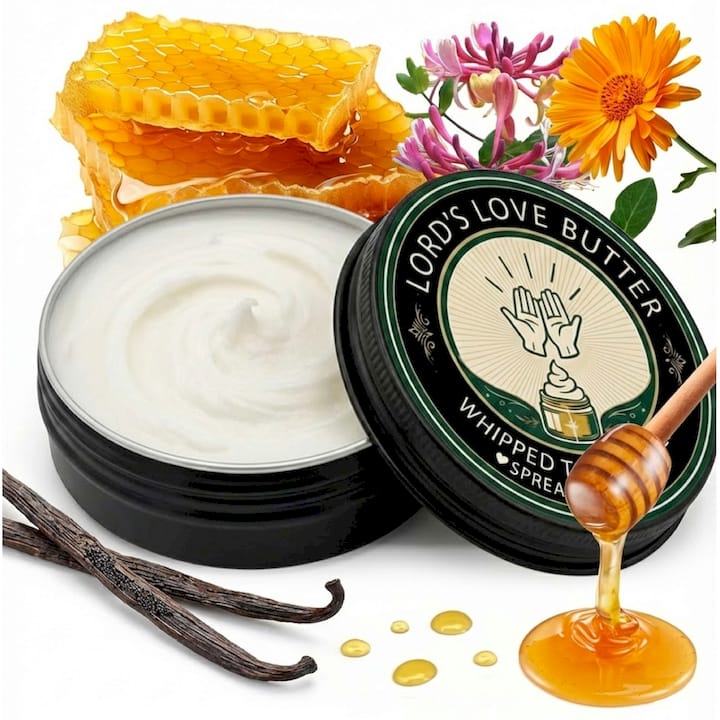
Lordslovebutter is veteran-owned and sources grass-fed tallow directly, with no synthetic fillers padding out the ingredient list, unlike a lot of mass-market “natural” balms that bury a handful of chemical stabilizers behind a botanical-sounding name. If the tin works well after your two-week trial, the full-size jar covers whole-body use without repurchasing every few weeks. Order directly through the site to start your patch test this week.
Sources
- Tallow, Rendered Animal Fat, and Its Biocompatibility With Skin: A Scoping Review - PMC
- Honey is potentially effective in the treatment of atopic dermatitis: Clinical and mechanistic studies
- Medical-grade manuka honey and a sugar-free manuka honey extract inhibit allergic IgE-induced mast-cell degranulation
- Is beef tallow a good treatment for eczema? | Children’s Hospital of Philadelphia

