

Does Tallow for Acne Actually Work? What the Evidence Says
Short answer: beef tallow is not a clinically proven acne treatment, and for oily or acne-prone skin, it often makes breakouts worse. No published trials show tallow clearing acne. The fatty-acid profile that makes it moisturizing is the same profile that raises pore-clogging concerns.
That doesn’t mean tallow is worthless as skincare, just that it’s the wrong tool for active breakouts. Here’s what’s actually going on:
- Zero randomized controlled trials exist testing tallow against acne.
- Dermatologists widely flag it as comedogenic, meaning it can plug pores.
- It may still have a place for chronically dry, non-acne-prone skin or for barrier repair once breakouts have healed.
If you’re set on trying it, there’s a safer way to do that without inviting a flare. That protocol comes later. First, the evidence.
Key Takeaways
Tallow lacks clinical proof as an acne treatment and its occlusive, saturated fat profile can worsen breakouts in oily or acne-prone skin, though it may suit dry, non-acne-prone skin when patch-tested carefully.
| Point | Details |
|---|---|
| No clinical proof | No randomized trials support tallow as an acne treatment; evidence is anecdotal. |
| Comedogenic risk | Dermatologists flag tallow’s occlusive, high-saturated-fat profile as pore-clogging for many users. |
| Narrow appropriate use | Best suited to dry, non-acne-prone skin, body areas, or healed post-acne barrier repair. |
| Patch test before facial use | Wait 48 to 72 hours and watch for delayed comedones over two to four weeks. |
| Lordslovebutter’s role | Offers grass-fed tallow balms like the Original Lite and Manuka Honey Tin for cautious, non-acne skincare use, not acne treatment. |
Table of Contents
- What the Science and Dermatologists Actually Say About Tallow and Acne
- What’s in Tallow, and Why It Cuts Both Ways for Skin
- Why Dermatologists Push Back on Tallow for Breakout-Prone Skin
- Who Might Actually Benefit from Tallow
- How to Test Tallow Without Risking a Flare
- Better-Proven Options for Acne-Prone Skin
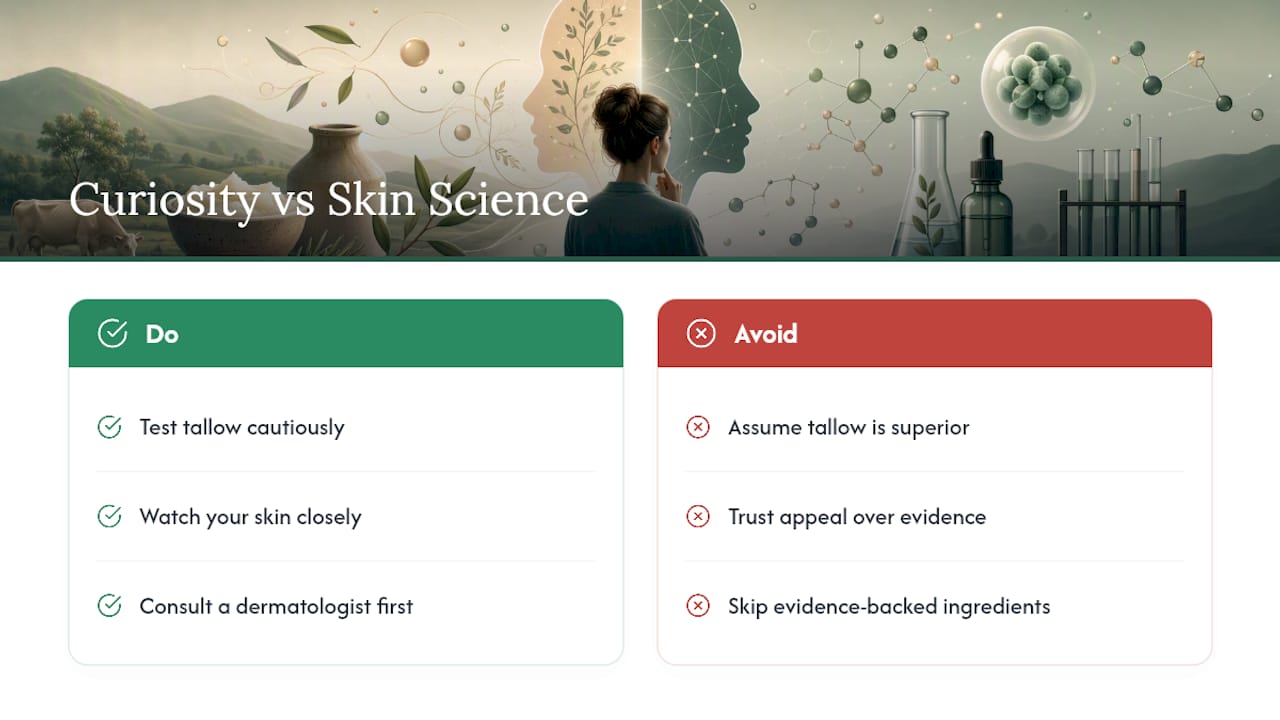
- Curiosity About Old Remedies Meets Modern Skin Science
- Where Lord’s Love Butter Fits Into a Careful, Evidence-Aware Routine
- Sources
What the Science and Dermatologists Actually Say About Tallow and Acne
No tallow-specific clinical trial has ever tested whether it clears acne. What exists instead are scoping reviews of skin lipids in general, which describe plausible moisturizing mechanisms but stop well short of endorsing tallow as an acne treatment. That’s a meaningful gap: plausible biology is not the same as demonstrated results.
The consensus gap: zero peer-reviewed studies support tallow as an acne remedy, despite its popularity on social platforms.
Board-certified dermatologists interviewed by Allure describe tallow as likely pore-clogging and not a substitute for actual acne treatment. MD Anderson’s skin and nutrition specialists go further, calling tallow comedogenic and steering acne-prone patients toward non-comedogenic moisturizers instead.
Meanwhile, the trend keeps growing online, fueled less by data than by a wellness narrative around “ancestral” and “natural” ingredients that predates modern dermatology. Fact-checkers have specifically taken on the tallow-for-acne claim and found no clinical evidence behind it, noting that testimonials on TikTok and Instagram aren’t a substitute for controlled research. A glowing before-and-after post tells you what happened to one person’s skin under one set of conditions. It doesn’t tell you what will happen to yours.
What’s in Tallow, and Why It Cuts Both Ways for Skin
Tallow is rendered beef fat, and its skincare effects trace directly to its fatty-acid makeup. It’s dominated by oleic acid, palmitic acid, and stearic acid, with a notably low share of linoleic acid compared to human sebum.
- Oleic acid is highly emollient, but research on skin lipids links high oleic content to barrier disruption and increased inflammation in some contexts.
- Palmitic and stearic acids are heavy, occlusive saturated fats. They seal moisture in effectively, but that same seal can trap sebum and debris in a pore.
- Low linoleic acid matters because linoleic-rich oils tend to be lighter and less comedogenic. Human sebum in acne-prone skin often runs low in linoleic acid too, so adding more of the same imbalance isn’t obviously helpful.
Reviews of tallow’s chemistry classify it as an occlusive emollient, not a therapeutic agent, and that’s the honest way to think about tallow and acne risk. Roughly half or more of tallow’s fatty-acid content is saturated fat, which is exactly the profile that behaves like a physical barrier on the skin surface rather than something that actively unclogs a pore. Any vitamin A or E naturally present in tallow doesn’t come with standardized concentrations, so counting on it for measurable skin benefit is optimistic at best.
Why Dermatologists Push Back on Tallow for Breakout-Prone Skin
The clinical objection isn’t about tallow being “unnatural.” It’s about what an occlusive, saturated-fat-heavy substance does when it sits on skin that’s already producing excess sebum. Dermatologists quoted by Allure describe the pore-clogging risk directly, and that caution shows up again in later reporting from Kansas City journalists who collected fresh clinician commentary on the trend, where practitioners repeated the same warning: hydration benefits don’t offset the occlusion risk for this skin type.
There’s also a treatment-interaction problem most viral posts skip entirely. A thick occlusive layer can trap bacteria against the skin and physically block topical acne medications like tretinoin or benzoyl peroxide from doing their job, since those actives need to actually reach the pore lining to work.
Pro Tip: If you’re using any prescription acne treatment, layering tallow on top the same night is one of the most common ways people accidentally sabotage their own regimen.
Skip tallow on your face entirely if you fall into any of these categories:
- Active whiteheads, blackheads, or inflamed cystic acne
- Naturally oily or combination skin with visible shine by midday
- Currently using retinoids, benzoyl peroxide, or prescription topicals
Who Might Actually Benefit from Tallow
The narrow cases where tallow makes sense have nothing to do with treating an active breakout. They’re about skin that’s simply dry.
- Chronically dry, non-acne-prone skin. People without a history of clogged pores tend to tolerate occlusive emollients far better, since there’s no excess sebum for the fat to trap.
- Body application away from the face. Elbows, knees, and heels have thicker skin and fewer active oil glands, so the comedogenic risk drops substantially.
- Post-acne barrier repair on fully healed skin. Some practitioners suggest tallow as a barrier-repair balm once breakouts have cleared, not as a treatment during an active flare.
Formulation quality matters here too. Pure, grass-fed tallow whipped with light carriers behaves differently than a cheap blend loaded with coconut oil fractions or heavy waxes, which are often the real culprit when someone blames “tallow” for a breakout. Anyone with a known beef or alpha-gal allergy should avoid tallow-based products altogether, regardless of skin type.
How to Test Tallow Without Risking a Flare
If you want to see how tallow feels on your own skin, treat it like you would any new active ingredient, not a miracle cure.
- Patch test first. Apply a small amount to your inner forearm or jawline and wait 48 to 72 hours, watching for redness, itching, or bumps.
- Start small on the face, if at all. Use a pea-sized amount only on dry, non-inflamed areas at night, avoiding the T-zone and any active lesions.
- Watch for delayed reactions. Comedones can take two to four weeks to form, so a clean first week doesn’t guarantee a clean month.
- Never layer over active treatments. Skip tallow on nights you use retinoids or benzoyl peroxide, and stop immediately if new bumps appear.
Pro Tip: Track application on a phone note with dates. Breakouts from occlusive products tend to show up gradually, and a log makes it obvious whether new bumps are trending up.
Better-Proven Options for Acne-Prone Skin
If your skin is oily or already breaking out, several ingredients have far stronger backing than tallow.
- Ceramides and hyaluronic acid hydrate without the heavy occlusion, restoring barrier function without the pore-clogging tradeoff.
- Niacinamide helps regulate oil production and calm inflammation in many people.
- Light squalane offers emollience closer to natural sebum, without tallow’s saturated-fat load.
- Benzoyl peroxide, azelaic acid, or retinoids are the actual acne treatments, and a dermatologist should guide their use for anything beyond mild, occasional breakouts.
Pair any of these with gentle cleansing and a lighter hand on exfoliation. Over-scrubbing irritated, breakout-prone skin usually backfires, no matter what moisturizer follows it.
Curiosity About Old Remedies Meets Modern Skin Science
There’s something appealing about an ingredient your grandmother might recognize, and I get why tallow’s resurgence has traction. But appeal isn’t evidence, and skin doesn’t care about a product’s backstory. It responds to fatty-acid ratios, occlusion, and what’s already happening in your pores.
If you’re dealing with persistent acne, the conservative move is to test cautiously, watch closely, and loop in a dermatologist before assuming an ancestral fat will outperform ingredients that actually have data behind them.
Where Lord’s Love Butter Fits Into a Careful, Evidence-Aware Routine
Given everything above, tallow’s real value shows up in dry-skin and barrier-repair use, not as an acne cure, and that’s exactly how Lordslovebutter formulates its lineup.
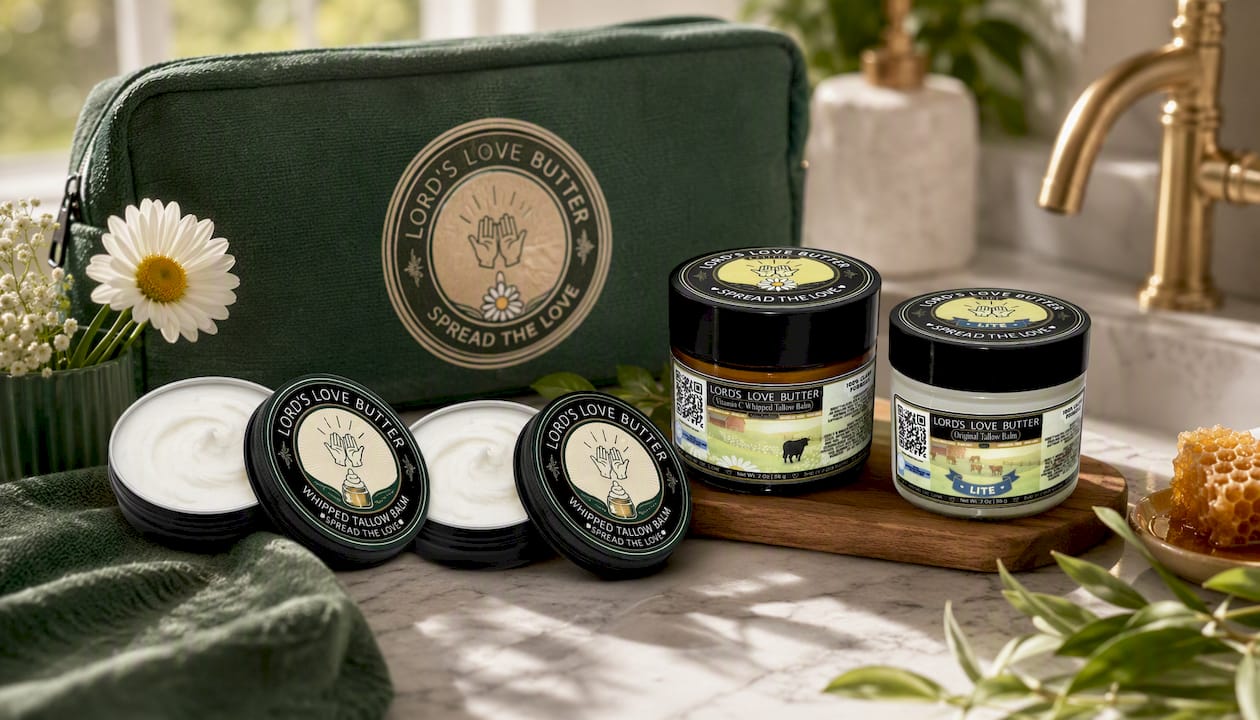
For body application and cautious, healed-skin trials, the Whipped Beef Tallow Balm with Manuka Honey is the core formula, whipped for lighter texture and blended with Manuka honey for its skin-soothing reputation. If you want an even gentler starting point for facial use, the Original Beef Tallow Balm Lite uses a reduced formulation designed for sensitive trial areas. For anyone specifically interested in facial application over acne-relevant concerns, the Tallow Face Duo with Vitamin C, squalane, and rosehip oil pairs tallow with lighter, non-heavy carriers rather than using tallow alone.
Other options in the line include the Vitamin C Whipped Beef Tallow Balm with Manuka Honey and squalane, the Tallow Lite Double with Manuka honey and propolis, a jar version of the core Manuka honey balm, the Mint Beef Tallow Lip Balm Stick for low-risk targeted use, and the Beef Tallow Sun Balm Stick with Zinc Oxide for daily mineral coverage on dry skin.
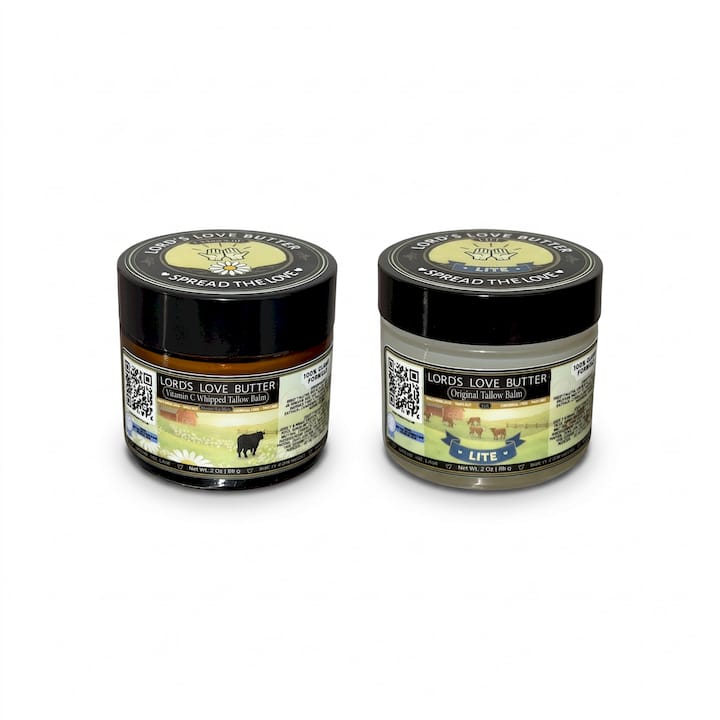
Every formula uses grass-fed tallow with minimal additives, which matters given how much comedogenic risk traces back to cheap filler oils rather than tallow itself. Before trying any of them on your face, run the patch-test and application steps outlined earlier, and start with a body or healed-skin area first. Browse the full lineup and pick the format that matches your skin’s actual needs, not just the trend.
Sources
- Beef Tallow Skin Care Is a Hard Pass For Dermatologists | Allure
- Beef tallow: dietitian and derm weigh in | UT MD Anderson
- Beef Tallow for Skin: Benefits & Uses — Superpower
- Fact Check: Is Tallow-Based Skincare Good for Acne? — AcneAdvocate

