

Whipped Tallow vs Coconut Oil for Eczema: What Works
For most people with eczema, virgin coconut oil (VCO) has stronger clinical trial support than whipped beef tallow. A randomized, double-blind trial in 117 pediatric patients showed VCO produced roughly a 68% decrease in mean SCORAD scores versus 38% for mineral oil, with measurable improvements in transepidermal water loss (TEWL) and skin capacitance over eight weeks. No equivalent human RCT exists for tallow.
That said, the choice is not absolute. If you have already tried VCO and found it irritating, or you need a heavier occlusive barrier, a well-sourced whipped tallow balm is a reasonable next step — provided you patch test first, discuss it with your dermatologist, and stop immediately if your skin worsens. Children and people with severe or infected eczema should get clinician input before trying either option.
Table of Contents
- How does whipped tallow vs coconut oil affect eczema-prone skin?
- What does the clinical research actually show?
- Side-by-side: comparing both options across what actually matters
- Safety considerations: patch testing, age cautions, and red flags
- When should you use a clinical emollient instead of a natural oil?
- Antimicrobial and anti-inflammatory properties specific to each ingredient
- Possible interactions with common eczema medications or treatments
- Environmental and ethical considerations affecting your choice
- Key Takeaways
- The tallow trend deserves a more honest conversation
- Lordslovebutter’s whipped tallow balms for eczema-prone skin
- Useful sources for further reading
How does whipped tallow vs coconut oil affect eczema-prone skin?
Eczema is fundamentally a barrier problem. The skin fails to hold water in and keep irritants out, which triggers inflammation, itch, and flare cycles. Any topical you apply to eczema-prone skin needs to address that barrier failure, and the two main ways to do it are occlusion and emolliency.
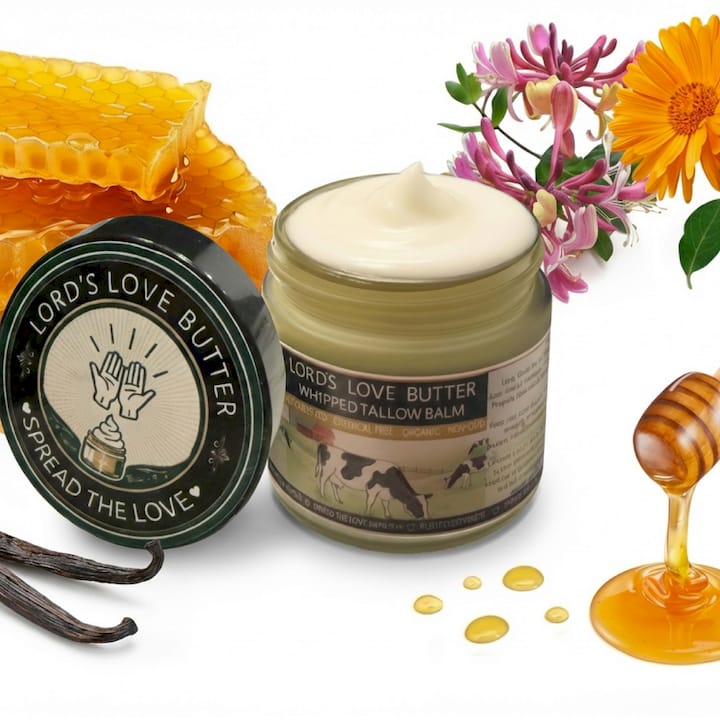
Occlusives form a physical film over the skin surface that slows water evaporation. Petrolatum is the gold standard. Whipped beef tallow works primarily as an occlusive: its triglyceride-rich fat layer sits on the stratum corneum and physically reduces TEWL. Tallow’s fatty-acid profile includes oleic acid (roughly 40–50%), palmitic acid, stearic acid, and small amounts of linoleic acid. Oleic acid penetrates the skin readily, which is partly why tallow feels less greasy than pure petrolatum — but that same penetration can disrupt barrier lipid organization in some people, potentially worsening TEWL rather than reducing it.
Emollients fill gaps between skin cells and restore the lipid matrix. VCO acts as both an emollient and a mild occlusive. Its dominant fatty acid is lauric acid (around 50%), a medium-chain saturated fat with documented antimicrobial activity against Staphylococcus aureus, the bacterium that colonizes eczema skin and drives flares. Lauric acid also has a lower skin-penetration profile than oleic acid, which may explain why VCO tends to be less disruptive to barrier lipids than high-oleic oils.
- Tallow: primarily occlusive; high oleic acid may help or hinder depending on individual barrier composition; mimics skin sebum in lipid ratios more closely than most plant oils
What does the clinical research actually show?
The evidence gap between these two ingredients is wide.
Virgin coconut oil: what the trials found
The most cited human trial enrolled 117 children with mild-to-moderate atopic dermatitis and compared VCO to mineral oil over eight weeks. The VCO group showed approximately a 68% decrease in mean SCORAD versus 38% in the mineral oil group, with VCO also producing greater reductions in TEWL and higher increases in skin capacitance. That is a meaningful clinical difference, not a marginal one.
| Outcome measure | VCO result | Mineral oil result | Evidence level |
|---|---|---|---|
| SCORAD reduction | ~68% decrease | ~38% decrease | Strong (RCT, 117 patients) |
| TEWL | Greater reduction | Smaller reduction | Strong (same RCT) |
| Skin capacitance | Greater increase | Smaller increase | Strong (same RCT) |
| Tallow (any outcome) | No RCT data | No RCT data | Limited (scoping review only) |
The bottom line on evidence: VCO is the only natural oil with randomized controlled trial data showing measurable improvement in SCORAD, TEWL, and skin capacitance for eczema. Tallow has none.
Beef tallow: the evidence gap
A scoping review in Cureus found that tallow components can be biocompatible with skin, but called for standardized testing and more safety data before conclusions can be drawn. A cross-sectional analysis of social-media claims found that most tallow promotion carries financial bias and that the literature evaluates tallow’s individual fatty-acid components rather than tallow as a finished product. No large-scale RCT comparing tallow to ceramide-containing emollients or to VCO exists.
Side-by-side: comparing both options across what actually matters
| Dimension | Virgin coconut oil | Whipped beef tallow |
|---|---|---|
| Eczema effectiveness (SCORAD/TEWL) | RCT-supported improvement | No human RCT; theoretical only |
| Mechanism | Emollient + mild occlusive | Primarily occlusive |
| Antimicrobial activity | Lauric acid active vs. S. aureus | Limited evidence for whole tallow |
| Safety / allergy risk | Low; rare contact allergy possible | Variable; oleic acid may worsen barrier |
| Suitability for children | Supported by pediatric RCT | Consult pediatric dermatologist first |
| Texture / cosmetability | Light-to-medium; absorbs well | Heavier; whipped form reduces greasiness |
| Evidence level | Moderate-to-strong (human RCTs) | Limited (scoping reviews, no RCTs) |
| Cost & availability | Widely available; $10 typical | Specialty product; varies by brand |
Quick picker rules:
- Choose VCO first if you want evidence-backed moisturization for mild-to-moderate eczema.
- Try whipped tallow if VCO irritates you, you need a heavier occlusive, and your patch test is negative.
- For children, follow AAP emollient guidance and discuss any natural oil with a pediatric dermatologist before starting.
Safety considerations: patch testing, age cautions, and red flags
People with eczema have a compromised skin barrier, which makes them more prone to contact sensitization. An ingredient that a person with healthy skin tolerates easily can trigger a reaction on eczema-prone skin, sometimes after repeated exposure rather than the first use.
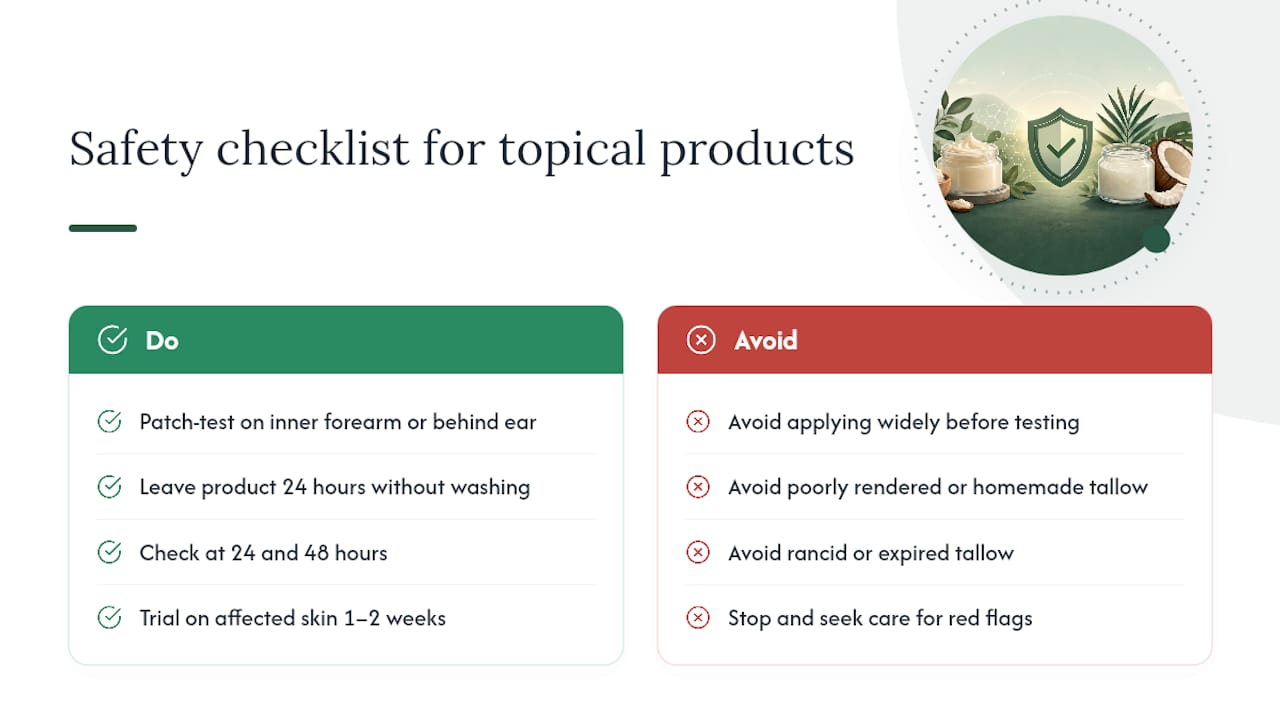
How to patch test: Apply a small amount of the product to the inner forearm or behind the ear. Leave it on for 24 hours without washing. Check at 24 and 48 hours for redness, itching, swelling, or new bumps. If nothing appears, do a small-area trial on affected skin for one to two weeks before applying widely.
CHOP’s guidance specifically flags that tallow products vary in quality and may cause allergic reactions, and that some fatty acids in tallow (particularly oleic acid) can increase TEWL rather than reduce it. For infants and young children, the AAP recommends clinician-guided emollient selection, not DIY animal fats.
Tallow-specific purity concerns: Poorly rendered or homemade tallow can harbor bacterial contamination. Even commercial products vary in processing standards. Look for grass-fed sourcing, a clear ingredient list, and a stated expiry date. Tallow is susceptible to rancidity, especially in warm environments — rancid fat can irritate skin further. The Cureus scoping review underscores that standardized safety testing for tallow products is still lacking.
Red flags requiring immediate discontinuation: rapid worsening of eczema, a spreading rash beyond the application area, blistering, oozing, or any systemic symptoms (hives, facial swelling, difficulty breathing). Contact your dermatologist or go to urgent care.
When should you use a clinical emollient instead of a natural oil?
Natural oils are adjuncts, not replacements for evidence-based eczema care. Ceramide-containing creams (such as CeraVe or EltaMD formulations) and petrolatum-based ointments have the most consistent evidence for barrier repair across all age groups. Petrolatum, in particular, is the most effective occlusive available and costs a fraction of specialty balms.
For mild eczema with infrequent flares, VCO or a well-formulated whipped tallow balm may be sufficient alongside good bathing habits. For moderate-to-severe atopic dermatitis, frequent flares, or any sign of skin infection, a dermatologist-prescribed regimen is the starting point, not a natural oil. The AAP is clear that emollients are a mainstay of pediatric eczema management and that caregiver-clinician collaboration drives better outcomes than self-directed product trials.
Expect four to six weeks of consistent use before assessing whether a new moisturizer is helping. Shorter trials are inconclusive because eczema naturally cycles. If your skin is not improving after six weeks of consistent application alongside your prescribed treatment, escalate to your dermatologist rather than switching to another natural product.
Clinicians generally advise against unregulated topicals when eczema is severe, skin is actively infected (look for yellow crusting, weeping, or warmth), or the patient is an infant under three months old. In those situations, the risk of a product reaction outweighs any potential benefit.
Antimicrobial and anti-inflammatory properties specific to each ingredient
S. aureus colonizes the skin of roughly 90% of people with atopic dermatitis and is a major driver of flares. Any topical that reduces bacterial load on eczema skin can break that cycle.
Coconut oil’s lauric acid disrupts the cell membrane of S. aureus and has demonstrated antimicrobial activity in laboratory studies. VCO also contains caprylic and capric acids, which add to its antimicrobial profile. On the anti-inflammatory side, lauric acid has shown some capacity to reduce pro-inflammatory cytokine activity in cell studies, though human trial data on this specific mechanism in eczema is limited.
Tallow’s antimicrobial story is less clear. Tallow itself has not been shown in human studies to reduce S. aureus colonization. When Manuka honey is added to a tallow balm, the picture changes: Manuka honey’s methylglyoxal (MGO) content has documented antimicrobial and wound-healing properties, and combining it with an occlusive base may help reduce bacterial load while maintaining moisture. That combination is part of why formulations like Lordslovebutter’s include it rather than using plain tallow alone.
Possible interactions with common eczema medications or treatments
Neither VCO nor whipped tallow is known to chemically interact with topical corticosteroids or calcineurin inhibitors. The practical concern is physical, not pharmacological: applying a thick occlusive layer before a topical medication can reduce the medication’s skin penetration, while applying it after can enhance absorption. The standard guidance is medication first, then the moisturizer or occlusive on top.
One real risk with any oil or balm is that it can increase the absorption of topical steroids under occlusive conditions, particularly with wet-wrap therapy. This is not unique to tallow or coconut oil; it applies to any occlusive used with a potent corticosteroid. Follow your prescriber’s wet-wrap protocol precisely rather than improvising the layering order.
Dupilumab (Dupixent) and other biologic treatments for moderate-to-severe atopic dermatitis do not interact with topical oils, but people on biologics typically have more severe disease and should still discuss any new topical with their dermatologist before adding it. The same applies to JAK inhibitors like upadacitinib (Rinvoq) or abrocitinib (Cibinqo).
Environmental and ethical considerations affecting your choice
Both ingredients carry environmental and ethical trade-offs worth knowing before you buy.
Beef tallow is a byproduct of the beef industry. Using tallow can be framed as reducing waste from an industry that already exists, rather than creating new demand. Grass-fed sourcing is an ethical differentiator: grass-fed cattle have lower environmental impact per unit of output than grain-fed operations, and the tallow’s fatty-acid profile differs slightly (higher conjugated linoleic acid, lower omega-6). The concern is supply-chain transparency — many tallow products do not disclose their sourcing clearly.
Coconut oil is plant-derived and widely perceived as more sustainable, but large-scale coconut monocultures in Southeast Asia and the Philippines have been linked to deforestation and biodiversity loss. Virgin, cold-pressed coconut oil from certified sustainable sources is the better choice, though certification is inconsistently applied across the market.
Neither option is clearly “greener” without knowing the specific supply chain. If sourcing transparency matters to you, look for grass-fed certification on tallow products and fair-trade or Rainforest Alliance certification on coconut oil.
Key Takeaways
Virgin coconut oil has randomized controlled trial evidence supporting its use for mild-to-moderate eczema, while whipped beef tallow lacks equivalent human trial data and requires careful patch testing before use.
| Point | Details |
|---|---|
| VCO has the stronger evidence | An RCT in 117 pediatric patients showed ~68% SCORAD reduction with VCO versus ~38% with mineral oil. |
| Tallow evidence is limited | No human RCT exists for tallow; a scoping review found biocompatibility but called for standardized testing. |
| Patch test before either option | Eczema-prone skin is more prone to contact sensitization; test on the inner forearm for 24–48 hours first. |
| See a clinician for moderate-to-severe disease | Natural oils are adjuncts to, not replacements for, prescribed emollients and medications. |
| Lordslovebutter as a tallow option | The whipped tallow balm with Manuka honey uses grass-fed tallow, no synthetic additives, and a lighter Balm Lite for daytime use. |
The tallow trend deserves a more honest conversation
The surge in tallow skincare is real, and it is almost entirely social-media driven. A cross-sectional analysis found that most tallow promotion online carries financial bias and that the scientific literature evaluates individual fatty-acid components rather than tallow as a finished product. That does not make tallow useless. It makes the claims around it overconfident.
What bothers me about the current conversation is the absolutism on both sides. Some dermatologists dismiss tallow entirely because it lacks RCT data, while tallow advocates claim it cures eczema when the evidence does not support that word. The honest position sits in the middle: tallow is a plausible occlusive with a reasonable fatty-acid profile, some biocompatibility data, and a long history of use in skincare. It also has real risks, particularly the oleic acid content that MedPage Today’s commentary flags as potentially worsening barrier function in some patients.
The practical advice I keep coming back to: test small, track results over weeks not days, and never abandon a working prescription regimen for a trending ingredient. Natural and evidence-based are not opposites, but they are also not synonyms. VCO earned its place in eczema care through trials. Tallow has not done that yet. That gap matters, and it should shape how confidently you reach for either product.
Lordslovebutter’s whipped tallow balms for eczema-prone skin
If you have done your patch test, discussed the option with your clinician, and decided to try a whipped tallow balm, the formulation details matter. Lordslovebutter makes grass-fed whipped beef tallow with Manuka honey, no synthetic chemicals, and no added fragrances — the short ingredient list that eczema-prone skin needs.
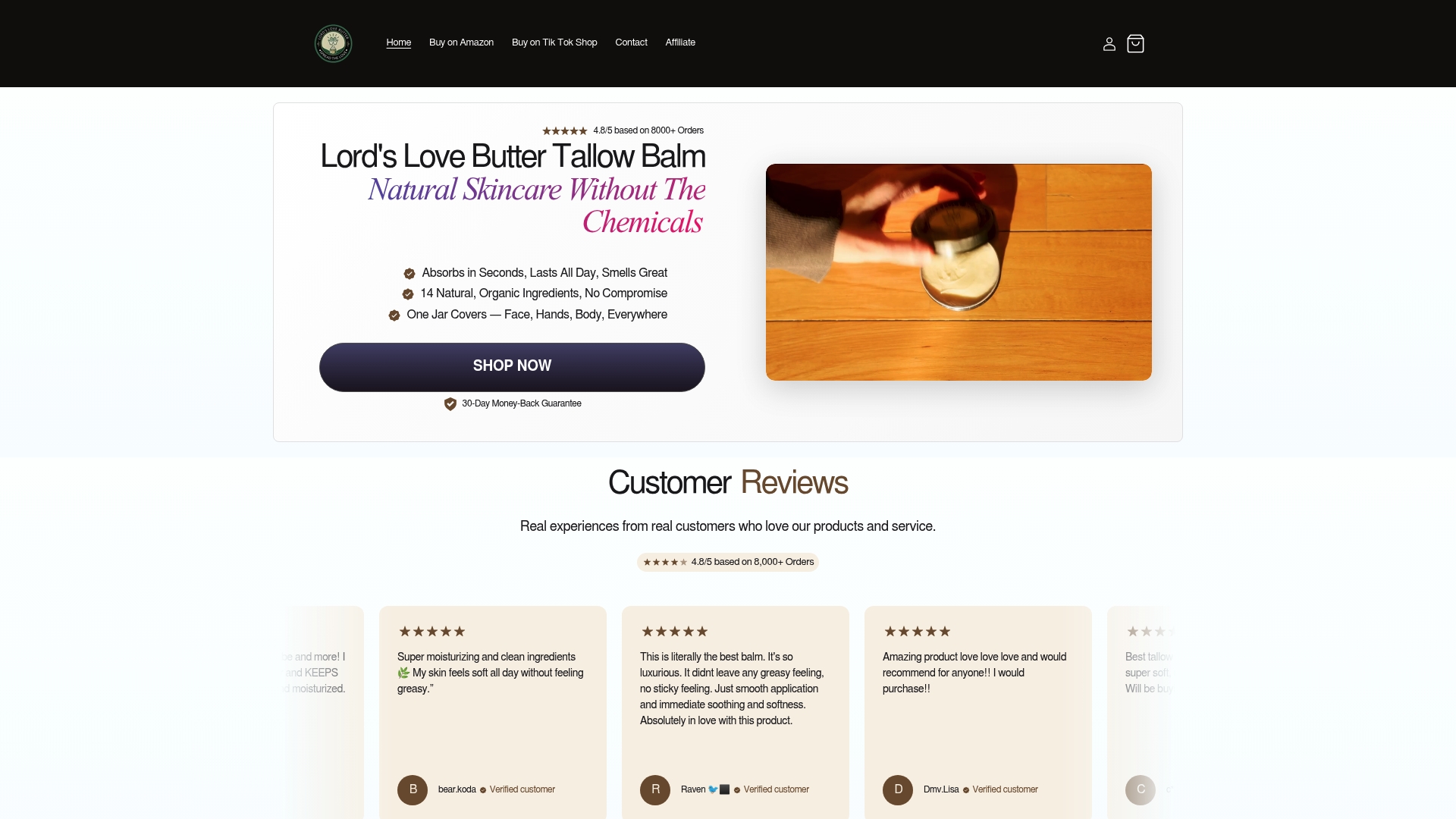
The 2.4 oz Whipped Beef Tallow Balm Tin is the go-to for targeted or whole-body application. If you want something lighter for daytime or first-time use, the Original Beef Tallow Balm Lite with Manuka Honey delivers the same grass-fed tallow and Manuka honey base in a less occlusive texture. For lip eczema or a low-commitment first trial, the Mint Beef Tallow Lip Balm Stick is a practical starting point. Apply to damp skin after bathing, layer over any prescribed topicals, and give it two full weeks before drawing conclusions. This is general skincare information, not medical advice; confirm any treatment changes with your dermatologist.
Useful sources for further reading
| Source | What it contributes |
|---|---|
| VCO pediatric RCT (International Journal of Dermatology) | Primary human trial showing SCORAD, TEWL, and skin capacitance outcomes for VCO vs. mineral oil in 117 children |
| CHOP: Is beef tallow good for eczema? | Pediatric clinical perspective on tallow’s theoretical benefits, risks, and evidence limitations |
| PMC: Tallow social-media claims analysis | Cross-sectional study documenting financial bias and evidence gaps in tallow promotion |
| MedPage Today: Beef tallow for eczema commentary | Expert dermatology commentary on tallow’s fatty-acid mix and clinical caution |
| Medical News Today: Beef tallow for eczema | Consumer-facing summary of potential benefits, irritation risks, and contamination concerns |
| Healthline: Coconut oil for eczema | Lauric acid antimicrobial activity, VCO hydration evidence, and application guidance |
| Cureus scoping review: tallow biocompatibility | Scoping review on rendered animal fat and skin; calls for standardized testing |
| AAP atopic dermatitis patient tool | Pediatric emollient guidance and recommendation for caregiver-clinician collaboration |
Before making any changes to your eczema treatment, consult a board-certified dermatologist or pediatric dermatologist. This article provides general information only and does not constitute medical advice.

