

Grass-Fed vs. Conventional Tallow: What Differs for Skin
Grass-fed beef tallow and conventional tallow share the same basic fat structure, but the differences in what they carry along for the ride matter a lot for your skin. Both types deliver a sebum-compatible lipid profile of roughly 40–50% oleic acid, 25–30% palmitic acid, and 20–25% stearic acid, which is why tallow absorbs so naturally. The gap opens up in the micronutrient layer.
Here is what sets them apart:
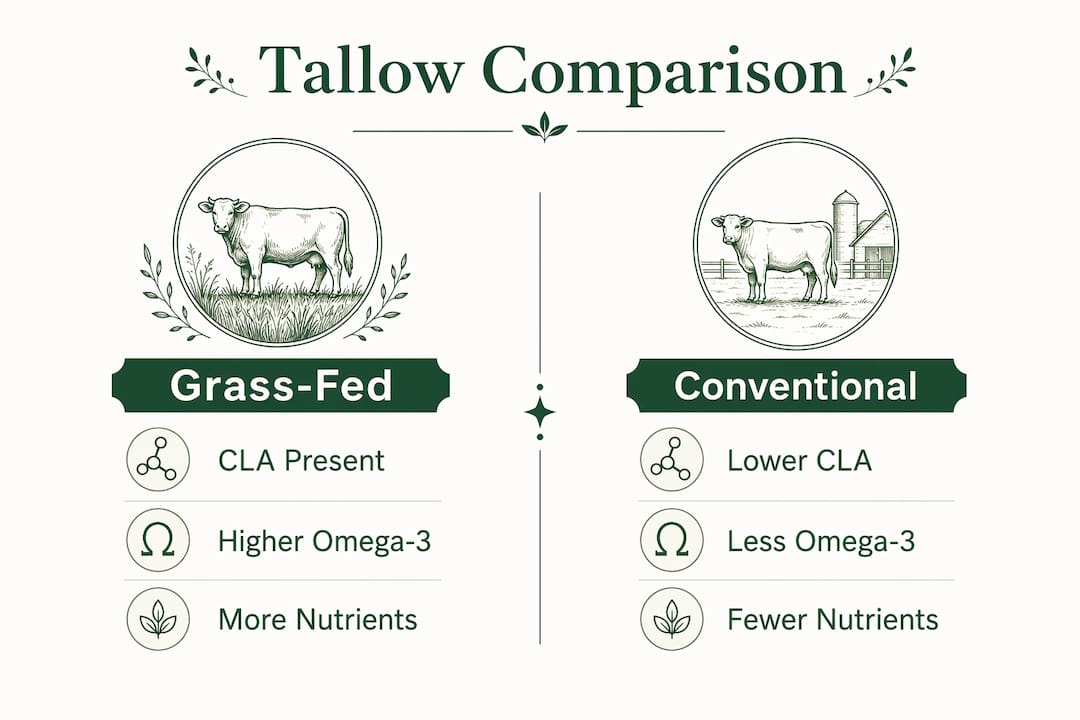
- Micronutrients: Grass-fed tallow supplies higher CLA and omega-3 fatty acids, plus fat-soluble vitamins A, D, E, and K. Conventional tallow carries far less of all of these.
- Fatty acid balance: Grass-fed tallow tends toward more stearic acid and less cholesterol-elevating palmitic acid than grain-fed sources.
- Sourcing: Grass-fed, grass-finished cattle eat forage exclusively. Conventional cattle finish on grain in feedlots, which shifts the fat composition.
- Hormone and antibiotic residues: Conventional tallow may carry synthetic hormone residues and produces a stronger odor. Grass-fed is cleaner and milder.
- Skin compatibility: The richer micronutrient profile in grass-fed tallow translates to better barrier support and anti-inflammatory potential, especially for sensitive skin.
Table of Contents
- Why grass-fed tallow has more nutrients for your skin
- Balms vs. soaps: formulation changes what you actually get
- How Lordslovebutter sources and formulates for sensitive skin
- How to pick a quality grass-fed tallow skincare product
- Allergenicity and sensitivities: grass-fed vs. conventional
- Lordslovebutter: grass-fed tallow skincare without the guesswork
- Key Takeaways
Why grass-fed tallow has more nutrients for your skin
The fatty acid and antioxidant advantage of grass-fed beef comes directly from what the animal eats. Pasture-raised cattle convert fresh forage into fat with a notably different composition than feedlot animals eating corn and soy.
| Nutrient | Grass-Fed Tallow | Conventional Tallow |
|---|---|---|
| CLA (conjugated linoleic acid) | present at notable levels | Lower in conventional tallow |
| Omega-3 fatty acids | Elevated (higher EPA, DPA) | Reduced |
| Stearic acid | Higher proportion | Lower proportion |
| Vitamins A, D, E, K | Richer | Diminished |
| Antioxidants (glutathione, SOD precursors) | Higher | Lower |
| Hormone residues | None (grass-finished) | Possible |
CLA and omega-3s are the two compounds that do the most work on skin. CLA and omega-3 content support reducing skin inflammation and enhancing barrier repair, which is exactly what sensitive, reactive, or eczema-prone skin needs. Stearic acid, present at higher levels in grass-fed fat, is cholesterol-neutral and contributes to the smooth, non-greasy skin feel tallow is known for.
Tallow’s lipid profile also mimics human sebum more closely than most plant oils, which is why it absorbs quickly without sitting on top of the skin. Grass-fed tallow brings that same compatibility plus the added micronutrient payload.

Balms vs. soaps: formulation changes what you actually get
This is the detail most people miss. Grass-fed tallow’s micronutrient advantages only survive in products where the fat stays chemically intact. Practitioners confirm that unsaponified balms and salves retain the bioactive compounds, including CLA and fat-soluble vitamins, while saponification during soap-making largely destroys them.
In practical terms: a grass-fed tallow balm delivers the full nutrient profile to your skin. A grass-fed tallow soap cleanses well, but by the time the fat has been converted to soap and rinsed off, the micronutrient gap between grass-fed and conventional has mostly closed. For leave-on applications, source quality is everything. For rinse-off cleansers, it matters far less.
This is why the skincare ingredients conversation around tallow almost always centers on balms and salves rather than soaps.
How Lordslovebutter sources and formulates for sensitive skin
Lordslovebutter’s sourcing standard is grass-fed, grass-finished, hormone-free, antibiotic-free, and suet-rendered. Suet, the dense fat surrounding the kidneys, renders into a purer, more stable tallow than fat trimmed from muscle. That matters for both shelf life and skin feel.
The product line reflects this directly:
- Whipped Beef Tallow Balm with Manuka Honey (2.4 oz Tin): the flagship balm, whipped for lighter texture, with raw Manuka honey for added antimicrobial and humectant properties.
- Whipped Beef Tallow Balm with Manuka Honey (2.4 oz Jar): same formula in a jar format for easy at-home use.
- Vitamin C Whipped Beef Tallow Balm with Manuka Honey & Squalane: adds vitamin C and squalane for antioxidant brightening alongside the base hydration.
Customers report improved skin texture and hydration within days, particularly on sensitive areas affected by eczema and psoriasis. Lordslovebutter is a veteran-owned business, and that background shows in the no-filler approach: every ingredient earns its place, and nothing synthetic makes the cut.
How to pick a quality grass-fed tallow skincare product
Not all tallow labeled “grass-fed” is equal. Here is what to look for:
- “Grass-fed AND grass-finished”: “Grass-fed” alone is not a strictly regulated term in the U.S. Animals can be grass-fed early and grain-finished. “Grass-finished” closes that loophole.
- Hormone-free and antibiotic-free: Synthetic hormones used in conventional finishing can persist in fat. Clean sourcing means neither.
- Suet-rendered: Suet tallow is denser, more stable, and less prone to oxidation than tallow rendered from other fat trimmings.
- Unsaponified form: For skincare balms, the fat must remain intact. Saponified tallow is soap, not a moisturizer.
- Transparent sourcing: Brands that name their farms or certifications are worth the premium. Vague labels are a red flag.
Pro Tip: Ask the brand directly where their cattle are sourced and whether they can provide a certificate of analysis. A company confident in its sourcing will answer without hesitation.
Oxidative stability is also worth considering. Properly rendered suet tallow, stored away from heat and light, has a long shelf life without synthetic preservatives. Conventional tallow, especially if poorly rendered, oxidizes faster and can develop an off smell that signals degraded fatty acids.
From an environmental standpoint, grass-finished cattle typically spend their lives on pasture, which supports soil health and reduces the concentrated waste issues associated with feedlot finishing. For buyers who care about sourcing ethics alongside skin results, grass-finished is the cleaner choice on both counts.
Allergenicity and sensitivities: grass-fed vs. conventional
Tallow is generally well-tolerated, but a few distinctions are worth knowing. Conventional tallow may carry trace synthetic hormone residues and stronger-smelling oxidized fats, both of which can irritate reactive skin. Grass-fed tallow’s milder scent and cleaner fat profile make it the lower-irritation option for most people.
True beef fat allergy is rare. People with alpha-gal syndrome, a tick-bite-triggered red meat allergy, should avoid all mammalian fats regardless of sourcing. For everyone else, the more common sensitivity trigger is not the tallow itself but added ingredients like fragrance, essential oils, or preservatives in the formulation. A single-ingredient or minimal-ingredient grass-fed tallow balm is typically the safest starting point for sensitive skin.
Grass-fed tallow’s higher omega-3 and CLA content may actually reduce the likelihood of inflammatory skin reactions over time, given both compounds’ anti-inflammatory properties. Conventional tallow’s relatively higher n-6 fatty acid content, by contrast, can tip the balance toward pro-inflammatory signaling in sensitive skin.
Lordslovebutter: grass-fed tallow skincare without the guesswork
If you have read this far, you already know what to look for. Lordslovebutter delivers exactly that: grass-fed, grass-finished, hormone-free, suet-rendered tallow in leave-on balm formulations that keep every bioactive compound intact. No synthetic fillers, no fragrance, no shortcuts on sourcing.
The Whipped Beef Tallow Balm with Manuka Honey is the place to start, whether you are managing dry skin, eczema, or just want a moisturizer that actually works without a long ingredient list. The Vitamin C variant adds squalane and antioxidant support for skin that needs a little more. Both are built for whole-body use and absorb without a greasy finish. Browse the full lineup at lordslovebutter.com and see which formulation fits your skin.
Key Takeaways
Grass-fed, grass-finished tallow retains CLA, omega-3s, and fat-soluble vitamins that conventional tallow lacks, and those nutrients only reach your skin intact in unsaponified balm formulations.
| Point | Details |
|---|---|
| Core fatty acid profile | Both types share ~40–50% oleic, 25–30% palmitic, and 20–25% stearic acid. |
| Grass-fed micronutrient edge | Grass-fed tallow carries higher CLA, omega-3s, and vitamins A, D, E, K. |
| Formulation determines delivery | Balms preserve bioactive compounds; saponification in soaps largely eliminates them. |
| Label scrutiny matters | “Grass-fed AND grass-finished” is the standard that guarantees forage-exclusive sourcing. |
| Lordslovebutter | Grass-fed, grass-finished, suet-rendered balms formulated for sensitive skin hydration. |

