

Manuka Honey for Skin: Benefits, Uses, and What Works
Manuka honey can genuinely help your skin. It hydrates, fights bacteria, calms inflammation, and supports wound repair when used correctly. The key signals to look for on any label are UMF (Unique Manuka Factor) and MGO (methylglyoxal) ratings, which tell you how potent the antibacterial activity actually is. That said, it is not a cure for chronic acne or eczema on its own, and a patch test before applying it to your face is non-negotiable.
Here is the short version of what you need to know:
- Manuka honey works as both a humectant (draws moisture in) and an emollient (seals it there), making it especially useful for dry and sensitive skin.
- Its MGO content gives it antibacterial action that regular honey simply cannot match.
- For daily use, a formulated balm or serum beats raw honey for texture and convenience. Lordslovebutter’s whipped beef tallow balms blend Manuka with grass-fed tallow for exactly this reason.
- Always patch test first. Bee or pollen allergies can cause reactions.
Pro Tip: If you are new to Manuka skincare, start with a formulated product rather than raw honey straight from the jar. You get the benefits without the stickiness, and the delivery system helps the ingredient actually stay on your skin long enough to work.
Key Takeaways
Manuka honey supports skin health through antibacterial, anti-inflammatory, and humectant action, with the strongest evidence in wound care and barrier repair.
| Point | Details |
|---|---|
| Patch test first | Apply to your wrist for 24 hours before using Manuka on your face, especially if you have bee or pollen allergies. |
| Match grade to goal | UMF 10+/MGO 263+ for general hydration; UMF 15+/MGO 514+ for acne or wound-care support. |
| Formulated balms for daily use | Raw honey is best for weekly masks and spot treatments; a formulated balm reduces tackiness and improves consistency. |
| Avoid mixing with BHA | Do not apply Manuka in the same step as salicylic acid or other chemical exfoliants. |
| Lordslovebutter for convenience | The Manuka tallow balm line delivers daily barrier repair without synthetic ingredients or greasy residue. |
Table of Contents
- What does Manuka honey actually do for your skin?
- How to use Manuka honey on your face and body
- Which Manuka honey grade should you choose for your face?
- Raw Manuka honey vs. formulated skincare products
- Allergies, side effects, and when to stop using it
- What the research and dermatologists actually say
- What I actually recommend for your routine
- Lordslovebutter’s Manuka tallow balms for daily skin support
- Sources
What does Manuka honey actually do for your skin?
The benefits are real, but they come from specific mechanisms. Understanding those mechanisms helps you use Manuka where it will actually make a difference.
Antibacterial action. MGO is the compound that sets Manuka apart from regular honey. It disrupts bacterial cell walls and has shown activity against Cutibacterium acnes, the bacterium most associated with inflammatory acne. Cleveland Clinic notes that higher UMF and MGO ratings correspond to stronger antibacterial activity, which is why grade matters for therapeutic use.
Humectant and emollient behavior. Manuka draws water into the skin and then helps hold it there. Dermatologist Dr. Michele Green explains that Manuka acts as both a humectant and an emollient, which helps dry and sensitive skin reestablish a healthy barrier. That dual action is why it shows up in products targeting eczema and chronic dryness.
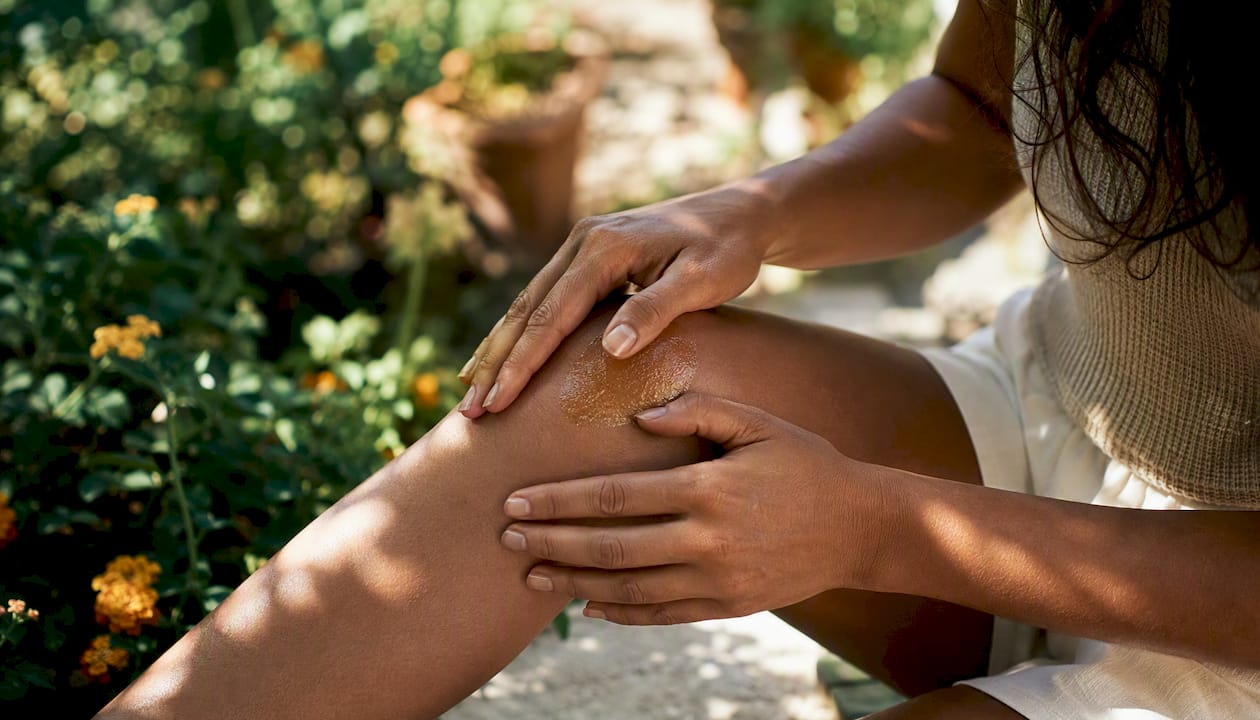
Anti-inflammatory effects. Manuka honey’s phenolic compounds reduce inflammatory signaling in skin tissue. For red, irritated, or reactive skin, this can mean visible calming within days rather than weeks.
Wound healing and tissue repair. This is where the clinical evidence is strongest. Medical-grade Manuka dressings are used in hospitals for wound infections and tissue repair, backed by clinical and in-vitro research confirming antibacterial, immunomodulatory, and wound-healing properties.
For acne specifically, the evidence is promising but not conclusive. Research published on PMC notes that while Manuka shows real antibacterial activity against acne-related bacteria, more randomized controlled trials are needed before it can be recommended as a primary acne treatment. Use it as a supportive ingredient, not a replacement for a dermatologist-guided routine.
Antioxidant protection. The phenolic compounds in Manuka also neutralize free radicals, which contribute to premature aging and barrier breakdown. This is a secondary benefit, but a real one for skin exposed to environmental stress.
How to use Manuka honey on your face and body
The method matters as much as the ingredient. Here is how to use it effectively across different applications.
As a face mask
- Start with clean, slightly damp skin.
- Apply a thin, even layer of Manuka honey (UMF 10+ or MGO 263+ is a reasonable starting point for cosmetic use).
- Leave on for 10–20 minutes.
- Rinse thoroughly with warm water, then follow with your regular moisturizer.
- Use 1–3 times per week depending on your skin’s tolerance.
As a spot treatment
- Apply a small amount directly to a blemish or irritated area using a clean fingertip or cotton swab.
- Leave on for 20–30 minutes, or overnight if your skin tolerates it.
- Remove with a warm, damp cloth. Do not rub; press and lift to avoid spreading bacteria.
As a cleanser
Massage a small amount onto dry skin, add a little water to emulsify, then rinse. This works well for dry or sensitive skin types that find foaming cleansers too stripping.
Layering with other actives
- Niacinamide and hyaluronic acid: Both layer well with Manuka. Apply Manuka first, let it absorb partially, then follow with a hyaluronic acid serum for compounded hydration.
- BHA/salicylic acid: Do not apply these in the same step. Medical News Today advises that Manuka can be incompatible with salicylic acid and potent exfoliants. Use them on alternating nights if you want both in your routine.
- Retinol: Same rule applies. Keep Manuka on nights when you skip the retinol.
Pro Tip: For body care, raw Manuka applied to dry patches on elbows, knees, or heels and left on under a cotton sock or sleeve overnight can deliver noticeable softening by morning. The occlusion amplifies the humectant effect.
Which Manuka honey grade should you choose for your face?
Not all Manuka is equal, and the label is where you find out whether you are buying something genuinely potent or just expensive grocery honey.
UMF vs. MGO explained. UMF (Unique Manuka Factor) is a grading system certified by the UMF Honey Association in New Zealand. It measures MGO content alongside other markers like leptosperin and DHA to verify authenticity. MGO (methylglyoxal) is the specific compound responsible for Manuka’s non-peroxide antibacterial activity. The two scales correlate: UMF 10+ corresponds roughly to MGO 263 mg/kg, and UMF 15+ corresponds to MGO 514 mg/kg.
- UMF 5–10+ / MGO 83–263 mg/kg: General hydration, antioxidant support, mild antibacterial benefit. Fine for dry skin maintenance and everyday masks.
- UMF 10–15+ / MGO 263–514 mg/kg: Stronger antibacterial activity. Better for acne-prone skin or minor skin irritation.
- UMF 15–20+ / MGO 514–829 mg/kg: Therapeutic range. Appropriate for wound care, active breakouts, or inflamed skin conditions. Medical-grade Manuka used in clinical wound dressings typically falls in this range or higher.
Authenticity cues to look for:
- A certified UMF trademark on the label (not just “active” or “bio-active,” which are unregulated terms)
- Country of origin listed as New Zealand (authentic Manuka comes from Leptospermum scoparium native to New Zealand and parts of Australia)
- Batch numbers and traceability information
- Price as a signal: genuine high-UMF Manuka is expensive. A $10 jar claiming UMF 20+ is almost certainly mislabeled.
Storage. Keep Manuka in a cool, dry place away from direct sunlight. Heat degrades MGO activity over time. A sealed glass jar at room temperature works well; refrigeration is not necessary but will not harm it. ApiHealth’s research confirms that MGO is a stable marker of antibacterial potency, but formulation stability in finished products matters equally.
Raw Manuka honey vs. formulated skincare products
Both have a place in a smart routine. The question is which one fits your actual life.
Raw Manuka honey delivers MGO directly with no dilution. You control the grade, the application, and the duration. For an occasional mask or targeted spot treatment, it is hard to beat. The downsides are real, though: it is sticky, difficult to remove without warm water and patience, and applying it evenly across the face takes practice. There is also a minor contamination risk if you are dipping fingers into the jar repeatedly.
Formulated products solve the texture problem. A well-made balm or serum blends Manuka with lipids, humectants, or other actives that improve spreadability, reduce tackiness, and create a stable delivery system. The tradeoff is that Manuka concentration in a finished product is typically lower than raw honey. Practitioners note that for daily leave-on use, a formulated product with Manuka blended into a lipid base significantly improves adherence because people will actually use it.
- Use raw Manuka for: weekly masks, overnight spot treatments, targeted application to a specific blemish or dry patch.
- Use formulated products for: daily moisturizing, barrier repair, whole-body hydration, and any situation where you need to get dressed within ten minutes of applying your skincare.
Pro Tip: When shopping formulated Manuka products, check that Manuka honey appears in the first half of the ingredient list. If it is listed near the bottom alongside preservatives, the concentration is likely too low to deliver meaningful MGO activity.
Allergies, side effects, and when to stop using it
Manuka honey is generally well-tolerated, but “generally” is doing real work in that sentence.
Allergy risk. If you have a known allergy to bees, bee stings, or pollen, Manuka honey can trigger a reaction. This is not theoretical. Medical News Today recommends a 24-hour patch test before any facial or large-area application, and that recommendation stands regardless of your allergy history.
How to patch test:
- Apply a small amount of Manuka (or the formulated product) to the inside of your wrist or elbow.
- Leave it for 24 hours without washing the area.
- If you see redness, swelling, itching, or any raised skin, do not use it on your face.
Possible side effects:
- Mild stinging on broken or very inflamed skin (normal and usually brief)
- Contact dermatitis in sensitive individuals
- Rare but serious: hives, difficulty breathing, or swelling of the face or throat. These require immediate medical attention.
Interactions with other treatments:
- Avoid applying Manuka in the same step as salicylic acid, glycolic acid, or other chemical exfoliants. The pH mismatch can reduce the effectiveness of both.
- If you are using a topical prescription (tretinoin, antibiotics, corticosteroids), check with your dermatologist before adding Manuka to the same routine.
When to see a doctor: If a wound or skin infection worsens after applying Manuka, stop immediately and seek medical care. Spreading redness, increasing warmth, or pus are signs that topical honey is not enough. Manuka supports healing; it does not replace medical treatment for serious infections.
What the research and dermatologists actually say
The clinical evidence for Manuka honey on skin is strongest in one area and more mixed everywhere else.
Wound care: This is where the science is clearest. A systematic review published on PMC confirms antibacterial, immunomodulatory, and wound-healing properties, with medical-grade Manuka dressings approved for clinical use in multiple countries. Hospitals use them for wound infections and tissue repair.
Formulated serums: An eight-week clinical trial of a serum containing Manuka honey (MGO ≥800 mg/kg) combined with royal jelly and bee venom reported measurable improvements in 12 of 17 skin health parameters by Week 2, and all 17 by Week 8. The caveat is significant: this was a combination product, so the results cannot be attributed to Manuka alone.
Acne and inflammatory conditions: Promising, but not proven at the level of a stand-alone therapy. Dr. Rachel Nazarian has noted Manuka’s usefulness for inflamed conditions like seborrheic dermatitis and psoriasis while being clear that it is not a proven monotherapy for acne.
Research gaps. Most cosmetic studies are small, short-term, or use combination formulas. The wound-care evidence is robust; the anti-aging and acne evidence is not yet at the same level. Realistic expectations matter: Manuka can support your skin, but it is not a replacement for a dermatologist-guided treatment plan for chronic conditions.
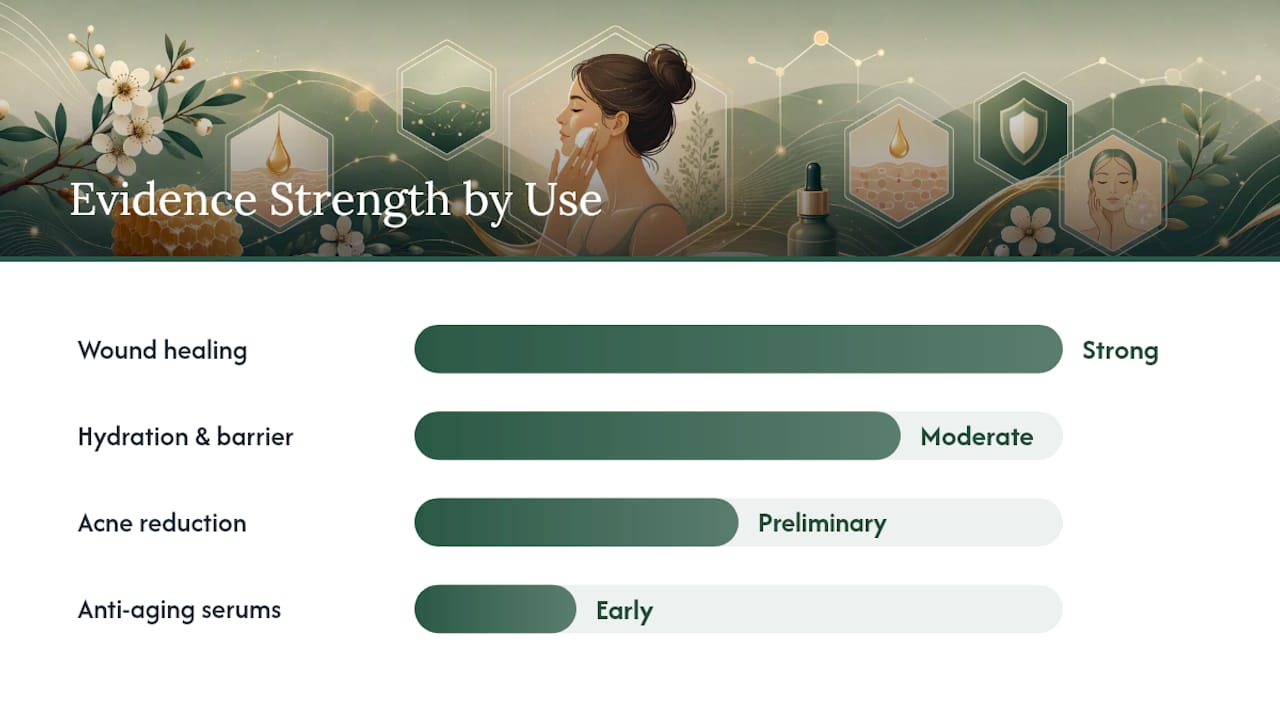
| Evidence area | Strength of evidence | Practical implication |
|---|---|---|
| Wound healing and tissue repair | Strong (clinical trials, hospital use) | Medical-grade Manuka appropriate for wounds |
| Hydration and barrier support | Moderate (mechanism well-established) | Useful for dry and sensitive skin daily |
| Acne reduction | Preliminary (antibacterial mechanism clear, RCTs limited) | Supportive role, not primary therapy |
| Anti-aging (cosmetic serums) | Early (combination formula study, 8 weeks) | Promising but results tied to full formula |
What I actually recommend for your routine
Most people reading this are not managing clinical wounds. They want clearer, softer, calmer skin without a complicated routine or a sticky mess on their pillowcase.
My honest recommendation: use raw Manuka for your weekly mask or the occasional spot treatment, and use a formulated balm for everything else. The daily routine is where most people fall off, and a balm that spreads easily, absorbs without tackiness, and pairs Manuka with complementary ingredients is simply going to get used more consistently than a jar of raw honey.
For sensitive or eczema-prone skin, the combination of Manuka and a lipid-rich base like grass-fed beef tallow is particularly well-suited. The tallow provides the occlusive barrier support; the Manuka brings the antibacterial and anti-inflammatory activity. Most people notice a difference in hydration and redness within a few days to two weeks of consistent use.
Lordslovebutter’s Manuka tallow balms are built around exactly this logic: clean ingredients, no synthetic additives, and a delivery system that makes daily use practical rather than a chore. If you have been curious about Manuka skincare but put off by the stickiness of raw honey, a formulated tallow balm is the sensible place to start.
Lordslovebutter’s Manuka tallow balms for daily skin support
Manuka honey’s benefits are real, but they only show up consistently when the delivery system makes daily use easy. That is the gap Lordslovebutter fills.
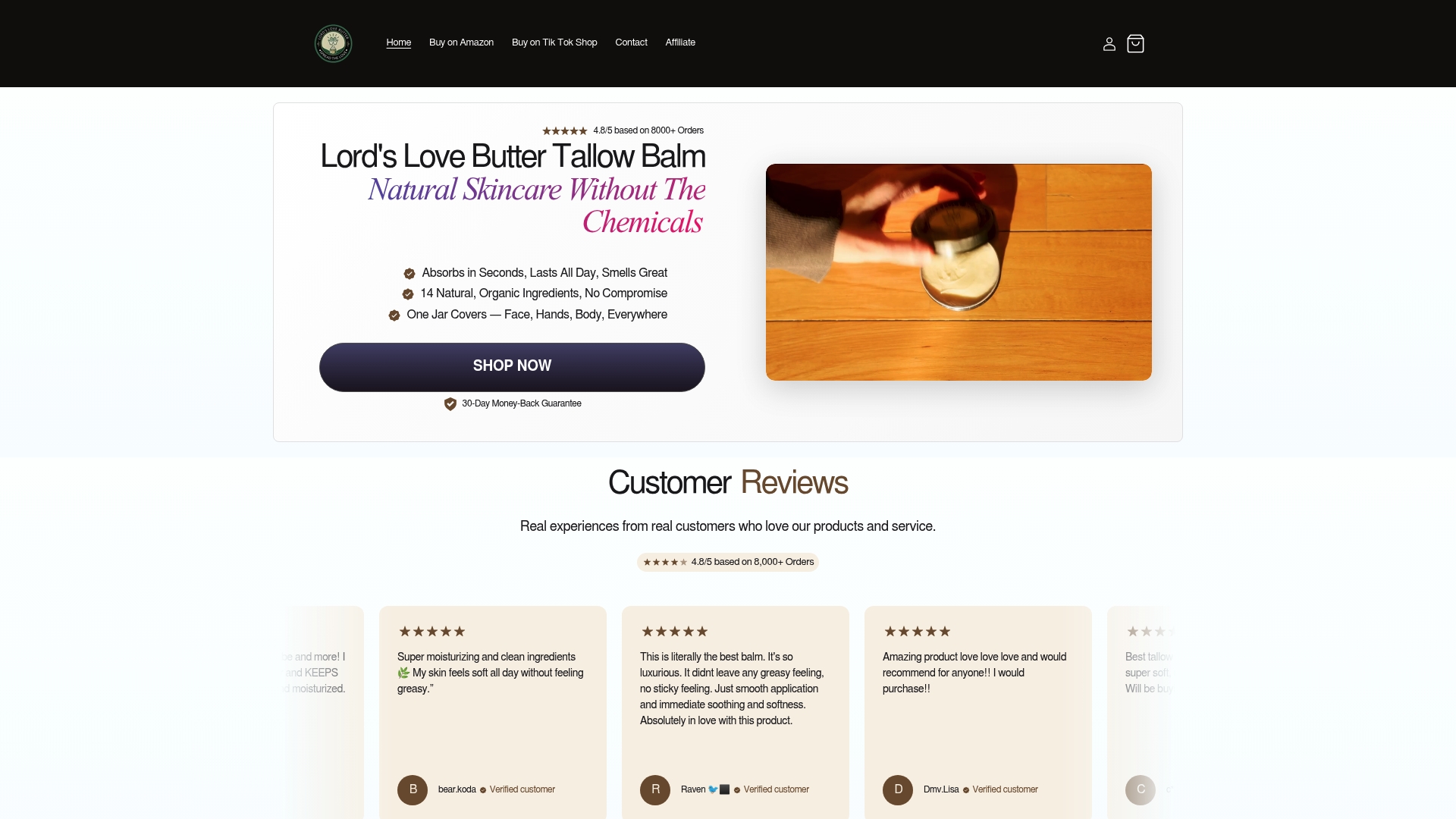
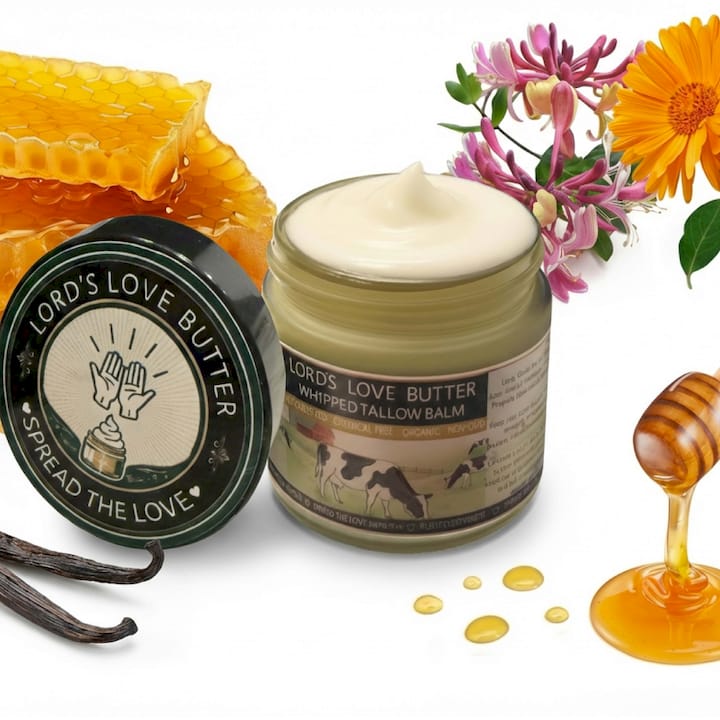
Three products cover different needs. The Vitamin C Whipped Beef Tallow Balm with Manuka Honey & Squalane adds brightening and antioxidant support alongside Manuka’s antibacterial action, making it a strong choice for dull or uneven skin. The Original Beef Tallow Balm Lite with Manuka Honey is the lightweight daily option: non-greasy, fast-absorbing, and practical for face and body use without any tackiness. For very dry or eczema-prone skin that needs deeper barrier repair, the Whipped Beef Tallow Balm with Manuka Honey in the 2.4 oz Tin delivers a richer, more occlusive application. All three are grass-fed, chemical-free, and made by a veteran-owned business that treats ingredient quality as non-negotiable. Browse the full line and find the right fit for your skin.
Sources
- Honey: A Therapeutic Agent for Disorders of the Skin - PMC
- Manuka honey for skin (Medical News Today)
- Manuka Honey Skincare: Acne, Eczema & Anti-Ageing | ApiHealth
- Everything You Need to Know About Manuka Honey Skin Care | Vogue
This article is general information, not a substitute for advice from a qualified doctor. Consult a qualified healthcare professional about your own circumstances before acting on anything here.
Recommended
- The Daily Ritual Kit | Tallow Balm Jar + Lip Balm + Sun Balm Bundle – Lord’s Love Butter
- How Animal-Based Skincare Works for Healthy Skin – Lord’s Love Butter
- The Starter Kit | Tallow Balm Lite + Lip Balm + Sun Balm Bundle – Lord’s Love Butter
- Organic Grass-Fed Beef Tallow Balm with Raw Honey – Lord’s Love Butter

