

Even Out Dry Skin: A Gentle Routine for Uneven Tone
If your skin is dry and unevenly toned, the fix is not a stronger acid or a bigger dose. It is the sequence: repair the barrier first with a gentle cleanser and a ceramide-rich moisturizer, layer a broad-spectrum, iron-oxide tinted sunscreen with adequate SPF protection on top every morning. Only then add one gentle brightening ingredient, like niacinamide, azelaic acid, or a low-strength vitamin C, at night.
Start today with three things. Swap your current moisturizer for something richer if your skin still feels tight an hour after applying it. Buy a tinted, mineral sunscreen with iron oxide and wear it daily, rain or shine. Patch-test one brightening serum on your inner forearm for three nights before it touches your face.
- Switch to a ceramide or squalane moisturizer if your current one leaves skin tight or flaky.
- Add a tinted, broad-spectrum sunscreen with iron oxide to your morning routine, applied after moisturizer.
- Patch-test a single brightening active (niacinamide or azelaic acid) for three nights before full use.
Expect the first signs of improvement, less flaking, slightly more even texture, within four to eight weeks. Real fading of dark spots or post-inflammatory marks typically takes eight to twelve weeks and sometimes longer, depending on how deep the pigment sits and how consistent you are with sunscreen. This is a slow-and-steady problem. Rushing it with strong actives on already-dry skin tends to backfire.
Key Takeaways
Addressing uneven skin tone on dry skin works best when you repair the barrier first, protect daily with iron-oxide sunscreen, and add brightening actives slowly and one at a time.
| Point | Details |
|---|---|
| Repair the barrier first | Use a ceramide moisturizer and gentle cleanser for two to four weeks before adding actives. |
| Wear tinted SPF daily | Choose broad-spectrum SPF 30+ with iron oxide, applied after moisturizer, to block HEVL-driven darkening. |
| Add one active at a time | Introduce niacinamide, azelaic acid, or low-strength vitamin C gradually, watching for two to three weeks. |
| Expect a real timeline | Initial improvement takes four to eight weeks; meaningful fading often takes three to six months or longer. |
| See a dermatologist for red flags | Rapidly changing spots, suspected melasma, or no progress after three to six months need professional evaluation. |
| Seal in progress overnight | A balm like Lordslovebutter’s Whipped Beef Tallow Balm supports barrier repair once actives are introduced. |
Table of Contents
- How to Address Uneven Skin Tone on Dry Skin: What’s Actually Going On
- What Causes Uneven Skin Tone in the First Place
- Why Dry Skin Makes Uneven Tone Look Worse
- A Daily Routine for Dry, Uneven Skin That Actually Works
- Which Brightening Ingredients Are Safe for Dry Skin (and Which Aren’t)
- How to Exfoliate Without Triggering More Discoloration
- Sunscreen: The One Step You Cannot Skip
- When to See a Dermatologist Instead of Waiting It Out
- A 4 to 8 Week Plan You Can Actually Follow
- Mistakes That Quietly Sabotage Your Progress
- What You Eat and Drink Shows Up on Your Skin
- Why I Believe in Treating the Barrier Before the Spot
- How Lordslovebutter Balms Fit Into a Barrier-First Routine
- Sources
How to Address Uneven Skin Tone on Dry Skin: What’s Actually Going On
Uneven skin tone is not one condition. It is an umbrella term covering several different things that all show up as patchy color, and each needs a slightly different approach.
Dark spots, also called solar lentigines, are flat brown marks caused by years of cumulative sun exposure. They sit mostly in the epidermis, the skin’s outer layer, which is good news: epidermal pigment generally responds faster to treatment than pigment buried deeper.
Post-inflammatory hyperpigmentation (PIH) is the discoloration left behind after acne, eczema flares, a scrape, or even aggressive exfoliation. It follows the shape of whatever injured the skin and tends to fade on its own over months, though sun exposure can lock it in place indefinitely.
Melasma is a chronic, often hormone-linked pattern of brownish-gray patches, usually across the cheeks, forehead, and upper lip. Unlike a single dark spot, melasma frequently involves pigment sitting deeper in the dermis, which makes it far more stubborn and prone to relapse. It typically needs long-term, individualized management rather than a quick fix, and dermatology guidelines point to agents like azelaic acid and combination topicals showing grade A evidence for this specific condition.
Redness (erythema) shows up as blotchy pink or red patches, often from rosacea, irritation, or a damaged barrier letting inflammation show through thinner skin.
General dullness is different from all of the above. It is not really a pigment problem. It is a texture problem, flaky, uneven skin scatters light unpredictably instead of reflecting it evenly, which reads to the eye as “tired” or “dull” even when no actual discoloration exists.
The depth of the pigment determines your timeline and your risk. Epidermal pigment (fresh dark spots, mild PIH) responds to gentle topicals in weeks to months. Dermal pigment (melasma, old deep PIH) can take six months to years and often needs a dermatologist’s help. Knowing which one you’re dealing with saves you from wasting months on the wrong strategy.
What Causes Uneven Skin Tone in the First Place
A handful of factors drive almost every case of blotchy, discolored skin, and they usually stack on top of each other rather than acting alone.
- Sun exposure is the single biggest driver. UVB and UVA rays trigger new dark spots, and high-energy visible light (HEVL), the light your phone screen and the sun both emit, contributes to persistent pigment darkening that regular sunscreen alone doesn’t fully block.
- Inflammation and injury from acne, eczema, or friction (think tight bra straps or a rough towel) leaves behind PIH as skin heals.
- Barrier disruption and chronic dryness make existing unevenness more visible and make skin more reactive to everything else on this list.
- Hormonal shifts, pregnancy, birth control, thyroid changes, drive melasma in people who are already genetically prone to it.
- Lifestyle habits: picking at spots, using harsh or fragranced products, skipping sunscreen on cloudy days, smoking, and certain medications that increase photosensitivity.
Most people dealing with uneven tone have two or three of these running at once. That’s why a single serum rarely solves it. It’s a systems problem, not an ingredient problem.
Why Dry Skin Makes Uneven Tone Look Worse
Dry skin doesn’t just feel uncomfortable. It actively distorts how your skin tone looks and slows down every treatment you throw at it.
Flaking and rough microtexture scatter light unpredictably across the skin’s surface. Instead of a smooth, even reflection, light bounces off dry patches at different angles than it does off hydrated skin, which exaggerates blotchiness that might otherwise be barely noticeable. Two people with identical pigment levels can look drastically different in tone evenness depending on how hydrated their skin barrier is.
There’s a second, sneakier problem. A compromised barrier amplifies your skin’s inflammatory response to everything you apply. That serum with 10% vitamin C that a friend swears by? On intact, well-moisturized skin it might cause mild tingling. On a cracked, dry barrier it can trigger real inflammation, and inflammation is exactly what causes new PIH. Clinical commentary on hyperpigmentation treatment consistently warns that more aggressive actives on already-compromised skin tend to backfire, creating the very discoloration you were trying to erase.
Pro Tip: Before introducing any brightening active, spend two to four weeks “preconditioning” dry skin: a rich moisturizer morning and night, plus an occlusive balm sealed over top at bedtime. This rebuilds your barrier’s tolerance and cuts your risk of triggering new PIH once you do start actives.
A Daily Routine for Dry, Uneven Skin That Actually Works
Order matters as much as ingredients here. Applying the right products in the wrong sequence either wastes them or irritates skin that’s already struggling.
Morning routine:
- Cleanse with a gentle, low-foam or cream cleanser. Skip anything that leaves skin feeling squeaky clean; that’s a sign it stripped your natural lipids.
- Apply a hydrating serum with hyaluronic acid on slightly damp skin to maximize water binding.
- Follow with a ceramide-rich moisturizer to seal that hydration in and reinforce the lipid barrier.
- Optionally, layer a lightweight, low-irritant antioxidant like niacinamide if your skin tolerates it.
- Finish with a broad-spectrum, iron-oxide tinted sunscreen SPF 30 or higher, applied after moisturizer, never before.
Evening routine:
- Cleanse again, using an oil or balm cleanser if you wore sunscreen or makeup during the day.
- Introduce one targeted brightening active, azelaic acid or a low-strength retinoid, only after your skin has tolerated a plain moisturizing routine for two to four weeks.
- Follow with a richer repair moisturizer or an occlusive balm to lock everything in overnight.
Apply products thin-to-thick: water-based serums before creams, creams before balms. If you notice pilling (product balling up instead of absorbing), you’re layering too fast or using too much of one step. Introduce only one new active at a time and watch for two to three weeks before adding anything else. If a product stings persistently, not the mild tingle that fades in a minute, stop using it. For readers who react to almost everything, squalane and niacinamide are generally the best-tolerated starting actives, and a pH-friendly, fragrance-free cleanser matters more than people think. Restoring moisture at this stage does real, measurable work on visible texture and tone, an effect documented in real-world results from people who prioritized hydration before anything else.
Which Brightening Ingredients Are Safe for Dry Skin (and Which Aren’t)
Not every ingredient marketed for “brightening” belongs on dry, sensitive skin. Some are well-tolerated first-line options; others carry real restrictions.
Azelaic acid, niacinamide, and carefully dosed retinoids sit at the safer end of the spectrum for dry skin. Azelaic acid in particular has favorable tolerability data, and formulations pairing it with moisturizing ingredients tend to perform even better on dry, reactive skin than the acid alone. Hydroquinone and triple-combination creams (TCC) work faster and stronger, but they are prescription-strength tools with real restrictions: duration limits, medical monitoring, and a risk of rebound pigmentation or exogenous ochronosis with long-term unsupervised use, which is why they belong under a dermatologist’s care rather than in a self-directed routine.
Expect initial improvement in texture and mild spot fading within four to eight weeks. Meaningful, visible change in stubborn discoloration usually takes three to six months, and maintenance is indefinite; pigment-prone skin relapses if you stop protecting it. Lasers and stronger chemical peels can accelerate results, but they carry a higher PIH risk on dry, sensitive, or deeper skin tones, and dermatologists generally require the barrier to be well-hydrated and calm before scheduling either.
How to Exfoliate Without Triggering More Discoloration
Exfoliation genuinely helps even out rough, dull, discolored skin. It also causes more PIH than almost any other at-home step when it’s done wrong on dry skin.
- Do choose PHA (polyhydroxy acid), low-percentage lactic acid, or gentle enzyme exfoliants; they work on the skin’s surface without the deeper penetration that irritates a dry barrier.
- Do start at a low frequency, once every ten to fourteen days, and only increase to once or twice weekly if your skin shows no redness or tightness afterward.
- Do patch-test any new exfoliant on your inner arm for three consecutive nights before using it on your face.
- Don’t use high-strength glycolic acid frequently on dry skin; it’s the acid most likely to compromise an already-thin moisture barrier.
- Don’t use physical scrubs with jagged particles (crushed shells, apricot pits); they create micro-tears that turn into new PIH.
- Don’t combine multiple acids, or an acid and a retinoid, in the same routine until you’ve built tolerance to each individually.
Sunscreen: The One Step You Cannot Skip
Every other step in this routine is optional compared to this one. Sunscreen is the foundation of treating and preventing uneven tone, full stop, and dermatologists consistently name it as the single most essential step for anyone dealing with dark spots or pigment issues.
Standard sunscreen blocks UVA and UVB, but it often misses high-energy visible light, the light emitted by the sun’s visible spectrum and, to a smaller degree, screens. HEVL has been shown to drive persistent darkening in existing pigment, which is why a plain SPF 30 sometimes isn’t enough for someone actively treating dark spots or melasma. Iron oxide, an ingredient found in tinted mineral sunscreens, blocks that visible-light range in a way untinted formulas typically cannot. For people with deeper skin tones especially, combining tinted SPF with iron-oxide makeup and physical barriers like a wide-brim hat substantially cuts relapse risk compared to sunscreen alone.

When shopping, look for broad-spectrum sunscreen for daily wear, and consider higher protection if actively treating dark spots or melasma. A tinted formula with visible iron oxide on the ingredient list, or a layer of iron-oxide mineral makeup over your regular sunscreen, covers that visible-light gap. Mineral sunscreens (zinc oxide, titanium dioxide) tend to sit better on dry, reactive skin than chemical filters, though a well-formulated chemical sunscreen with added ceramides can work too if mineral formulas feel chalky on you.
Apply sunscreen last, after moisturizer, using roughly a nickel-sized amount for the face. Reapply every two hours if you’re outdoors, and don’t skip it on cloudy days; UV and HEVL both penetrate cloud cover. If you wear a tinted SPF instead of foundation, you can skip a separate makeup step entirely, which actually simplifies a dry-skin routine rather than complicating it.
When to See a Dermatologist Instead of Waiting It Out
Most uneven tone responds to consistent home care. Some situations need professional eyes sooner rather than later.
- Any lesion that’s spreading rapidly, has irregular borders, or is changing shape or color needs urgent evaluation, not a home remedy.
- A patch that doesn’t heal or fade at all after several months, particularly if it’s raised, crusted, or bleeding.
- No visible improvement after three to six months of consistent OTC care with sunscreen, moisturizer, and a gentle active.
- Suspected melasma or deep dermal pigment, since these patterns typically need individualized, staged treatment that goes beyond what’s available over the counter.
- Recurrent, intense PIH that keeps returning after minor skin injuries, which can signal your skin needs a different management approach entirely.
If you land in a dermatologist’s office, expect a conversation about prescription-strength topicals, possibly a triple-combination cream, chemical peels, or non-ablative lasers. All of these can work well, but they come with a critical caveat: a dry or compromised barrier needs to be stabilized before any of these procedures, or the treatment itself risks causing more PIH than it resolves.
A 4 to 8 Week Plan You Can Actually Follow
Here’s how to structure the first two months without overwhelming already-sensitive skin.
Weeks 1 to 2: Focus entirely on hydration and barrier repair. Gentle cleanser, hyaluronic acid serum, ceramide moisturizer, tinted SPF every morning. No brightening actives yet. Patch-test one active on your forearm during week two.
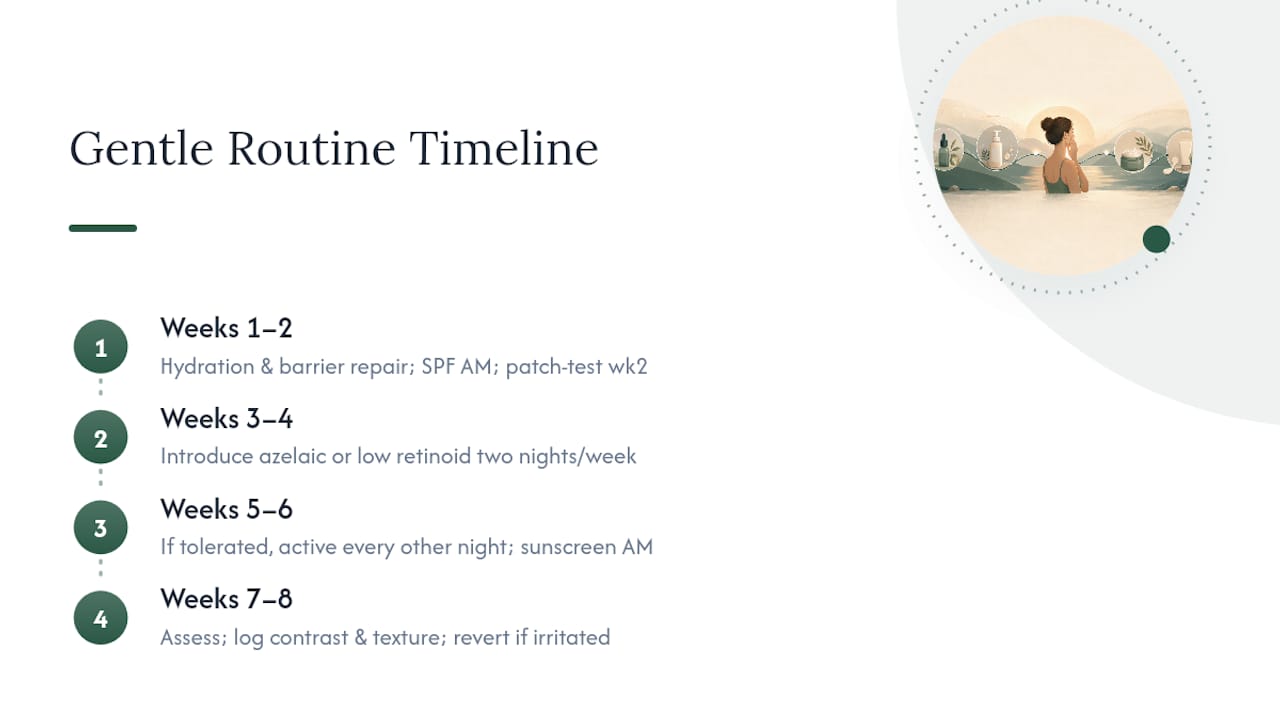
Weeks 3 to 4: If your patch test showed no redness, flaking, or persistent stinging after 72 hours, introduce your chosen active (azelaic acid or a low-strength retinoid) two nights a week. Watch for mild tingling that fades within a minute; that’s normal. Watch for burning, swelling, or redness that lasts hours; that’s not, and means you should pause and step back to plain moisturizing.
Weeks 5 to 6: If tolerated, increase the active to every other night. Keep sunscreen non-negotiable every single morning.
Weeks 7 to 8: Assess. Log what you notice: is patch contrast lower than it was at week one? Does skin feel smoother under your fingertips? These are your real progress markers, not a mirror check under bad lighting. If irritation shows up at any point, drop back to the previous week’s frequency for a week before trying to advance again.
Mistakes That Quietly Sabotage Your Progress
A few habits undo months of careful routine building, often without the person realizing it’s happening.
- Over-exfoliating, or stacking multiple high-strength actives (a retinoid plus an AHA plus vitamin C) in the same week, overwhelms a dry barrier fast.
- Harsh, fragranced cleansers strip natural lipids and trigger the exact inflammation that leads to new PIH.
- Skipping sunscreen on gray days or “forgetting” reapplication undoes weeks of topical progress in a single afternoon outdoors.
- DIY “bleaching” remedies, lemon juice, household bleach, unregulated high-concentration creams bought online, are actively dangerous and can cause chemical burns and permanent scarring rather than fading. Dermatology patient guidance is consistent on this point: skip anything that isn’t a recognized topical agent.
- Picking at spots, scabs, or flaking skin restarts the inflammation cycle every time, which is often why the same spot seems to “never fully heal.”
What You Eat and Drink Shows Up on Your Skin
Topical care does most of the heavy lifting for uneven tone, but what happens inside your body sets the baseline your skin starts from. Dehydration makes existing dryness and flaking worse, which, as covered earlier, exaggerates how blotchy uneven pigment looks. Drinking enough water throughout the day supports overall skin hydration, though it works alongside topical moisturizers rather than replacing them.
A diet rich in antioxidants, colorful vegetables, berries, leafy greens, helps your body manage the oxidative stress that sun exposure and inflammation both generate. Omega-3 fatty acids from sources like fatty fish or walnuts support the skin’s lipid barrier from the inside, complementing what a ceramide moisturizer does on the outside. Excess sugar and highly processed foods are linked to increased inflammation in general, and since inflammation is a direct driver of PIH, a lower-sugar diet is a reasonable, low-effort lever alongside your topical routine. None of this replaces sunscreen or a proper skincare routine, but it’s the quiet foundation that makes everything else work better.
Why I Believe in Treating the Barrier Before the Spot
Most advice about uneven skin tone treats the pigment as the problem to solve and the dryness as an afterthought. I think that gets the order backward. Dry, compromised skin isn’t just uncomfortable scaffolding around the “real” issue. It’s often what’s making discoloration look worse and what’s making every treatment you try less effective and more likely to backfire.
That’s the philosophy behind how Lordslovebutter approaches skin at all: repair capacity has to come before correction. A barrier that can’t hold onto moisture can’t tolerate a brightening active without flaring up, and a flare turns into new post-inflammatory pigment, which is the exact problem you were trying to fix in the first place. I’ve seen this pattern described consistently across dermatology guidance, aggressive treatment on unprepared skin tends to create more discoloration, not less, and it’s the reason “start slow” isn’t a hedge. It’s the actual strategy.
What gets underestimated is how much of this is patience, not product. The right ingredients matter, but sequencing and restraint matter more for anyone whose skin is already dry and reactive.
How Lordslovebutter Balms Fit Into a Barrier-First Routine
Once your skin is hydrated and calm enough to tolerate a brightening active, you still need something to seal that progress in overnight, and that’s where an occlusive balm earns its place. Lordslovebutter makes three formulas built around grass-fed beef tallow and Manuka honey, chemical-free and gentle enough for the sensitive, flare-prone skin that eczema and psoriasis create, which is the same skin type that needs the most careful approach to uneven tone.

The Whipped Beef Tallow Balm with Manuka Honey works best as your nightly occlusive, sealed over moisturizer to lock in hydration while you sleep, exactly the kind of barrier support that makes brightening actives easier to tolerate. If your skin runs on the drier, thicker side or you want a full-strength option, the tin format spreads thin without feeling greasy. For daytime or combination skin that needs something lighter, the Original Beef Tallow Balm Lite delivers the same barrier support in a less occlusive formula. And for the perioral area, one of the most commonly overlooked dry, discoloration-prone zones, the Mint Beef Tallow Lip Balm Stick handles targeted dryness without needing a separate product.
Patch-test any new balm on your inner forearm for two nights before applying it broadly, same rule as any other new product in your routine. Ready to give your barrier the support it needs before tackling uneven tone? Start with the Whipped Beef Tallow Balm tin tonight.

Sources
The clinical guidance behind this routine comes from dermatology organizations and peer-reviewed research, not general wellness advice. For readers who want to dig deeper into the evidence, these sources cover sunscreen statistics and pigment prevention from the American Academy of Dermatology, staged treatment protocols from the Medscape melanin hyperpigmentation guideline, a systematic review of topical and systemic melasma therapies on PMC, and patient-facing guidance on dark spots from Mayo Clinic. If you want a hydration-focused supplement to your evening routine while your skin adjusts to a new active, an overnight bio-collagen hydrating mask can offer a gentle boost during the barrier-repair phase.
Is this general information a substitute for a dermatologist’s advice? No. This article offers general skincare guidance, not a diagnosis or treatment plan. If you have persistent, spreading, or unusual pigment changes, or an underlying skin condition, consult a board-certified dermatologist to confirm what’s actually happening on your skin.
How long does it take to see results when treating uneven skin tone on dry skin? Expect early signs, less flaking, slightly smoother texture, within four to eight weeks of a consistent routine. Real fading of dark spots or PIH typically takes three to six months, and melasma can take longer with ongoing maintenance required indefinitely.
Can I use vitamin C and a retinoid together if I have dry skin? Not right away. Introduce one active at a time, wait two to three weeks to confirm tolerance, then consider layering carefully, ideally vitamin C in the morning and a retinoid at night, never combined in the same application on dry, reactive skin.
Do I really need tinted sunscreen instead of regular sunscreen? For pigment-prone skin, yes, tinted formulas with iron oxide block high-energy visible light that regular sunscreen typically misses, and that light is a known driver of persistent pigment darkening.
What’s the difference between dark spots, PIH, and melasma? Dark spots come from cumulative sun exposure and sit near the skin’s surface. PIH follows an injury or inflammation, like acne or eczema, and takes the shape of whatever caused it. Melasma is a chronic, often hormone-linked pattern that sits deeper in the skin and generally needs longer, more individualized treatment.
This article is general information, not a substitute for advice from a qualified doctor. Consult a qualified healthcare professional about your own circumstances before acting on anything here.
- AAD — sunscreen guidance and statistics
- Melanin hyperpigmentation management guideline — Medscape (2026)
- Topical and Systemic Therapies in Melasma: A Systematic Review — PMC
- Age spots — Mayo Clinic patient information

