

How Skin Texture Improves with Moisture: Real Results
Skin texture improves with moisture because hydration restores water balance inside skin cells while moisturization seals that water in, preventing evaporation and smoothing the surface. These two processes work together. Hydration activates the enzymes that drive healthy cell turnover, while moisturization builds a protective barrier that keeps roughness from returning. Most people see visible results within 1–2 weeks of consistent application, with full barrier restoration taking 4–8 weeks. Understanding both mechanisms is what separates a routine that works from one that just feels like effort.
How skin texture improves with moisture: hydration vs. moisturization
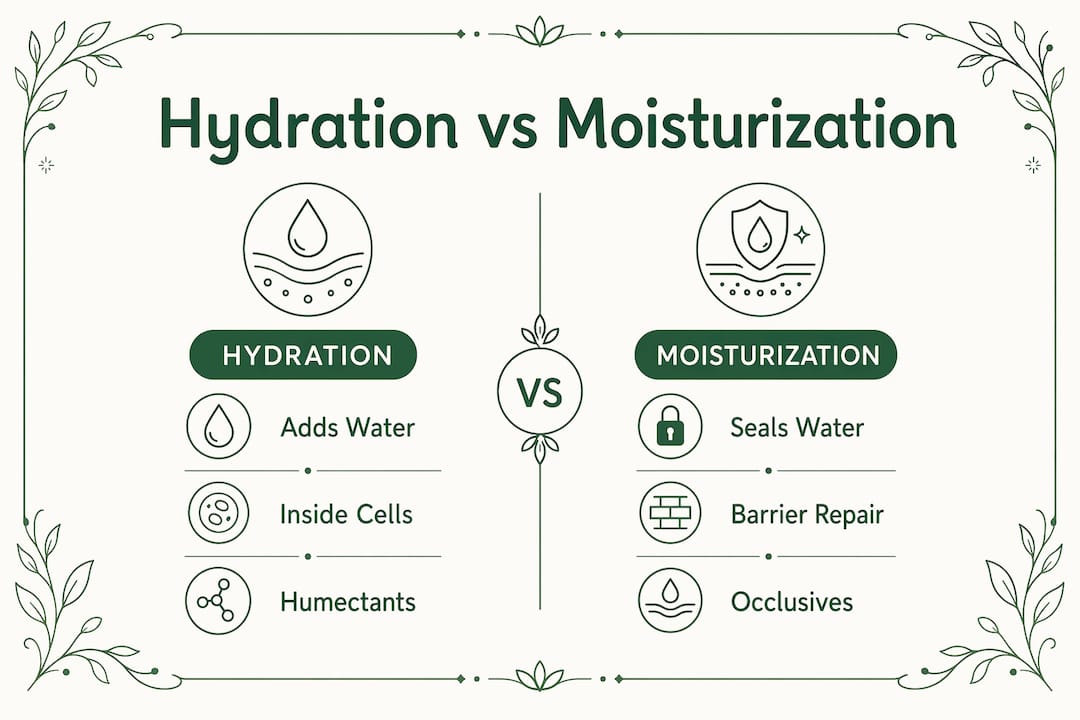
Hydration and moisturization are not the same thing. Treating them as interchangeable is the single most common reason people stay stuck with rough, uneven skin despite using multiple products.
Hydration refers to the water content inside skin cells. Water makes up about 70% of skin cell volume and powers the enzymes that drive healthy exfoliation. When those enzyme levels drop from dehydration, dead skin cells accumulate on the surface and create the rough, dull texture most people want to fix. The stratum corneum, the outermost skin layer, contains only 10–20% water, but that fraction determines how smooth your skin actually feels.
Moisturization is the act of sealing water inside the skin using occlusive agents. Humectants like hyaluronic acid pull water into the skin. Occlusives like shea butter and ceramides then lock it there. Without both working together, moisture evaporates rapidly through a process called transepidermal water loss, and your skin returns to rough within hours.
| Feature | Hydration | Moisturization |
|---|---|---|
| What it does | Adds water to skin cells | Seals water inside the skin |
| Key ingredients | Hyaluronic acid, glycerin, aloe vera | Ceramides, shea butter, beef tallow |
| Primary benefit | Activates cell renewal enzymes | Prevents transepidermal water loss |
| Visible timeline | 1–2 weeks for texture improvement | 4–8 weeks for full barrier restoration |
| Common mistake | Skipping occlusives after hydrating | Using occlusives without prior hydration |
Pro Tip: Apply your humectant serum first, then layer your occlusive moisturizer on top while your skin is still slightly damp. This two-step sequence is what makes the difference.
How does skin barrier health affect moisture and texture?
The skin barrier operates on a “bricks and mortar” model. Skin cells are the bricks. The lipid matrix surrounding them is the mortar. That matrix is made of three specific components: ceramides, cholesterol, and fatty acids. When all three are present in the right ratio, the barrier holds water in and keeps irritants out. When even one is depleted, the structure weakens.
A damaged barrier leads directly to rough skin texture. Persistent dryness despite moisturizing almost always signals barrier dysfunction rather than a need for more product. The skin is losing water faster than any moisturizer can replace it. This is why people with eczema or psoriasis often feel like nothing works. Their barrier is compromised at the structural level.
The fix is targeted. Moisturizers containing ceramides restore the lipid matrix by filling the gaps between skin cells, which reduces water loss and physically smooths the surface. Clinical studies confirm smoother skin and measurably improved barrier function with ceramide-based formulas. Ingredients like grass-fed beef tallow are naturally rich in fatty acids that mirror the skin’s own lipid profile, making them particularly effective for barrier repair.
Pro Tip: If your skin stays dry and rough even after moisturizing, switch to a product that lists ceramides, cholesterol, and fatty acids together. That combination repairs the barrier structure rather than just sitting on top of it.
For a deeper look at which ingredients deliver the most barrier repair, the guide on aging skin texture ingredients breaks down the science by ingredient type.
Can drinking water alone improve skin texture?
Drinking water is good for your health. It does not reliably improve skin texture on its own. Increased water intake benefits skin thickness and density only when someone is in a state of systemic dehydration. If you are already adequately hydrated, drinking more water does not push additional moisture into your skin cells.
The reason is simple. Water consumed orally gets distributed to organs in order of metabolic priority. Skin is last. Topical hydration delivers water directly to the stratum corneum, bypassing that distribution queue entirely. That is why a well-formulated moisturizer outperforms a gallon of water for texture improvement every time.
That said, lifestyle factors do support skin health in ways that make topical products work better:
- Adequate sleep supports skin cell repair cycles overnight, when barrier restoration is most active
- A diet rich in omega-3 fatty acids from sources like salmon, walnuts, and flaxseed supports the lipid matrix from the inside
- Limiting alcohol and caffeine reduces systemic dehydration that can push skin toward the threshold where water intake does matter
- Humidifier use in dry indoor environments reduces the rate of transepidermal water loss, extending how long your moisturizer stays effective
- Sun protection with SPF 30 or higher prevents UV-driven barrier damage that undoes hydration gains
Think of drinking water as maintaining the floor, not raising the ceiling. Topical moisturization is what actually moves the needle on texture.
What are the best practices for moisturizing to improve skin texture?
The technique matters as much as the product. Applying moisturizer to slightly damp skin improves absorption and traps existing surface moisture. This outperforms application on dry skin because humectants need water present to pull into the skin. Pat your face or body dry after washing, leave a little moisture behind, then apply immediately.
Ingredients worth prioritizing
Not all moisturizers are built the same. These ingredients have the strongest evidence for texture improvement:
- Hyaluronic acid pulls water into the skin from the environment and deeper skin layers, plumping the surface and reducing the appearance of rough patches
- Ceramides repair the lipid matrix and are the most clinically validated ingredient for barrier restoration
- Niacinamide reduces inflammation, tightens pores, and supports ceramide production, making it a strong supporting ingredient
- Shea butter acts as an occlusive and provides fatty acids that soften rough texture on contact
- Grass-fed beef tallow contains oleic acid, palmitic acid, and stearic acid in ratios close to human skin lipids, making it one of the most biocompatible natural occlusives available
The over-exfoliation trap
Aggressive exfoliation damages the moisture barrier, increases water loss, and worsens roughness. This is counterintuitive because exfoliation feels like it should smooth skin. It does, in moderation. But more than two or three times per week with chemical exfoliants like AHAs or BHAs strips the lipid matrix faster than it can regenerate. The result is skin that feels tight, looks dull, and absorbs nothing.
Combination routines that pair gentle exfoliation with layered hydration and barrier repair deliver the best texture results within a month. The sequence is: cleanse, hydrate, seal. Exfoliate no more than twice weekly. Let the barrier lead.
For people working from home or spending long hours in climate-controlled environments, the guide on moisturizing during work from home covers how to maintain hydration throughout the day without disrupting your routine.
Natural balms made from grass-fed tallow are worth considering as a final occlusive layer, especially for sensitive skin or areas prone to roughness like elbows, knees, and hands. The article on whipped balm for rough skin explains how this works in practice.
Key takeaways
Skin texture improves when hydration restores cellular water balance and moisturization seals the barrier, with visible results appearing in 1–2 weeks and full restoration by 4–8 weeks.
| Point | Details |
|---|---|
| Hydration and moisturization differ | Use humectants first to add water, then occlusives to seal it in. |
| Barrier repair drives texture change | Ceramides, cholesterol, and fatty acids restore the lipid matrix that controls smoothness. |
| Drinking water has limits | Topical application is the primary method for improving texture in already-hydrated individuals. |
| Application technique matters | Apply moisturizer to damp skin immediately after washing for better absorption. |
| Over-exfoliation backfires | Limit exfoliation to twice weekly to avoid stripping the barrier and worsening roughness. |
What I’ve learned after years of watching people get this wrong
Most people come to skin texture problems with the wrong mental model. They think rough skin means dirty skin, so they scrub more. Or they think dry skin means they need to drink more water, so they carry a water bottle everywhere and wonder why nothing changes. Both instincts are understandable and both make the problem worse.
The real issue is almost always barrier dysfunction. Hydration controls the speed of skin cell renewal, and when the barrier is compromised, that renewal slows down. Dead cells pile up. Skin looks dull and feels rough. The fix is not more scrubbing. It is sealing the barrier and letting the skin do its job.
What I find most people miss is the layering sequence. They apply a heavy cream and call it done. But if there is no humectant underneath pulling water in, the cream is just sitting on the surface. And if they exfoliated too aggressively the night before, the barrier cannot hold anything anyway. The routine has to be built in the right order: hydrate, then seal, then protect.
I also think natural occlusives are underrated. Grass-fed beef tallow has a lipid profile that genuinely resembles human skin. That is not marketing. It is biochemistry. For people with sensitive skin, eczema, or psoriasis who have tried every synthetic formula and still struggle, switching to a simple, clean occlusive often produces results faster than anything else they have tried.
Patience is the other piece. A 42% increase in skin hydration after 28 days of consistent application is real and measurable. But 28 days requires showing up every day. The people who see the best results are not using the most expensive products. They are using the right products in the right order, consistently.
— Michael
Why Lordslovebutter is worth adding to your routine
If you have been layering products without seeing real texture improvement, the missing piece might be your occlusive.
Lordslovebutter’s Whipped Beef Tallow Balm with Manuka Honey is made from grass-fed beef tallow and contains no synthetic fillers or chemical additives. The fatty acid profile in grass-fed tallow closely mirrors the skin’s own lipid structure, which makes it one of the most effective natural occlusives for barrier repair. Customers with eczema and psoriasis report improved texture within days. The balm absorbs without a greasy feel and works on the face, hands, elbows, and anywhere else roughness shows up. Lordslovebutter is a veteran-owned business that puts real ingredients first. That shows in the results.
FAQ
How quickly does skin texture improve with moisturizing?
Most people see visible texture improvement within 1–2 weeks of consistent moisturizing. Full barrier restoration takes 4–8 weeks with daily application of humectants and occlusives.
What is the best moisturizer ingredient for rough skin texture?
Ceramides are the most clinically validated ingredient for texture improvement because they repair the lipid matrix and reduce transepidermal water loss. Grass-fed beef tallow is a strong natural alternative with a similar fatty acid profile.
Does drinking water improve skin texture?
Drinking water improves skin texture only if you are systemically dehydrated. For most people, topical moisturization is the primary and more effective method for smoothing rough skin.
Should I moisturize on wet or dry skin?
Apply moisturizer to slightly damp skin immediately after washing. This traps surface moisture and improves humectant absorption into the stratum corneum compared to application on fully dry skin.
Can over-exfoliating make skin texture worse?
Yes. Exfoliating more than two to three times per week strips the lipid barrier, increases water loss, and worsens roughness. Barrier repair and consistent moisturizing should come before increasing exfoliation frequency.

