

How Natural Balms Seal Moisture for Dry Skin
Natural balms seal moisture by forming a hydrophobic film on the skin’s surface that physically slows water evaporation. This process, known in dermatology as controlling transepidermal water loss (TEWL), is the core mechanism behind every effective occlusive moisturizer. Ingredients like beeswax, grass-fed beef tallow, shea butter, and plant-based oils each contribute to this barrier in different ways. Understanding how natural balms seal moisture, and how to apply them correctly, is the difference between skin that stays hydrated for hours and skin that feels tight again by midday.
How natural balms seal moisture: the science of occlusion
Natural balms work as occlusives. That means they sit on top of the stratum corneum, the outermost layer of skin, and form a physical barrier that slows water from escaping into the air. Occlusives primarily inhibit TEWL by creating this barrier without adding water themselves. That distinction matters more than most people realize.
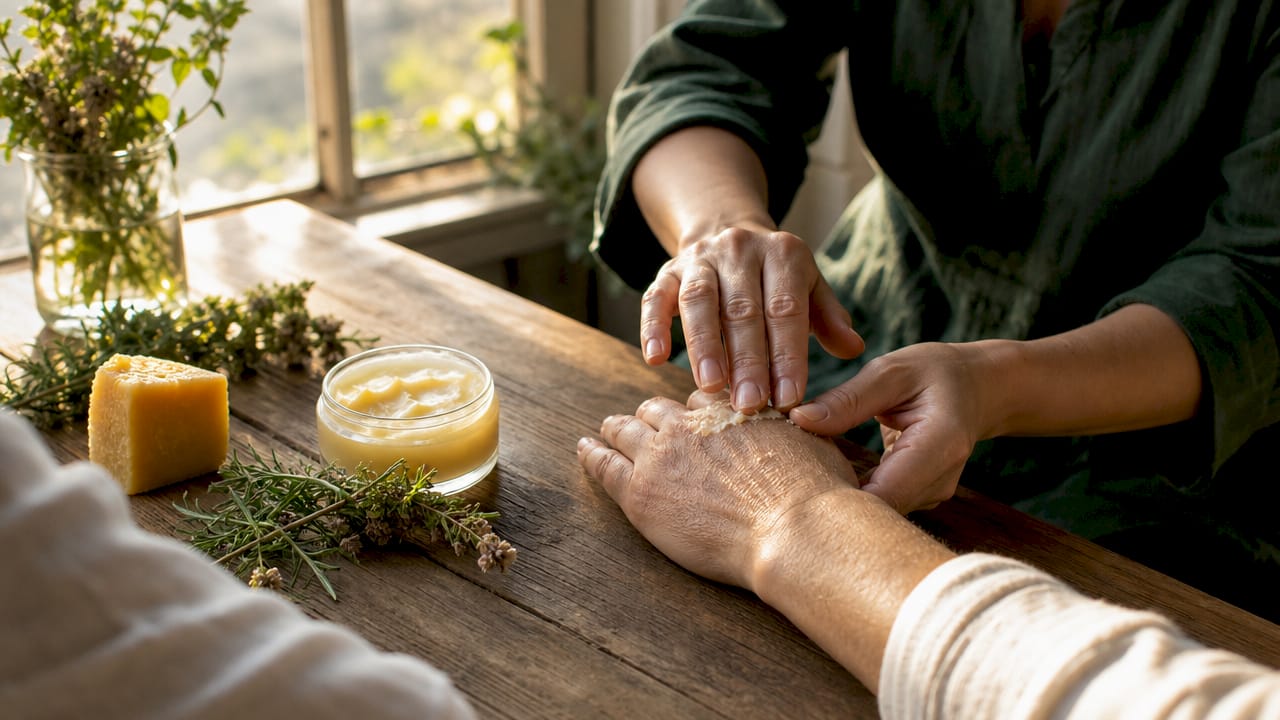
Transepidermal water loss is the continuous, passive movement of water through the skin and into the environment. Dry skin loses water faster than healthy skin because its barrier is compromised. Occlusives slow that loss by covering the surface with a film that water molecules cannot easily pass through.
Three categories of moisturizing agents work together in the best formulas:
- Occlusives form a physical barrier to prevent water evaporation. Examples include beeswax, tallow, and petrolatum.
- Humectants draw water into the skin from the environment or deeper skin layers. Glycerin, hyaluronic acid, and honey are common humectants.
- Emollients fill gaps between skin cells, smoothing texture and softening the barrier. Shea butter and many plant oils serve this role.
Effective hydration requires the integration of all three functions. A balm that only occludes will trap whatever moisture is already present. A balm that combines occlusion with emollient properties does more work per application.
“Skin-barrier science views moisture sealing as controlling TEWL; combining humectants with occlusives yields the highest hydration benefit rather than relying on occlusives alone.” — Journal of Skin and Sexually Transmitted Diseases
How do different natural balm ingredients compare in sealing moisture?
Not all natural moisture sealers perform equally. The strength of an occlusive depends on how well it forms a continuous, water-resistant film. Here is how the most common natural balm ingredients stack up.
| Ingredient | Occlusive strength | Emollient effect | Skin compatibility |
|---|---|---|---|
| Petrolatum | Very high | Low | Generally well tolerated |
| Beeswax | High | Moderate | Well tolerated |
| Grass-fed beef tallow | High | High | Excellent for sensitive skin |
| Shea butter | Moderate | High | Well tolerated |
| Extra virgin olive oil | Moderate | High | Good for most skin types |
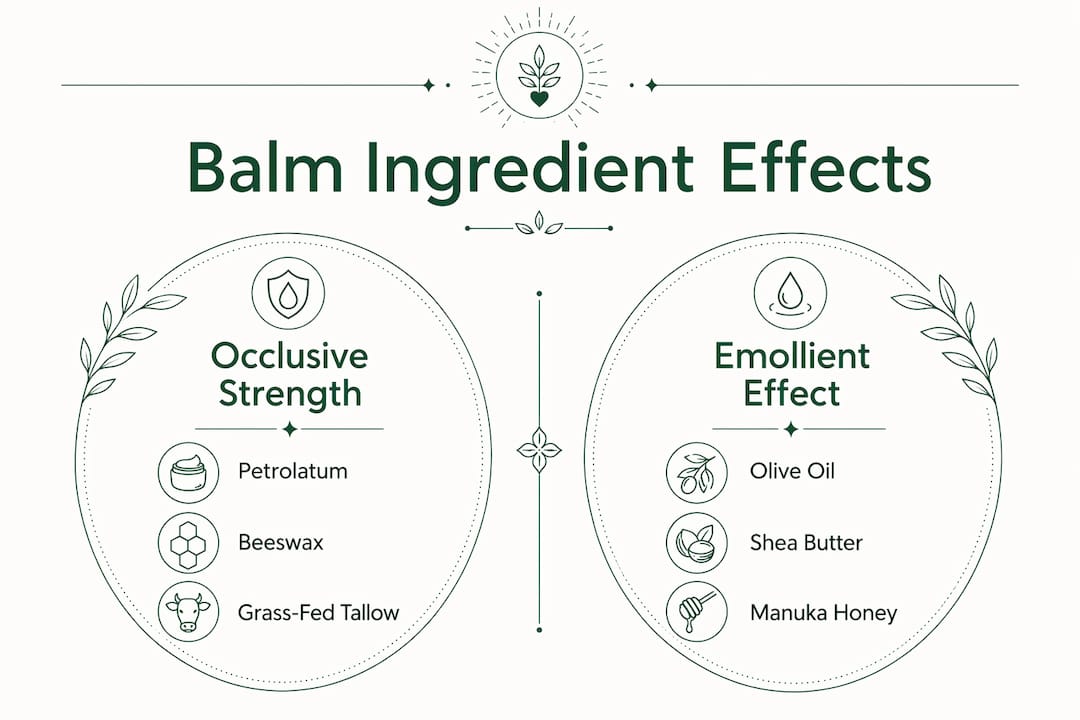
Petrolatum reduces TEWL by 30–50% through forming a nearly continuous hydrophobic film. That makes it the clinical benchmark against which natural ingredients are measured. The tradeoff is that petrolatum provides no emollient benefit and sits entirely on the surface.
Both extra virgin olive oil and petrolatum improve skin barrier function, but petrolatum provides stronger occlusion while olive oil supports epidermal renewal. That means olive oil does something petrolatum cannot: it contributes to repairing the barrier over time, not just covering it.
Grass-fed beef tallow has a fatty acid profile that closely resembles human sebum. This compatibility means it absorbs without clogging pores and works as both an occlusive and an emollient. For people with eczema or psoriasis, that dual function is particularly useful. You can read more about tallow versus argan oil for a direct comparison of occlusion and emollient effects.
Certain natural emollients penetrate and are retained within the stratum corneum lipid matrix, providing longer-lasting hydration beyond surface occlusion. This is a key advantage of ingredient-rich natural balms over single-ingredient synthetics.
Pro Tip: Look for balms that combine a wax-based occlusive like beeswax with a lipid-rich oil like tallow or shea. The wax holds the film together; the oil feeds the barrier.
Why applying balm after hydration is the key to retaining moisture
The most common mistake with natural balms is applying them to completely dry skin. Occlusives are inert barrier sealants that hold existing moisture inside. They do not supply water. If the skin is already dry when you apply the balm, you are sealing in very little.
The correct sequence for maximum moisture retention is straightforward:
- Cleanse with a gentle, non-stripping cleanser.
- Apply a humectant, such as a glycerin serum or a product containing manuka honey, while skin is still slightly damp.
- Wait 30–60 seconds for the humectant to absorb.
- Apply your occlusive balm immediately, before the skin surface dries.
Applying natural balms on damp skin significantly improves their moisture sealing effect compared to application on dry skin. The balm locks in the water that is already sitting on the surface and the humectant that has just been applied.
This layering approach is especially important for people with eczema or psoriasis, where the skin barrier is already compromised and water loss is accelerated. Applying a balm alone on dry, inflamed skin will reduce TEWL somewhat, but it will not restore hydration to a meaningful level. The whole-body moisturizing routine that integrates humectants and occlusives consistently outperforms single-step approaches.
Pro Tip: Apply your balm within 60 seconds of stepping out of the shower. That window, while skin is still slightly damp, is when occlusives perform at their best.
What makes natural balms different from synthetic occlusives?
Petrolatum is the gold standard for occlusion in clinical dermatology. Natural balms cannot always match its barrier uniformity. Natural balms often require sufficient quantity and even application to form effective occlusive barriers, unlike petrolatum’s nearly uniform film formation. That means technique matters more with natural products.
The practical differences between natural and synthetic moisture barrier balms come down to a few key factors:
- Film consistency: Petrolatum forms a nearly unbroken film. Natural wax and oil blends can leave thinner spots if applied unevenly or in too small an amount.
- Reapplication frequency: Natural balms typically require more frequent reapplication, especially in cold, dry climates or after handwashing.
- Skin integration: Some natural oils penetrate the stratum corneum and integrate with skin lipids, providing hydration that persists beyond the surface film. Petrolatum does not penetrate at all.
- Ingredient complexity: Natural balms often deliver emollient and barrier-repair benefits alongside occlusion. Petrolatum delivers occlusion only.
- Tolerability for sensitive skin: Many people with sensitive or reactive skin find natural balm ingredients gentler than synthetic formulations, which can contain preservatives or fragrances.
For dry and sensitive skin, the argument for natural balms is not that they out-occlude petrolatum. It is that they do more than occlude. A well-formulated natural balm seals moisture, softens the skin, and supports barrier repair simultaneously. That combination is harder to achieve with a single synthetic ingredient. Learning how whipped balm smooths rough skin gives a practical look at how application technique affects these outcomes.
Key Takeaways
Natural balms seal moisture most effectively when applied over damp skin or a humectant, forming an occlusive barrier that slows TEWL while emollient ingredients simultaneously support barrier repair.
| Point | Details |
|---|---|
| Occlusives prevent water loss | Natural balms form a hydrophobic film that slows TEWL without adding water to skin. |
| Ingredient choice matters | Tallow and beeswax provide both occlusion and emollient benefits; petrolatum occludes only. |
| Application timing is critical | Apply balm on damp skin or over a humectant to lock in existing moisture effectively. |
| Natural balms need even coverage | Unlike petrolatum, natural wax and oil blends require thorough, even application to maintain barrier integrity. |
| Layering outperforms single steps | Combining a humectant with an occlusive balm delivers better hydration than either product used alone. |
What I’ve learned from years of watching people use balms wrong
The single most persistent mistake I see is treating a balm like a lotion. People apply a thin scrape to dry skin and wonder why their hands are still cracked by evening. A balm is a seal, not a source. You have to give it something to seal in.
The second mistake is underestimating how much ingredient quality changes the result. A beeswax and tallow balm from grass-fed sources behaves differently on skin than a generic wax blend. The fatty acid profile of grass-fed tallow is closer to the skin’s own lipids, which means it integrates rather than just sitting on top. That is not marketing language. It shows up in how the skin feels 8 hours later.
My consistent recommendation for dry and sensitive skin is to use a humectant first, always, and then apply the balm while the skin is still tacky. Overnight application on the hands, feet, or face is where natural balms genuinely outperform most synthetic alternatives, because the extended contact time allows the emollient components to work alongside the occlusive barrier. In harsh winter climates, reapplication every 4–6 hours is realistic and necessary. Expecting one morning application to last all day is asking too much of any natural product.
Understand what each ingredient does. Then use the product in a way that matches its actual function.
— Michael
Lordslovebutter’s natural balm for dry and sensitive skin
If you have been applying balm to dry skin and not getting results, the formula matters as much as the technique.
Lordslovebutter’s Whipped Beef Tallow Balm with Manuka Honey combines grass-fed beef tallow, a high-occlusion, lipid-compatible ingredient, with manuka honey, a natural humectant. That pairing addresses both sides of the moisture equation in one product. The formula is free from synthetic chemicals and designed for whole-body use, including sensitive areas affected by eczema or psoriasis. Customers report improved skin texture within days. Lordslovebutter is a veteran-owned business, and every batch reflects that standard of care. See the full ingredient breakdown to understand exactly what goes on your skin.
FAQ
What does “sealing moisture” actually mean for skin?
Sealing moisture means applying an occlusive agent that slows transepidermal water loss by forming a physical barrier on the skin’s surface. The balm does not add water; it prevents the water already in your skin from evaporating.
Can a natural balm hydrate skin on its own?
No. Occlusives do not add water to skin but prevent its evaporation. For real hydration, apply a humectant first, then seal it in with the balm.
How often should I reapply a natural balm?
Natural balms typically need reapplication every 4–6 hours in dry or cold conditions, or after washing. Their barrier film is less uniform than petrolatum, so consistent reapplication maintains protection.
Is beef tallow a good occlusive for sensitive skin?
Beef tallow has a fatty acid profile similar to human sebum, making it highly compatible with sensitive skin. It provides both occlusion and emollient benefits, which is useful for skin conditions like eczema or psoriasis.
Does the order of skincare products affect how well a balm works?
Yes. Applying a balm over a humectant on slightly damp skin produces significantly better moisture retention than applying it to dry skin alone. Sequence directly determines how effective the occlusive barrier becomes.

