
Yes, Manuka honey can trigger an allergic skin reaction in people who are sensitized to bee products, pollen, or certain cosmetic additives, though true anaphylaxis from topical use is rare. People most likely to react are those with a known bee-sting allergy, pollen sensitivity, or a history of contact dermatitis from skincare ingredients. Patch test any new product first, stop immediately if irritation develops, and call emergency services for throat swelling or breathing trouble.
TL;DR:
- People with bee-sting allergies or pollen sensitivities are at higher risk of skin reactions from Manuka honey, especially with products containing trace bee proteins or high MGO levels.
- Immediate allergic reactions may include hives, redness, or swelling within minutes to an hour, whereas delayed reactions often appear after 12 to 72 hours as contact dermatitis.
- Patch testing small skin areas before broader use is essential, particularly for those prone to irritation or with compromised skin conditions like eczema or psoriasis.
- Formulation additives such as surfactants or preservatives are common allergen sources in honey-based products, sometimes more than the honey itself.
- Severe systemic reactions like throat swelling or difficulty breathing are rare but require immediate emergency treatment.
Table of Contents
- Manuka Honey Allergy Skin Symptoms: What to Watch For
- Who Is Most at Risk From Topical Manuka Honey?
- Why Does Manuka Honey Cause Skin Reactions in Some People?
- How to Patch Test a Manuka Honey Product Safely
- When Does a Manuka Honey Reaction Become a Medical Emergency?
- What Does the Research Actually Say About Manuka Honey and Allergies?
- Using Manuka Honey Products if You Have Eczema or Psoriasis
- Why Safety Testing Matters More Than the Marketing
- Try Manuka Honey the Safe Way, With a Balm Built for Sensitive Skin
- Sources
- FAQ
Manuka Honey Allergy Skin Symptoms: What to Watch For
A skin reaction to Manuka honey rarely shows up as one single symptom. Most people notice a cluster: redness, itching, localized swelling, hives, or patches that look like an eczema flare. In more severe contact dermatitis cases, blistering can develop at the application site.
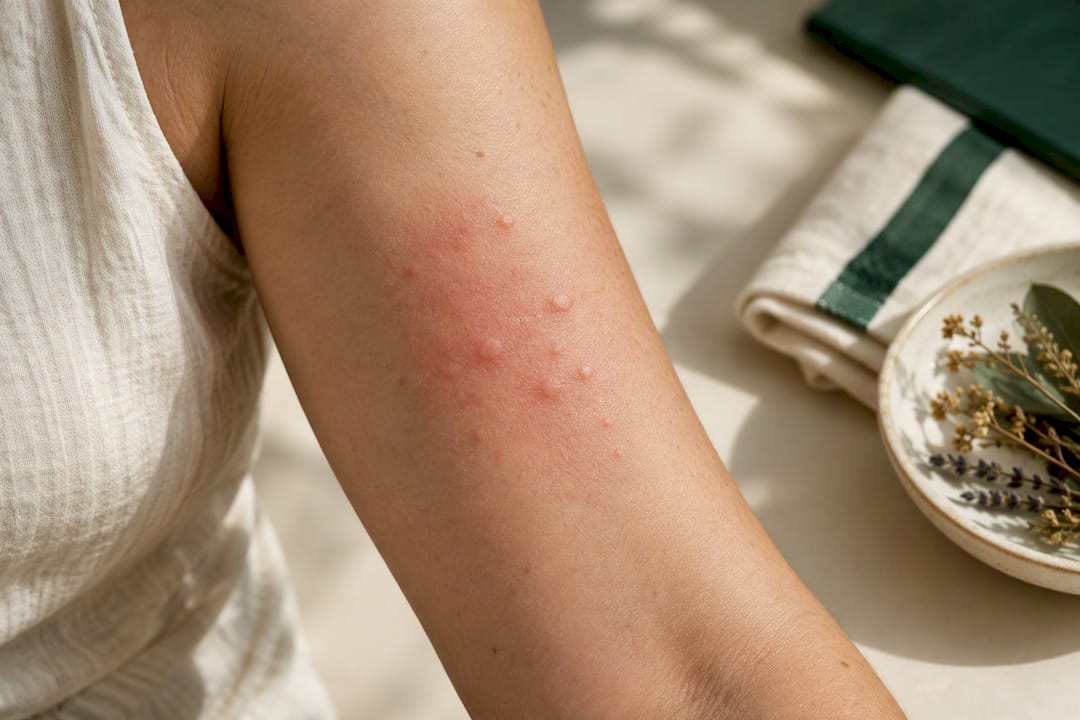
Timing tells you a lot about what kind of reaction you’re dealing with. An immediate reaction, appearing within minutes to an hour, points to an IgE-mediated allergy, the same immune pathway behind classic hive outbreaks and, in rare cases, anaphylaxis. A delayed reaction, showing up 12 to 72 hours later, usually signals allergic contact dermatitis, a T-cell driven response that behaves more like poison ivy than a bee sting.
Here’s what typically happens after you stop using the product:
- Mild redness and itching often fade within 2 to 5 days with no treatment beyond avoidance.
- Antihistamines can calm itching and hives from an immediate-type reaction.
- Topical corticosteroids, used short-term, help resolve eczematous or contact dermatitis patches.
- Blistered or weeping skin may need a dermatologist’s evaluation to rule out secondary infection.
- Symptoms lingering past two weeks warrant a professional look rather than continued home treatment.
Severe systemic reactions are possible but stay uncommon. Serious honey allergy reactions, including throat swelling, difficulty breathing, or fainting, are rare but well documented, and most people who react to honey experience localized skin symptoms rather than a whole-body emergency.
Who Is Most at Risk From Topical Manuka Honey?
Not everyone faces the same odds here. Your personal allergy history matters more than anything else on the label.
- People with a diagnosed bee-sting allergy carry the highest risk, since Manuka products contain trace bee proteins that can cross-react with venom sensitivities.
- Anyone with pollen allergies, especially to plants in the same family as manuka (myrtle/tea tree relatives), should be more cautious than the average user.
- Infants should never have Manuka honey products applied where they could lick or suck on treated skin. Ingesting even small amounts of raw honey carries a botulism risk for children under one, separate from any topical allergy concern.
- People with diabetes or chronic wounds should get clinician input before applying honey-based products to broken or slow-healing skin.
- Anyone with a history of reacting to skincare ingredients in general is a candidate for a formal allergist or dermatologist consult before experimenting.
Formulation matters as much as the honey itself. Sterile, medical-grade honey used in wound-care settings goes through purification steps that a cosmetic body balm simply doesn’t need. A whipped skincare product blends honey with oils, butters, and sometimes preservatives or surfactants, each one a separate variable in whether your skin tolerates it. If you fall into any higher-risk group above, a quick conversation with an allergist beats guessing.
Why Does Manuka Honey Cause Skin Reactions in Some People?
Three separate things can be responsible when skin reacts to a Manuka product, and they’re often confused for one another.
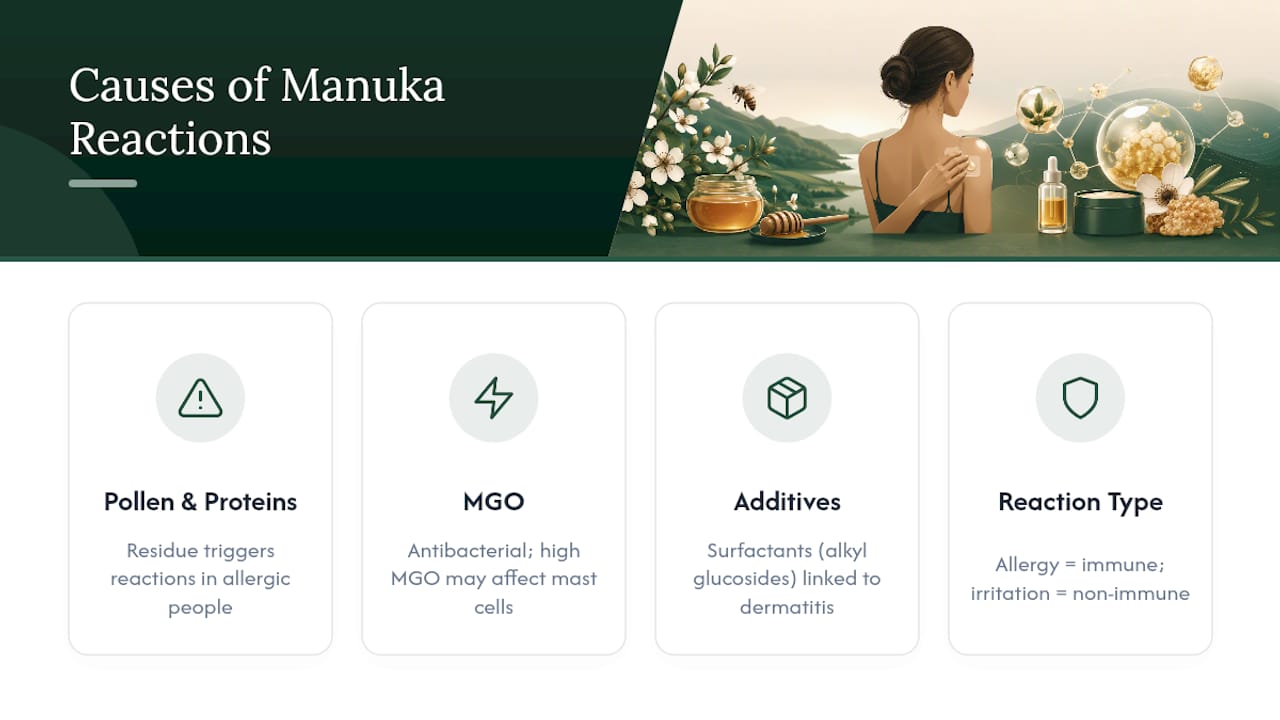
Pollen and trace bee proteins are the classic sensitizing agents. Honey is never fully free of the plant pollen or bee-derived proteins it picked up during production, and for someone with an existing bee-sting or pollen allergy, that residue is enough to set off a reaction.
Methylglyoxal, or MGO, is the compound that gives Manuka honey its antibacterial reputation. Lab research shows MGO has real antibacterial chemistry and may influence mast-cell activity, the cells responsible for releasing histamine during an allergic response. That dual nature is exactly why MGO is interesting scientifically and worth some caution practically. High-MGO products are more concentrated, and concentration can matter for anyone with sensitive or compromised skin.
Then there’s what’s not honey in the jar. Commercial Manuka formulations frequently include surfactants or stabilizers to help the product blend and spread. Case reports have linked allergic contact dermatitis to additives like alkyl glucosides in Manuka-based gels, not the honey itself. That distinction changes what you do next: switching to a simpler formulation with fewer additives, rather than avoiding Manuka honey altogether, often solves the problem.
It also helps to know the difference between a true allergy and simple irritation. Irritant dermatitis happens to almost anyone if a substance is applied too often or too concentrated, with no immune system involved. True allergy involves your immune system recognizing a specific protein or chemical as a threat. Both can look similar on skin, but only one means you should avoid that ingredient permanently.
Pro Tip: If a product irritates you, check the ingredient list for surfactants before writing off Manuka honey entirely. The additive, not the honey, is often the actual culprit.
How to Patch Test a Manuka Honey Product Safely
Patch testing is the practical, near gold-standard method for catching a contact allergy before it becomes a face-wide or body-wide problem. Here’s how to do it right.
- Choose a small, easily monitored site. The inner forearm or behind the ear both work well since you can check them without a mirror.
- Apply a small amount. A pea-sized dab is plenty. More product doesn’t give you better information.
- Leave the area uncovered unless you’re testing a product meant to be worn under clothing or a bandage.
- Wait 24 to 48 hours before judging the result. Immediate reactions show up in minutes; delayed contact allergies can take two full days.
- Check for redness, swelling, itching, or small bumps. Any of these count as a positive result, and you should not proceed to wider use.
- If clear, apply to a slightly larger area for a second 24 hour check before using the product on your face or body more broadly.
Never patch test on broken skin, and never apply to a spot an infant or toddler could reach with their mouth. If a reaction appears, stop immediately, wash the area gently, and avoid re-testing the same product for at least a few weeks, longer if the reaction was significant. Persistent or worsening symptoms deserve a formal patch test panel with a dermatologist rather than repeated home attempts.
Pro Tip: Take a photo of the test site every few hours and jot down the time. A simple photo log gives a dermatologist exactly the timeline they need if you ever need to sort out a delayed reaction.
When Does a Manuka Honey Reaction Become a Medical Emergency?
Most reactions stay local to the skin, but a few signs mean you stop treating this at home and get help immediately.
- Swelling of the lips, tongue, or throat
- Difficulty breathing or a tight feeling in the chest
- Widespread hives covering large areas of the body, not just the application site
- Sudden dizziness, fainting, or a rapid drop in alertness
If you or someone else shows any of these signs, call emergency services right away. Use an epinephrine autoinjector immediately if one is available and prescribed, keep the person lying down with legs slightly elevated, and follow up at an emergency department even if symptoms seem to improve, since biphasic reactions can recur hours later.
Severe honey-related anaphylaxis is genuinely rare, but rare doesn’t mean impossible, and skin-only allergic contact dermatitis, however uncomfortable, is a different category from a systemic emergency. Redness and itching that stay confined to the application site call for the patch-test and discontinuation steps above. Swelling that spreads beyond where you applied the product, or that involves your airway, calls for a phone call to 911, not a wait-and-see approach.
What Does the Research Actually Say About Manuka Honey and Allergies?
The honest answer sits between hype and dismissal. Lab research is genuinely promising, but human clinical evidence remains thin.
- Laboratory work confirms Manuka honey’s antibacterial chemistry and shows it may modulate mast-cell activity, the immune cells at the center of allergic reactions.
- A broader review of honey and allergic disease found encouraging cell and animal-model results, but concluded human clinical evidence for treating allergic conditions is limited and inconsistent.
- Small human tolerability trials exist and generally show honey is well tolerated on sensitive skin, though researchers themselves call for larger, better-controlled trials before drawing conclusions about eczema efficacy.
- Case reports tie some allergic contact dermatitis diagnoses to formulation additives rather than the honey component, reinforcing that ingredient lists matter as much as the headline ingredient.
Lord’s Love Butter has run its own small trials on this front, including a 7-night trial tracking skin response to a Manuka-containing balm, and a 15-patient study on psoriasis-prone skin. Both are small by clinical-trial standards, and neither replaces an independent randomized controlled trial. They’re useful as a transparent look at real-world tolerability, not as proof of therapeutic effect.
Small in-house trials are genuinely useful for product development and for generating hypotheses worth testing further. They are not a substitute for independent, adequately powered randomized controlled trials, and any responsible summary plainly states this.
Memorial Sloan Kettering Cancer Center sums up the current state well: Manuka honey has real, lab-supported antibacterial and wound-related properties, but anyone considering it for an actual medical condition should talk with a physician first. That’s a reasonable line to hold. The mechanisms are plausible. The proof for treating eczema or psoriasis specifically isn’t there yet. Safety precautions aren’t optional in the meantime.
Using Manuka Honey Products if You Have Eczema or Psoriasis
If your skin already has a compromised barrier, a new ingredient carries more weight than it would on unaffected skin. That’s not a reason to avoid Manuka honey outright, but it is a reason to be deliberate.
Talk with your dermatologist before adding anything new to an eczema or psoriasis routine, especially during an active flare. A Manuka-containing balm can work as a complementary moisturizing step, not a replacement for prescribed treatments like topical steroids or biologics.
- Patch test on unaffected skin first, never on an active, cracked, or weeping lesion.
- Choose formulations with a short ingredient list and minimal surfactants or fragrance additives.
- Avoid applying to broken skin unless a clinician has specifically approved it.
- Introduce the product gradually, once every few days at first, rather than switching your whole routine overnight.
Diabetes adds another layer of caution. Impaired healing and reduced skin sensation make it harder to notice early signs of irritation, so a clinician review before regular use is worth the extra step, particularly on the feet or lower legs.
Pro Tip: If tolerated over two weeks with no irritation, most people can fold a Manuka balm into a normal moisturizing routine. Stop immediately and reassess if a flare coincides with starting the product; correlation isn’t proof, but it’s worth investigating.
Why Safety Testing Matters More Than the Marketing
I’ve spent enough time looking at the honey and allergy literature to notice a pattern: the marketing around Manuka honey moves faster than the clinical evidence supporting it. That’s not a knock against the ingredient. It’s a reason to separate what’s plausible from what’s proven, and to build products and guidance around that gap rather than around it.
Some small trials have been run rather than just repeating claims from other brands. Neither study is a substitute for a large randomized controlled trial, and the limitation is stated clearly. What those trials gave was practical: real feedback from real skin, which shaped decisions like keeping the ingredient list short and steering away from the surfactants that show up in contact-dermatitis case reports elsewhere.
Customer feedback has mattered just as much as lab data. When people told which areas of skin reacted and which didn’t, that fed directly into patch-test guidance and the decision to keep formulations simple.
— Michael
Try Manuka Honey the Safe Way, With a Balm Built for Sensitive Skin
Lord’s Love Butter is the alternative to synthetic, chemical-laden moisturizers for anyone who wants Manuka honey’s benefits without guessing at what else is in the jar. The Whipped Beef Tallow Balm with Manuka Honey & Propolis pairs grass-fed tallow with Manuka honey and propolis in a short, recognizable ingredient list, built for whole-body use including sensitive areas prone to eczema and psoriasis flares.
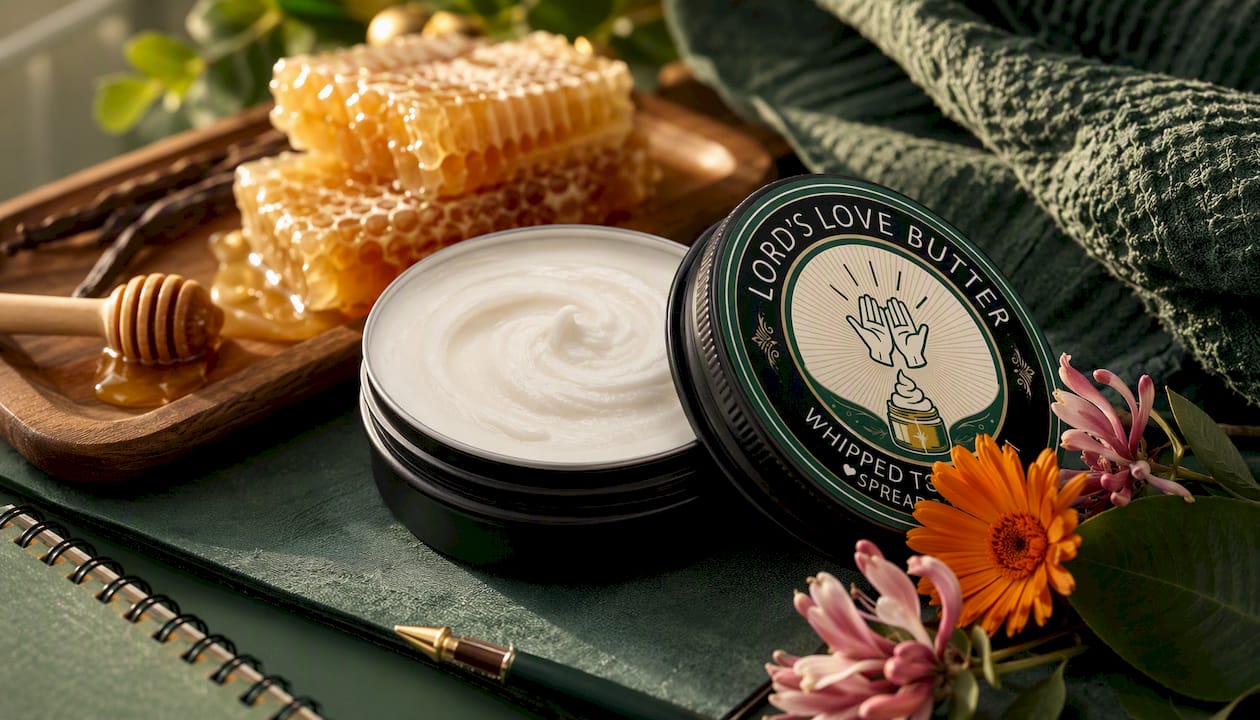
Before using any new balm, including ours, patch test a small area for 24 to 48 hours and skip broken or actively flaring skin unless your clinician has approved it. If you have questions about a specific ingredient, our support team can walk through the formulation with you directly. For anyone who wants to try a Manuka-containing product at low risk before committing to a full-size tin, the full product lineup includes lip balm and zinc sun balm options alongside the tallow balm, all backed by a 30-day money-back guarantee. Start with a small patch test today, and give your skin two days to tell you what it thinks.
Sources
- Manuka honey antibacterial and immune-modulating properties — PMC (2017)
- Allergic contact dermatitis to Medihoney gel — Gulf Coast HCA scholarlycommons
- Manuka honey — Memorial Sloan Kettering Cancer Center
FAQ
Can Manuka honey irritate skin?
Yes, Manuka honey can irritate skin either through a true allergic reaction to bee proteins and pollen or through simple irritant contact dermatitis unrelated to allergy. Additives in commercial formulations, like certain surfactants, are a common cause of irritation that gets mistakenly blamed on the honey itself.
Does Manuka honey have high histamine?
Manuka honey itself isn’t classified as a high-histamine food, but it can trigger histamine release indirectly in people who are already sensitized to bee products or pollen. The reaction comes from your immune system’s response to trace proteins in the honey, not from histamine content in the honey itself.
What are the symptoms of a honey allergy on the skin?
Skin symptoms of a honey allergy typically include redness, itching, hives, and localized swelling, sometimes with eczema-like patches or blistering in more severe cases. Symptoms can appear within minutes for an immediate allergic reaction or take up to 72 hours for delayed allergic contact dermatitis.
How long does a honey allergy last?
A localized skin reaction to honey usually resolves within 2 to 5 days once you stop using the product and treat symptoms with antihistamines or short-term topical steroids. More severe contact dermatitis or blistering can take longer and may need a dermatologist’s care if it hasn’t improved within two weeks.
Is Manuka honey safe for sensitive skin?
Manuka honey is generally well tolerated on sensitive skin when introduced carefully, but it isn’t automatically safe for everyone. People with a bee-sting allergy, pollen sensitivity, or a history of reacting to skincare ingredients should patch test first and consult a clinician before regular use, especially on eczema-prone or broken skin.