

7 Night Trial Shows Manuka Honey Helps Eczema Safely
Manuka honey can calm mild to moderate eczema flare-ups when used as a topical adjunct, largely due to its antibacterial and anti-inflammatory properties, but it works best alongside emollients and prescribed treatment, not instead of them. The strongest human evidence comes from a small 2017 trial showing real improvement over seven nights. Before applying anything, patch test on your inner arm for 48 hours, and if your eczema is moderate to severe, loop in your dermatologist first.
TL;DR:
- Manuka honey shows short-term improvement in eczema severity over seven nights, but larger and longer studies are still needed to confirm its effectiveness.
- Its antibacterial action primarily targets Staphylococcus aureus, which worsens eczema flares, while anti-inflammatory properties help reduce redness and itching.
- Only medical-grade, sterilized Manuka honey formulations are proven suitable, as raw retail honey may contain contaminants and is impractical for larger areas.
- Patch testing is essential before use to avoid allergic reactions, and honey should be avoided on infants under 12 months due to the risk of botulism.
- For practical application, use a thin layer of medical-grade honey after gentle cleansing, leave it on for 20 minutes to overnight, then follow with an emollient.
Table of Contents
- Does Manuka Honey Help Eczema? The Clinical Evidence
- How to Apply Manuka Honey to Eczema Safely
- Manuka Honey Allergy Risks and When to See a Doctor
- Choosing a Manuka Honey Product for Eczema
- How Lordslovebutter Formulates With Manuka Honey
- What I’d Actually Try First, and What I Wouldn’t
- Try Manuka Honey Where the Evidence Actually Points
- Sources
Does Manuka Honey Help Eczema? The Clinical Evidence
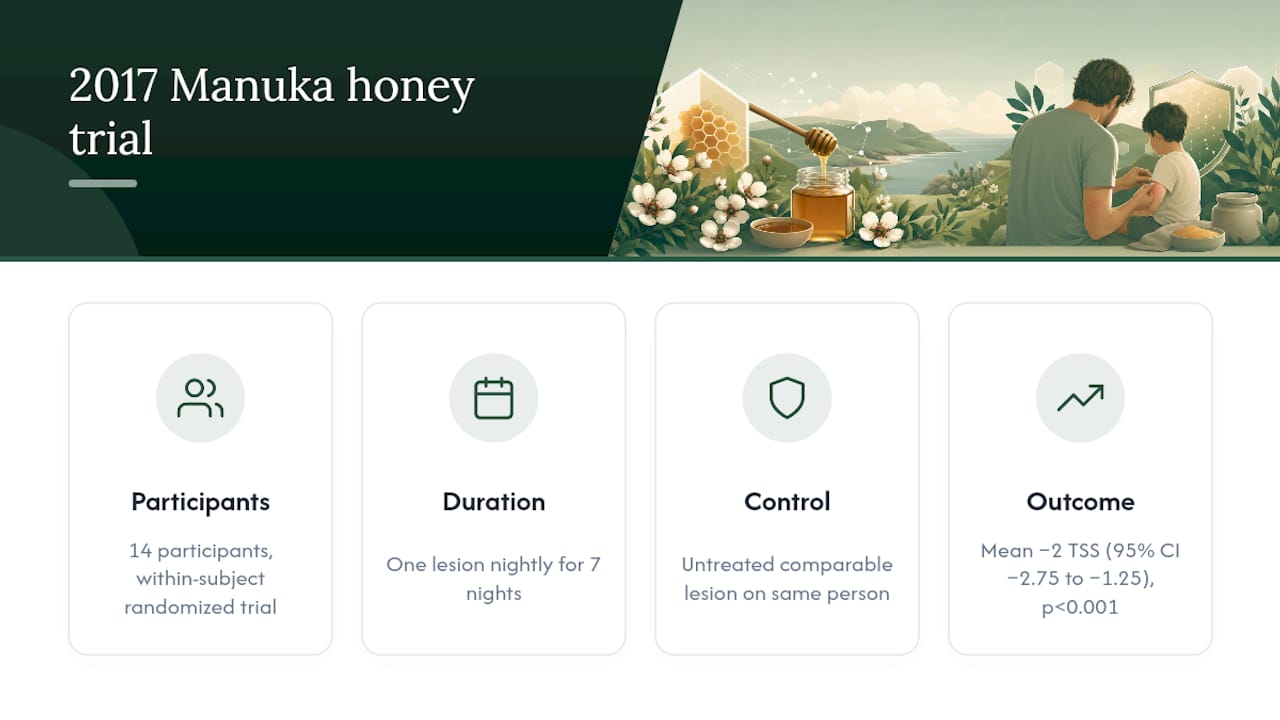
The most-cited human study on Manuka honey and eczema is a 2017 within-subject randomized trial published in Immunity, Inflammation and Disease. Researchers had 14 participants with atopic dermatitis apply medical-grade Manuka honey to one lesion each night for seven nights, while a comparable untreated lesion on the same person served as the control. That within-subject design matters. It cancels out variation between people, since each participant’s treated skin is compared only to their own untreated skin.
The result: lesions treated with Manuka honey showed a mean improvement of about 2 points on the Total Severity Score, compared to the untreated side (95% CI −2.75 to −1.25, p < 0.001). In plain terms, the treated patches got visibly calmer, less red, and less scaly than the untreated ones on the same body.
That is a real signal from a controlled trial, but it is also a small one. A small trial over the course of a week suggests Manuka honey can have a short-term effect. It does not tell you what happens after a month, whether results hold across different eczema severities, or how it performs against a standard topical steroid. Reviews of the wider evidence base describe the research as promising but still thin, with a clear call for larger, longer randomized trials before anyone can call honey a proven eczema therapy.
Why Manuka honey works on skin at all
The mechanism has two parts, and both are backed by lab research rather than guesswork.
- Antibacterial action. Manuka honey’s methylglyoxal content gives it stronger antistaphylococcal activity than most other honey varieties, which matters because Staphylococcus aureus colonizes an estimated 70 to 90 percent of atopic dermatitis lesions and tends to worsen flares.
- Anti-inflammatory effect. Lab studies show honey can inhibit mast cell degranulation, part of the biochemical cascade that drives itching and redness in eczema.
- Emollient function. Honey is humectant. It draws and holds moisture at the skin surface, which helps a compromised barrier hold onto hydration rather than losing it to the air.
Board-certified dermatologists interviewed on the subject describe honey as antibacterial, anti-inflammatory, and emollient in one package, which is unusual. Most topical ingredients do only one of those three jobs.
Statistic to remember: In the 2017 trial, the treated lesions improved by an average of 2 points on a standard severity scale over just seven nights of use, a difference the researchers called statistically significant.
One detail gets lost in most consumer coverage: every trial that produced these results used medical-grade Manuka honey, not the jar from the grocery store aisle. That distinction shapes almost everything about how you should shop and apply it, and it is worth understanding before you try anything on your skin.
Key takeaways from the current evidence:
- A controlled human trial found measurable improvement in eczema severity after seven nights of treatment.
- The antibacterial effect targets Staph aureus, a bacterium strongly associated with worse eczema flares.
- Anti-inflammatory activity in lab studies helps explain reduced redness and itch.
- All positive trial results used medical-grade honey formulations, not raw retail honey.
- Sample sizes remain small, and nobody has published a large, long-duration RCT yet.
If you want a deeper look at how Manuka honey behaves on skin generally, beyond eczema specifically, this breakdown of Manuka honey’s skin benefits covers the broader use cases.
How to Apply Manuka Honey to Eczema Safely
Applying honey to broken or inflamed skin is not the same as slapping moisturizer on your hands. Follow this sequence, and don’t skip step one no matter how mild your eczema looks.
- Patch test first, every time. Apply a small amount of the Manuka product to your inner forearm or inner elbow, then leave it uncovered for 48 to 72 hours. A negative result means no redness, swelling, itching, or bumps at the site. Any of those reactions is a positive result, and it means stop.
- Cleanse the area gently. Use lukewarm water and a fragrance-free cleanser. Pat the skin dry rather than rubbing it, since friction alone can trigger a flare on already-irritated skin.
- Apply a thin layer. You do not need a thick coating. A thin, even layer of medical-grade Manuka honey or a honey-containing ointment covers the lesion without excess mess.
- Give it contact time. The 2017 trial used overnight application, roughly seven to eight hours. If overnight feels impractical for a work day, a minimum contact window of 20 to 30 minutes still allows some antibacterial and moisturizing effect, though the trial’s results were built on longer exposure.
- Rinse gently and follow with an emollient. Warm water, no scrubbing. If your skin feels tight afterward, seal it with a fragrance-free moisturizer or barrier balm.
- Track your response daily for one to two weeks. Note redness, itch intensity, oozing or exudate, and skin texture. Two weeks is a reasonable window to judge whether this is doing anything for your specific skin.
For larger surface areas, raw honey from a jar becomes impractical fast. It’s sticky, it doesn’t spread evenly, and it’s messy to keep on for hours. A formulated Manuka-containing cream or balm is the more workable choice once you’re treating more than a small patch, a point echoed in guidance from MedicalNewsToday’s review of honey for eczema.
On covering versus leaving open: light dressings help on limbs and torso where honey might rub off on clothing or bedding, but facial skin is usually better left uncovered and treated with a lighter, formulated product rather than raw honey, since facial skin tends to be thinner and more reactive.
Pro Tip: If you’re treating a toddler’s eczema, skip raw honey applications on the face and hands entirely, since young children reflexively lick their skin, and topical honey near the mouth raises unnecessary ingestion risk. Stick to formulated creams on limbs and torso, and always run it by your pediatrician first.
If your eczema covers a broad area of your body rather than a few isolated patches, a whole-body approach built around barrier repair tends to work better than spot-treating with raw honey. Practical routines built around tallow balm show what that looks like day to day.
Manuka Honey Allergy Risks and When to See a Doctor
Honey allergy is uncommon but not theoretical. Case reports document rare instances of anaphylaxis following honey exposure, whether topical or ingested. Anaphylaxis from a topical application is rarer still than from eating honey, but it has happened, and it’s the reason patch testing isn’t optional.
If you notice hives spreading beyond the application site, swelling of the lips or face, throat tightness, dizziness, or trouble breathing after applying Manuka honey, stop use immediately and seek emergency care. Those are systemic signs, not a normal skin reaction, and they need to be treated as urgent.
A separate and distinct caution applies to infants. Never feed honey of any kind to a child under 12 months old, due to the risk of infant botulism from Clostridium spores that can be present in honey. Topical application to a baby’s skin carries a far lower theoretical risk of botulism, since the spores need to be ingested and colonize the gut to cause illness, but pediatric guidance still leans toward caution with topical honey on very young or broken skin. When in doubt, ask your pediatrician before using any honey-based product on a child under one.
Statistic to remember: Systemic honey allergy reactions are rare enough that they show up mainly as isolated case reports in the medical literature, not population-level statistics, which is exactly why patch testing before broader use matters so much.
Watch for these red flags, and get medical evaluation if you see any of them:
- Rash or redness spreading well beyond the treated area within hours
- Fever alongside a worsening lesion
- Pus, increasing pain, or warmth at the site, suggesting secondary infection
- Any systemic symptom: facial swelling, difficulty breathing, widespread hives
If a reaction does occur, save the product packaging and note the batch or lot number. That detail helps your clinician and, if needed, lets you report the reaction accurately.
Choosing a Manuka Honey Product for Eczema
Labels on Manuka honey can be confusing, and the terminology matters more than most shoppers realize. Two numbers show up constantly: MGO (methylglyoxal content, a direct measure of antibacterial potency) and UMF (Unique Manuka Factor, a broader New Zealand-based grading and authenticity system). Higher MGO generally correlates with stronger antibacterial activity, but neither number alone tells you whether a product is safe for topical use on broken skin.
That’s where “medical-grade” comes in. Medical-grade Manuka honey is sterilized, typically through irradiation, to eliminate bacterial spores and contaminants that can be present in raw, unprocessed honey. Guidance for wound care patients specifically recommends sterilized, medical-grade honey for any application to disrupted or open skin, precisely because raw retail honey isn’t processed to that standard.
Here’s the practical tradeoff: raw jar honey is cheap and available everywhere, but it’s messy, hard to dose evenly, and not certified for use on open lesions. Medical-grade gels and ointments cost more but come sterile and pre-formulated for skin contact. Formulated creams and balms that incorporate Manuka honey split the difference, offering easier application across larger areas without the raw honey mess.
A short checklist before you buy:
- Look for “medical-grade” or wound-certified language on the label if you’re treating open or weeping lesions.
- Check for a stated MGO or UMF number rather than vague marketing terms like “active” with no figure attached.
- For open skin, prefer sterile or irradiated packaging over a bulk retail jar.
- Factor in how much surface area you’re treating. A tiny jar of medical-grade gel is fine for a patch on your wrist; a whole-body eczema flare calls for a larger, formulated product.
The National Eczema Association lists Manuka honey ointment among recognized product options, which is a reasonable starting point if you want a vetted category rather than guessing from an ingredient list alone.
How Lordslovebutter Formulates With Manuka Honey
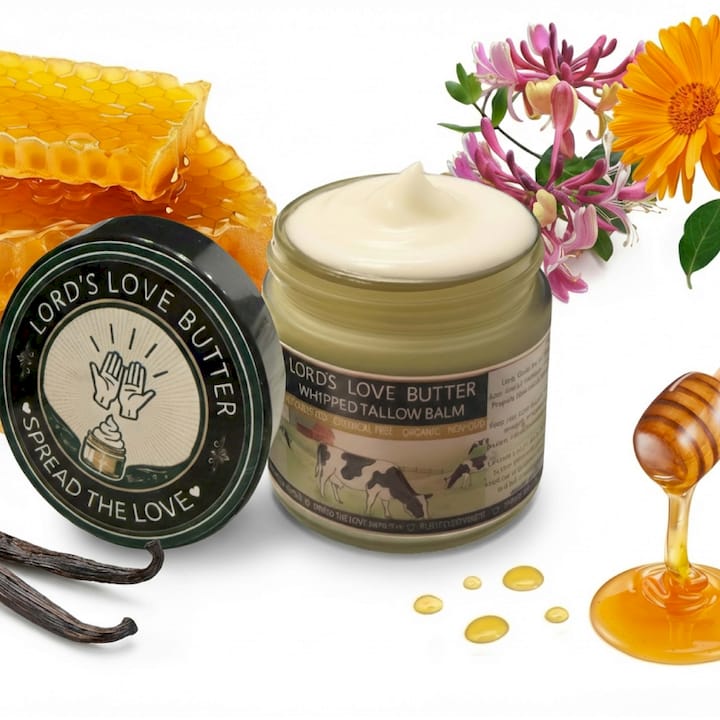
A whipped beef tallow balm blended with Manuka honey can address multiple skin concerns at once. Tallow’s fatty acid profile mimics the lipids naturally found in human skin, which helps rebuild a compromised barrier. Manuka honey adds the antibacterial and anti-inflammatory contribution described in the clinical research above, without synthetic fragrance, dyes, or filler ingredients that commonly irritate eczema-prone skin.
A whipped texture spreads thin and absorbs faster than a dense salve, so it can work across larger body areas without leaving a greasy residue.
What sets the approach apart from spot-treating with raw honey:
- Whole-body use capability for common eczema sites, not just isolated patches.
- Absorbs rather than sitting on the surface.
- Free of synthetic additives such as fragrances or chemical fillers.
Barrier repair and antimicrobial support work better together than either one does alone. A moisturizer that only hydrates, without addressing the bacterial load common in eczema-prone skin, leaves half the problem untouched.
For a closer look at the customer results behind the formulation, this deeper dive into the Manuka honey balm walks through the reasoning in more detail. As with any Manuka product, patch test first, and if you’re managing moderate to severe eczema, run any new topical by your dermatologist before making it part of your routine.
What I’d Actually Try First, and What I Wouldn’t
I’d reach for Manuka honey on a localized, mild-to-moderate patch, an elbow crease or a stubborn spot on the back of the hand, before I’d use it as a strategy for widespread or severe flares. That’s where the trial evidence actually applies, and where the downside of trying it stays small.
A meaningful result looks like less redness and less itch within a week or two, not overnight and not a full disappearance of the lesion. If you see zero change after two weeks of consistent use, that’s useful information too. It tells you this particular ingredient isn’t your answer, and it’s time to talk to a dermatologist about what might work better for your skin specifically.
Write down what you notice, redness, itch, texture, day by day if you can. Vague impressions (“it seems better?”) are the enemy of figuring out whether something actually works for you. And if anything gets worse, spreads, or comes with fever or swelling, stop and call your doctor. That’s not being cautious for its own sake. That’s just how you use an unproven adjunct responsibly.
— Michael
Try Manuka Honey Where the Evidence Actually Points
If the research above convinced you Manuka honey is worth trying but you don’t want to deal with sticky raw honey and guesswork dosing, A whipped beef tallow balm with Manuka Honey offers a formulated option suited for this use case.
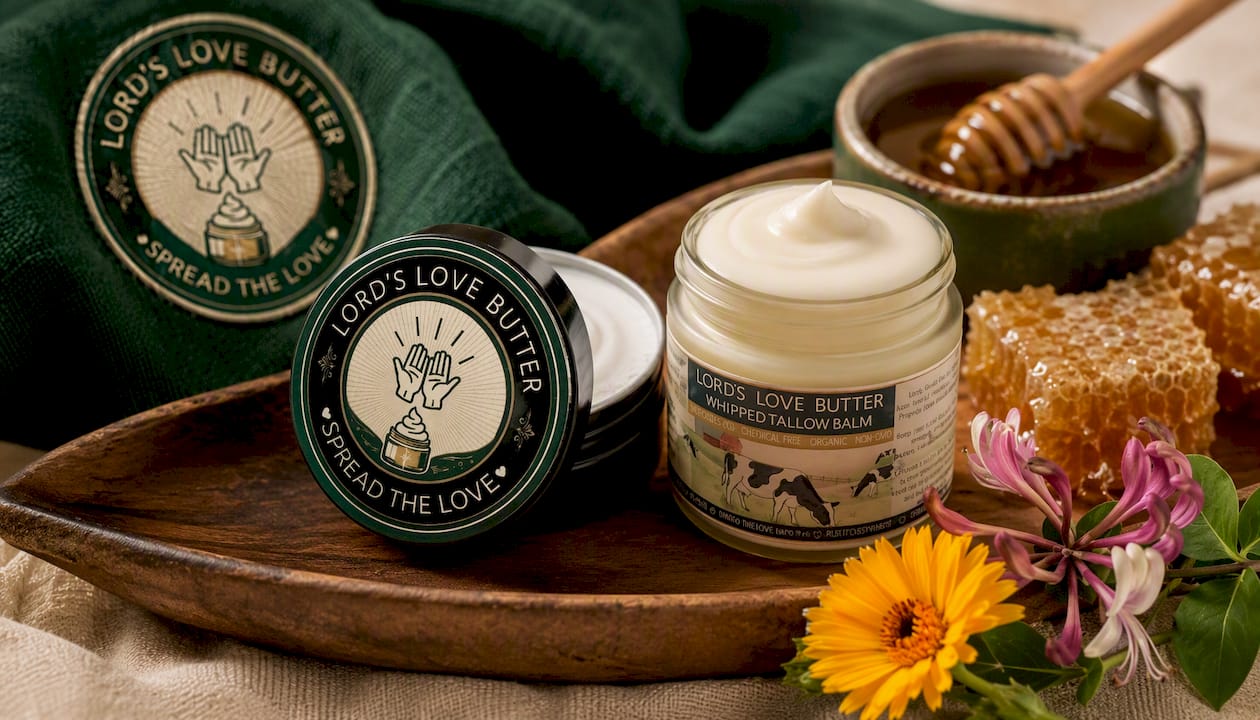
It works as a spot treatment on isolated patches or as a whole-body emollient for widespread dryness, without the greasy film that makes a lot of tallow products hard to live with day to day. Grab the 2.4 oz jar for home use, or the 2.4 oz tin if you want something sturdier for a gym bag or travel kit. Either format gives you the same grass-fed tallow and Manuka honey formulation, free of synthetic fillers.
If your eczema is stubborn enough that a topical alone isn’t cutting it, a professional skin evaluation can help you figure out what’s actually going on. VÉLOURA’s at-home skincare services are worth a look for that kind of hands-on assessment. Whatever you choose, patch test first: apply a small amount to your inner arm, wait 48 hours, and confirm your skin tolerates it before working it into your routine.
This article is general information, not a substitute for advice from a qualified doctor. Consult a qualified healthcare professional about your own circumstances before acting on anything here.
Sources
- Honey is potentially effective in the treatment of atopic dermatitis: Clinical and mechanistic studies
- Can honey soothe eczema? (practical dermatologist guidance)

