
Manuka honey helps some wounds heal faster, but it does not reliably fade or remove existing scars. A randomized control trial found no significant cosmetic improvement in surgical scars after weeks of daily application, and systematic reviews back that up: benefits show up mostly in active wound care, not finished scars. Used early, alongside a formulated option like Lord’s Love Butter’s balm, it’s a reasonable adjunct. It’s not a substitute for silicone and sunscreen, which remain the two things with the strongest track record for minimizing how a scar ultimately looks.
TL;DR:
- Manuka honey speeds up wound healing, especially for burns, but does not significantly improve the cosmetic appearance of mature scars.
- Clinical studies show no meaningful difference in scar quality after months of daily honey application, with most benefits limited to early wound care.
- Effective long-term scar management relies on silicone products and sun protection, not honey, once a scar has fully formed.
- Using medical-grade honey in a formulated balm can support early healing, but raw honey or unsterilized products pose infection risks.
- A 3 to 6 week trial of honey-based balm during the healing phase is recommended, with expectations focused on comfort and environment rather than scar removal.
Table of Contents
- Manuka Honey Scars: What the Clinical Research Actually Shows
- How Manuka Honey Stacks Up Against Proven Scar Treatments
- How to Use Manuka Honey for Wounds and Fresh Scars
- Is Manuka Honey Safe for Every Scar and Skin Type?
- Why a Balm Beats Raw Honey for Everyday Scar Care
- The Bottom Line on Manuka Honey and Scars
- A Realistic Take on Natural Scar Remedies
- Try Lord’s Love Butter’s Manuka Balm During Your Healing Window
- Sources
- FAQ
Manuka Honey Scars: What the Clinical Research Actually Shows
The best evidence on Manuka honey and scars comes from a small but well-designed study, and it’s not the slam dunk that wellness blogs suggest. The 2016 randomized control trial by Thamboo and colleagues tracked 21 patients who had just undergone thyroidectomy, a procedure that leaves a visible neck scar. Half applied Manuka honey paste daily for four weeks; the other half didn’t. Researchers used the Patient and Observer Scar Assessment Scale (POSAS), the standard tool dermatologists use to rate scar color, texture, and thickness. At the follow-up visits a few weeks apart, there was no statistically significant difference between groups. Some patients in the honey group did report better pigmentation, but overall, the scars looked about the same either way.
That single trial doesn’t settle the question on its own. Small sample sizes and mixed compliance (some participants complained about the stickiness making daily application a hassle) limit how far you can extrapolate. But it lines up with the broader pattern in the wound-care literature.
A systematic review of honey as a topical wound treatment found real benefits for certain wound types, particularly partial-thickness burns, where honey dressings sped healing compared to conventional dressings. The catch: evidence quality varies a lot from study to study, and almost none of them measured long-term scar appearance as an endpoint. They measured how fast the wound closed, not how the resulting scar looked six months later. A related meta-analysis on honey and burns reported faster healing in superficial and partial-thickness burns, sometimes by several days compared to other dressings, but flagged the same methodological weaknesses: inconsistent honey types, different application protocols, and small trial sizes.
What the research pattern actually tells you:
- Honey has a real, repeatable effect on wound healing speed, especially for burns.
- That effect does not reliably translate into a better-looking finished scar.
- Most trials measure healing time or bacterial load, not cosmetic outcome, which is the gap most marketing claims quietly skip over.
- Study quality is inconsistent enough that “honey heals wounds” and “honey fades scars” are two very different claims with two very different levels of support.
Animal research fills in some of the biological reasoning. A porcine model study found that Manuka-treated burn wounds showed increased collagen density, reduced inflammatory cell activity, and faster re-epithelialization compared to untreated wounds. That’s a plausible mechanism for why honey might, in theory, produce a better-organized scar. It is not proof that the same thing happens reliably in human skin, where genetics, wound depth, and tension all complicate the picture.
Statistic worth sitting with: In the Thamboo trial, honey-treated patients showed no measurable improvement in scar assessment over controls at follow-up checks a few weeks apart, despite daily application. If a controlled clinical setting couldn’t produce a clear cosmetic win, that’s a useful reality check before assuming a jar of honey will erase a scar at home.
A separate meta-analysis on honey in obstetric wound care adds a useful wrinkle: across five trials and 353 patients, honey didn’t change final wound-healing outcomes, but it did reduce pain during treatment and lowered how much pain medication people needed. That’s a legitimate benefit, just not the one most people are searching for when they type “manuka honey scars” into Google.
How Manuka Honey Stacks Up Against Proven Scar Treatments
Scar management splits into two very different phases, and where honey fits depends entirely on which phase you’re in. During active wound healing, before the skin has closed, keeping the area moist and reducing bacterial load genuinely matters. Once a scar has matured and closed, you’re no longer managing a wound. You’re managing tissue that has already remodeled, and topical anything has a much smaller window to make a visible difference.
For the active healing phase, Manuka honey has a reasonable case: it can support a moist wound environment and has documented antibacterial activity, which matters for reducing infection risk that would otherwise worsen scarring. This is where a formulated balm has a practical edge over raw honey straight from the jar, since it applies without pooling or dripping onto clothing and bedding.
For mature, already-closed scars, the American Academy of Dermatology points to a different toolkit entirely, one with stronger and more consistent clinical backing:
- Silicone gel or sheets, worn consistently for weeks to months, remain the most evidence-supported at-home scar treatment.
- Daily broad-spectrum SPF 30+ sunscreen on healing or healed scars prevents the dark, permanent discoloration that UV exposure locks in.
- Keeping the wound moist early on to prevent scab formation, since scabbing tends to produce rougher, more visible scarring later.
- Avoiding tension on the healing site, which flattens and widens scars over time if ignored.
For scars that have been mature for months or years and still bother you cosmetically, topical products of any kind, honey included, have limited reach. That’s the territory for professional intervention: laser resurfacing, intralesional steroid injections, or microneedling, all administered by a dermatologist. If you’re weighing adjunct professional options beyond topicals, red light therapy is one that comes up often for scars that have stopped responding to creams and gels.
The practical takeaway: use Manuka honey, or a Manuka-based balm, during the early healing window to support a clean, moist recovery. Lean on silicone and sun protection as your actual long-term scar-prevention strategy, because that’s where the clinical evidence is strongest.
How to Use Manuka Honey for Wounds and Fresh Scars
Before anything else: honey belongs on clean, healing skin, not on deep, dirty, or actively infected wounds. If a wound is gaping, pus-filled, or the result of a serious injury, see a clinician first. Manuka honey is not a substitute for stitches, wound irrigation, or antibiotics when those are actually needed.
For everyday scrapes, minor surgical incisions once your doctor clears topical care, or closed wounds in the early scarring phase, here’s a regimen grounded in how the clinical trials actually applied it:
- Cleanse the area gently with mild soap and water, then pat dry. Don’t scrub.
- Apply a thin layer of medical-grade Manuka honey or a formulated balm containing it. A thin, even coat works better than piling it on.
- Cover if needed. On open wounds, a sterile non-stick dressing over the honey keeps it in place and protects against contamination. On closed scars, a balm can usually go on bare, since there’s no wound to protect.
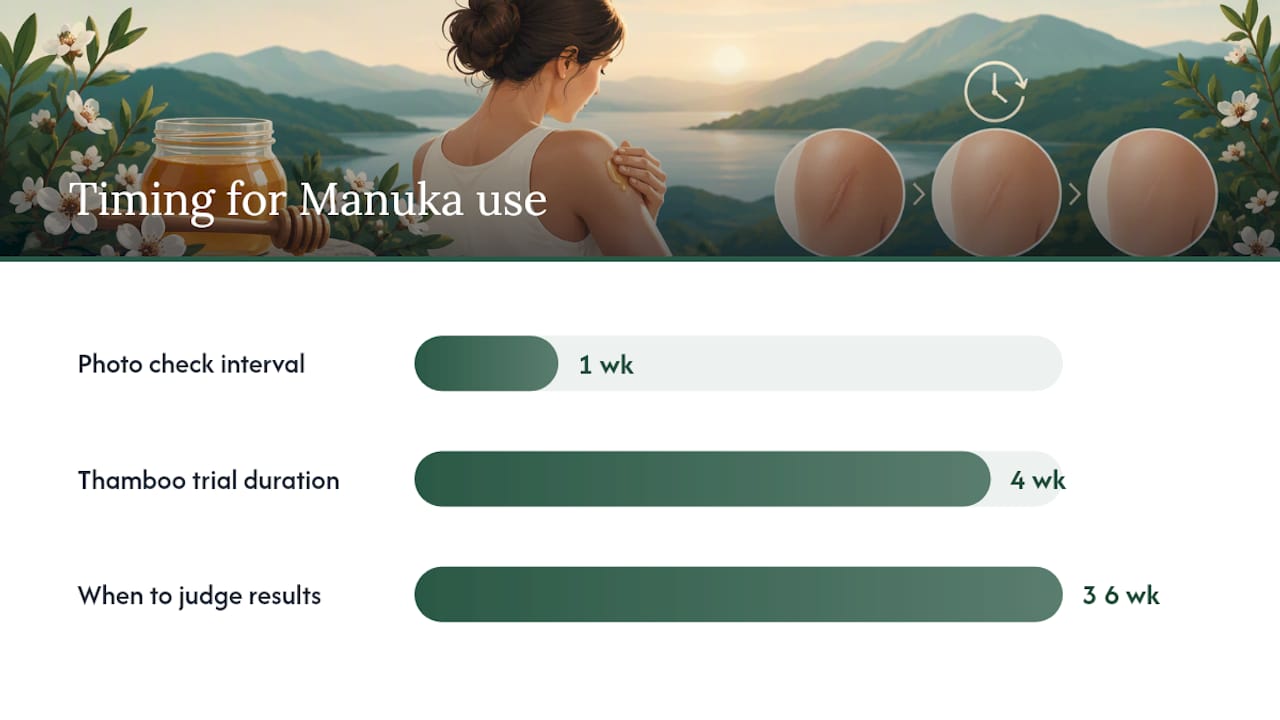
- Reapply daily, matching the frequency used in the Thamboo trial, where once-daily application for four weeks was the protocol.
- Give it 3 to 6 weeks before judging results. Skin remodeling is slow, and shorter trials rarely show anything measurable.
Look for language like “medical-grade” or a stated UMF (Unique Manuka Factor) or MGO (methylglyoxal) rating on the label. These numbers indicate standardized antibacterial potency, the same kind of quality control that separates a clinical-grade product from a jar picked up at the grocery store.
A few practical tips make this easier to stick with:
- Use a balm format instead of raw honey if stickiness is your main objection. Loose honey tends to migrate onto sheets and clothing, which is exactly the compliance problem researchers flagged in clinical trials.
- Apply at night if you’re using raw honey on an area that clothing might rub against during the day.
- Use a snug, breathable dressing over open wounds to hold the honey in place without smothering the skin.
Pro Tip: Take a photo of the area once a week, same lighting, same angle, before you start and throughout the 3 to 6 week trial window. Scar color and texture change so gradually that memory alone will trick you into thinking nothing’s happening, even when it is (or isn’t).
Is Manuka Honey Safe for Every Scar and Skin Type?
Not all honey belongs on skin, and that distinction matters more than most product pages let on. Medical-grade honey is gamma-sterilized and standardized for consistent antibacterial activity, which is why it’s used in clinical wound-care products. Pantry honey, even a jar labeled Manuka, hasn’t gone through that process and isn’t validated for use on open wounds. Using unsterilized honey on broken skin introduces a real infection risk, since raw honey can carry contaminants that a healing wound doesn’t need.
Watch for these safety issues:
- Allergic reactions. Honey is a bee product, and people with bee or pollen allergies can react to topical application with redness, swelling, or itching.
- Debris trapping. Raw honey’s thickness can trap dirt or dead skin against the wound, which occasionally increases irritation instead of reducing it.
- Discomfort during treatment. Some trial participants reported the honey stung or felt uncomfortable during the first few applications, even without a true allergy.
- Unrealistic expectations for old scars. A mature scar that’s been static for a year is not going to meaningfully change from six weeks of topical anything, honey included.
Statistic worth remembering: in the obstetric wound care meta-analysis covering 353 patients, honey didn’t move the needle on final healing outcomes, but it did meaningfully reduce mid-treatment pain and cut down on pain medication use. That’s the kind of benefit honey reliably delivers: comfort and support during healing, not a cosmetic transformation.
See a clinician if you notice spreading redness, increasing pain instead of gradual improvement, fever, or a wound that hasn’t progressed toward closure within the timeline your doctor expects. Those are signs of infection or a healing problem that a jar of honey, medical-grade or otherwise, won’t fix. A wound-care specialist, like the guidance outlined by Stride Foot & Ankle, can also help if a wound is in a high-friction area like the foot, where standard dressings often fail.
Why a Balm Beats Raw Honey for Everyday Scar Care
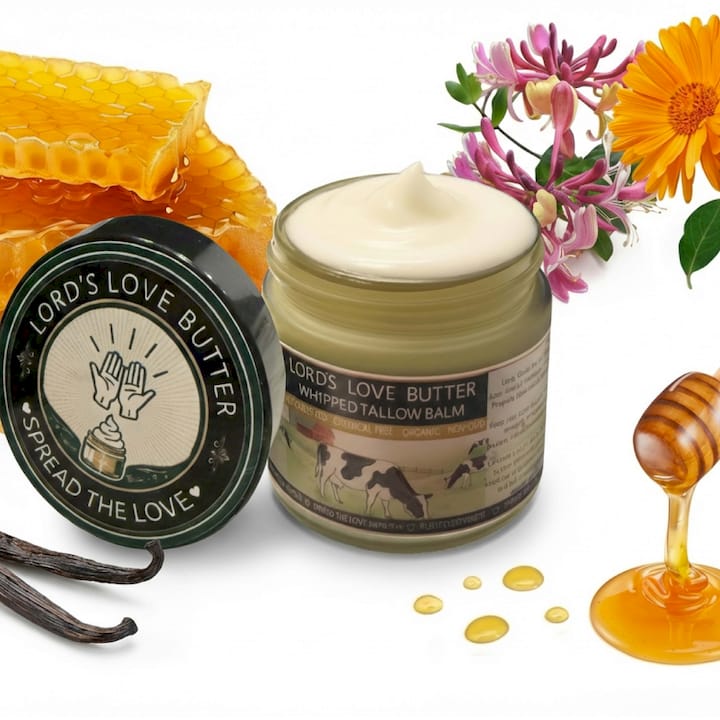
Whipped beef tallow balm with Manuka honey and propolis is formulated to offer a less messy alternative to raw honey for daily use. It drips, it pools, it gets on fabric, and it doesn’t stay where you put it.
Whipped tallow creates a semi-occlusive barrier that holds Manuka honey against the skin without the mess of applying it straight from the jar. That barrier effect also supports the skin’s own moisture retention during the healing window, which matters more than most people realize when a wound or fresh scar is trying to close cleanly.
What the formulation is built to do:
- Deliver Manuka honey and propolis in a form that stays put on the skin instead of running.
- Provide the kind of steady hydration and barrier support that helps skin, including sensitive or reactive skin, recover its texture.
- Skip synthetic fillers and fragrances that can irritate healing or compromised skin.
- Work across the whole body rather than being formulated for one narrow use case.
To be direct about it: this is a topical support product, not a clinically tested scar-removal treatment. No independent trial has tested this specific balm’s effect on scar aesthetics, and none of the claims here should be read as a substitute for the RCT and review data covered earlier. If you want more on how the combination of tallow and Manuka behaves on skin, Lord’s Love Butter’s own breakdown of the pairing covers the formulation in more depth, and the piece on using tallow for healed scars addresses the mature-scar side of things specifically.
The Bottom Line on Manuka Honey and Scars
If you’re dealing with a fresh wound or a scar still in its early healing weeks, Manuka honey, preferably medical-grade or in a formulated balm, is a reasonable adjunct. Expect it to support comfort and a clean healing environment. Don’t expect it to erase a scar that’s already fully formed. Silicone gel and daily sunscreen still carry the strongest evidence for shaping how a scar ultimately looks, and they should stay your primary strategy, not honey.
Give any regimen 3 to 6 weeks before judging it, and take weekly photos so you’re comparing real progress instead of guesswork. Patch-test first if you have any bee product sensitivity, and stick to medical-grade or properly formulated products on skin that’s still healing. If a scar isn’t improving after a couple of months of consistent care, or if a wound looks infected at any point, that’s a dermatologist visit, not a longer honey trial.
A Realistic Take on Natural Scar Remedies
Natural remedies get oversold constantly, and Manuka honey is a repeat offender in wellness marketing that stretches a real, narrow finding (faster burn healing) into a broad claim (fades all scars) the data doesn’t support. That gap is worth naming plainly instead of dancing around it.
The honest position sits in the middle. Manuka honey has a genuine mechanism and real clinical support for wound healing and comfort, and dismissing it entirely would ignore actual evidence. But treating it as a scar eraser ignores the same evidence just as badly. The smartest approach pairs a sound wound-care routine, moisture, sun protection, and patience, with products like honey used for what they’re actually good at. Save the dermatologist visit for scars that genuinely need more than a topical can offer.
— Michael
Try Lord’s Love Butter’s Manuka Balm During Your Healing Window
Raw honey works, but it’s messy enough that most people quit before the 3 to 6 week window even matters. Lord’s Love Butter solves the compliance problem the clinical trials kept running into: a whipped beef tallow balm with Manuka honey and propolis that goes on clean, stays put, and supports skin barrier repair without the sticky residue that made trial participants abandon raw honey applications.
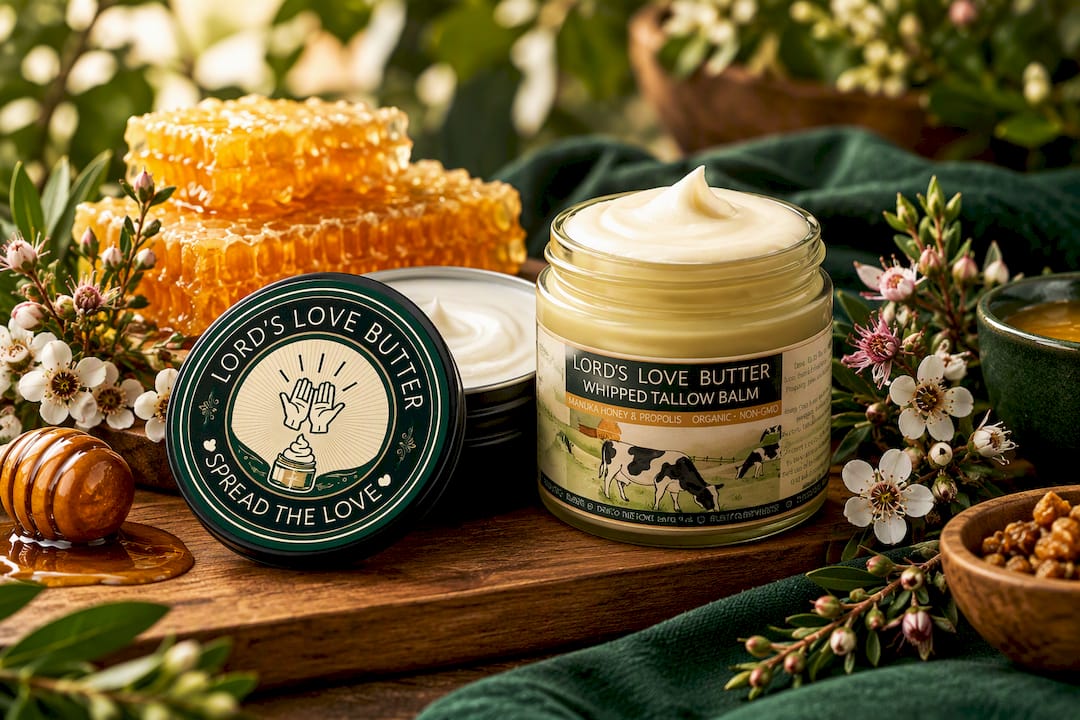
The 2.4 oz jar and 2.4 oz tin both deliver the same formulation. Choose the tin if you want something more travel-friendly, the jar if you prefer scooping straight from a wider opening. Neither is a guaranteed scar remover, and no formulated balm should be sold as one. What it offers is a practical, less-mess way to support hydration and barrier repair during active healing, gentle enough for sensitive skin and suited to whole-body use, not just one scar site. If you’re curious how it performs alongside other skin concerns, the full product lineup includes options worth exploring. Try it for a full 3 to 6 week cycle on a fresh scar or healing area.
Sources
- Objective and subjective scar aesthetics with topical Manuka honey post-thyroidectomy: A randomized control study
- Honey in the treatment of burns: a systematic review and meta-analysis of its efficacy
- Manuka honey: medicinal uses (WebMD)
FAQ
How long does honey take to remove scars?
Honey doesn’t reliably remove scars at all. In the Thamboo trial, four weeks of daily application produced no significant cosmetic improvement at either the 4 or 8 week check. Give any regimen 3 to 6 weeks to judge realistically, but expect support for healing comfort more than a visible scar disappearance.
What is best for healing old scars?
For scars that are already mature and closed, topical products including honey have limited effect, since the tissue has finished remodeling. Professional options like laser resurfacing or steroid injections tend to produce more noticeable change, while silicone and consistent sun protection remain the strongest at-home approach for scars still in an earlier phase.
Does Manuka honey really heal wounds?
Yes, with real support behind it. Reviews show honey dressings speed healing in partial-thickness burns and some acute wounds compared to conventional dressings, and it also reduced pain during treatment in an obstetric wound care meta-analysis covering 353 patients. It helps wounds heal; it just doesn’t reliably improve how the resulting scar looks.
Is there a downside to manuka honey?
The main risks are using unsterilized pantry honey on open wounds, which carries infection risk, and bee product allergies in sensitive individuals. Raw honey can also trap debris and feels sticky enough that many people abandon daily use, which is part of why a formulated balm tends to work better for consistent application.
Does Lord’s Love Butter’s balm treat scars?
This Manuka honey balm supports hydration and barrier repair during healing; it is not marketed or clinically tested as a scar-removal treatment. It’s best used as a practical, less-mess adjunct during the early healing window, alongside silicone and sun protection for long-term scar appearance.