
Minimizing your skincare product ingredient list means choosing products where every ingredient earns its place, with no fillers, no redundant actives, and no unnecessary additives that raise your irritation risk. The industry term for this practice is “skinimalism,” a mindset built on trust in tailored key ingredients rather than chasing marketing trends. For anyone with sensitive skin, eczema, psoriasis, or just a drawer full of products that aren’t working, this approach cuts through the noise. Tools like INCIDecoder and EWG Skin Deep give you the power to decode any label in minutes, and the science behind ingredient order makes the process far more straightforward than most brands want you to believe.
How to minimize your skincare product ingredient list
Reading a skincare label is a skill, and once you have it, you stop falling for marketing claims. The first 5–7 ingredients on any product make up the majority of the formula by weight. Those top positions reveal the product’s real purpose and its most likely irritants.

What the top positions tell you
The base of most skincare products is water or a similar delivery system, sitting at position one. Positions 2–5 hold the primary actives and moisturizers that define what the product actually does. If glycerin, niacinamide, or ceramides appear in the top five, the product is genuinely built around those ingredients. If they appear near the bottom, they are likely present in amounts too small to matter.
The 1% rule and what it means for you
Ingredients below 1% concentration can be listed in any order by law. This means preservatives, fragrances, and trace botanical extracts can appear anywhere after the midpoint of the list. A product with 30 ingredients may have 20 of them present in near-invisible amounts. That long list is not a sign of a better product. It is often a sign of marketing padding.
Pro Tip: Use INCIDecoder to paste any ingredient list and instantly see each ingredient’s function, concentration estimate, and safety rating. It takes under two minutes and removes all guesswork.
Common ingredient roles to recognize
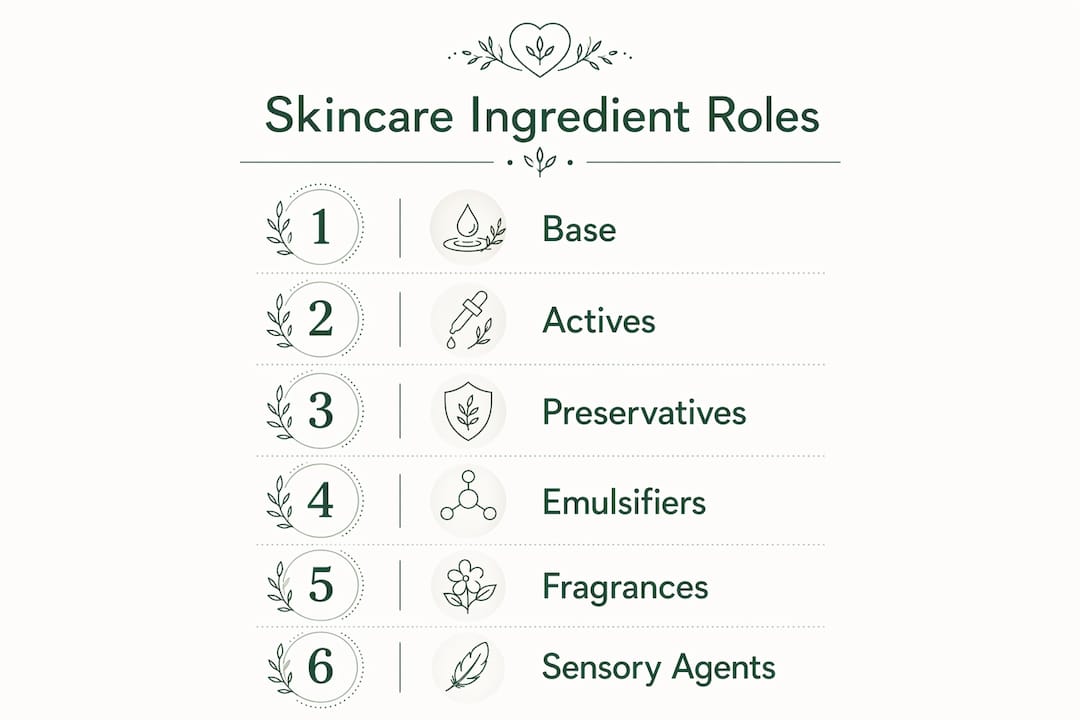
Understanding what each ingredient category does helps you spot redundancy fast:
- Base or solvent: Water, aloe vera juice, rose water. These make up the bulk of most formulas.
- Actives: Retinol, vitamin C, niacinamide, hyaluronic acid. These drive results.
- Emollients and occlusives: Shea butter, jojoba oil, beeswax, tallow. These seal moisture in.
- Preservatives: Phenoxyethanol, ethylhexylglycerin. These prevent microbial growth.
- Fragrance: Listed as “fragrance,” “parfum,” or individual essential oils. These are the most common irritants for sensitive skin.
Many long ingredient names are standard scientific nomenclature and do not indicate harmful chemicals. “Tocopherol” is vitamin E. “Ascorbic acid” is vitamin C. Recognizing these naming conventions stops unnecessary product avoidance.
What are the best ingredients for a minimalist routine?
A minimalist routine for sensitive or condition-prone skin requires only 3–4 core products. Experts recommend a gentle cleanser, a barrier-supporting moisturizer, broad-spectrum SPF 30–50, and optionally one evidence-backed active. That structure covers every skin need without stacking risks.
Here is how to build that routine with intention:
-
Gentle cleanser with appropriate pH. Choose a fragrance-free, sulfate-free cleanser with a pH between 4.5 and 5.5. Brands like CeraVe Hydrating Cleanser and Vanicream Gentle Facial Cleanser keep ingredient lists short and avoid known irritants.
-
Moisturizer with barrier-supporting ingredients. Look for ceramides, niacinamide, and fatty acids in the top half of the ingredient list. These ingredients repair the skin barrier rather than just sitting on top of it. Natural alternatives like grass-fed beef tallow provide fatty acids that closely match the skin’s own lipid profile, making them particularly effective for sensitive skin conditions.
-
Broad-spectrum SPF 30–50 sunscreen. This is non-negotiable for skin health and anti-aging. Mineral sunscreens with zinc oxide or titanium dioxide tend to have shorter ingredient lists and cause less irritation than chemical filters.
-
One optional active, used with care. Retinoids and vitamin C are the two most evidence-backed actives available. Use one at a time, not both simultaneously.
-
An 8–12 week reset if your skin is irritated. Dropping all actives for 8–12 weeks and using only a cleanser, moisturizer, and SPF restores the skin barrier and gives you a clean baseline. This reset period is the fastest way to identify which products were causing problems.
Pro Tip: When your skin is reacting, resist the urge to add more products. Adding a calming serum on top of an irritated barrier often makes things worse. Subtract first, then reintroduce one product at a time.
How do you simplify your skincare routine step by step?
Simplifying a routine is not about throwing everything away. It is about auditing what you have and keeping only what serves a clear purpose. Decision fatigue is real with complex 10-step routines, and lower adherence means worse skin results regardless of how good the products are.
Follow this process:
- Lay out every product you currently use. List each one and write down its stated purpose.
- Identify overlapping functions. If you use two serums that both contain hyaluronic acid, you are doubling up without benefit.
- Check for active ingredient conflicts. Stacking vitamin C, retinol, AHAs, BHAs, and niacinamide in the same routine can trigger barrier emergencies. Pick one active per routine cycle.
- Choose multi-functional products. A moisturizer with ceramides, niacinamide, and hyaluronic acid replaces three separate serums. Fewer products mean fewer ingredient interactions and a shorter list to manage.
- Phase out complex products gradually. Do not stop everything at once. Swap one product per week for a simpler alternative so your skin adjusts without shock.
Once your barrier is stable, reintroduce a single active and observe your skin for four weeks before adding anything else. This slow reintroduction is the only reliable way to know what is actually working. Building healthy skin habits around this rhythm produces consistent results over time.
Minimalist formulas vs. complex, marketing-driven products
The difference between a minimalist formula and a marketing-driven one shows up clearly in the ingredient list. Every added ingredient introduces a unique risk of skin irritation and incompatibility. A product with 40 ingredients is not four times better than one with 10. It is four times more likely to contain something your skin objects to.
| Product Type | Typical Ingredient Count | Key Characteristics |
|---|---|---|
| Minimalist moisturizer | 5–12 ingredients | Functional actives in top positions, no fragrance, clear purpose |
| Marketing-driven serum | 25–45 ingredients | Many botanical extracts below 1%, fragrance, hero ingredient buried low |
| Natural balm (e.g., tallow-based) | 3–6 ingredients | Whole-food fats, no synthetic preservatives, occlusive barrier support |
| Standard drugstore lotion | 15–30 ingredients | Water base, emulsifiers, fragrance, multiple preservatives |
Marketing-driven products often feature a “hero ingredient” prominently on the packaging while burying it near the bottom of the actual list. A product that advertises retinol but lists it as ingredient 28 of 30 contains retinol in amounts that will not produce results. Effective minimalist routines depend on formulation quality and concentration, not the number of ingredients on the label.
Pro Tip: When comparing two products, ignore the front of the package entirely. Flip to the ingredient list and find the active ingredient you care about. If it appears after the midpoint of the list, the product is not built around that ingredient.
Understanding emulsifier roles in formulations also helps you recognize when a long ingredient list is mostly structural chemistry rather than active benefit. Many of those extra ingredients exist to keep the formula stable, not to help your skin.
Key takeaways
Simpler ingredient lists reduce irritation risk, improve routine adherence, and make it easier to identify what your skin actually needs.
| Point | Details |
|---|---|
| Read the top 5–7 ingredients | These make up the majority of the formula and reveal the product’s true purpose. |
| Apply the 1% rule | Ingredients after the midpoint may be present in trace amounts and offer little benefit. |
| Build a 3–4 product core routine | Cleanser, moisturizer, SPF, and one optional active cover every skin need. |
| Avoid stacking actives | Use one active at a time to protect the skin barrier and identify what works. |
| Reset for 8–12 weeks when irritated | Strip back to basics to restore the barrier before reintroducing any actives. |
Why i think most skincare routines are working against you
I have watched people with genuinely healthy skin develop chronic sensitivity after adopting elaborate routines. The pattern is consistent. They add a new serum, their skin reacts, they add a calming product to fix the reaction, and then they add another product to fix what the calming product disrupted. Within six months, they are using 12 products and their skin is worse than when they started.
The skincare industry profits from complexity. Every new product category creates a new purchase. But skin is not a chemistry experiment that rewards more inputs. It is a barrier system that rewards consistency and restraint.
What I have found actually works is boring by marketing standards. A short ingredient list, a product that does one or two things well, and the patience to use it for at least eight weeks before judging results. Sensitive skin especially responds to this approach because you remove variables rather than adding them.
The most underrated move in skincare is subtraction. Before you buy anything new, ask what you can remove. Your skin will tell you what it needs if you stop overwhelming it with signals.
— Michael
A one-ingredient solution worth knowing about
If you want to experience what a truly minimal ingredient list feels like on your skin, Lordslovebutter makes it straightforward.

The Whipped Beef Tallow Balm with Manuka Honey from Lordslovebutter contains grass-fed beef tallow and Manuka honey. That is it. No synthetic preservatives, no fragrance, no emulsifiers, no fillers. Tallow’s fatty acid profile closely mirrors the skin’s natural lipids, which is why customers with eczema and psoriasis report visible improvement within days. It works as a whole-body moisturizer without a greasy finish, making it one of the most practical minimalist skincare products available today. Lordslovebutter is a veteran-owned business, and that personal accountability shows up in every ingredient decision they make.
FAQ
What does it mean to minimize a skincare ingredient list?
Minimizing a skincare ingredient list means choosing products where every ingredient serves a clear function, with no fillers, redundant actives, or unnecessary additives. The goal is fewer ingredients with higher purpose, not fewer products overall.
Which ingredients are truly essential for sensitive skin?
The core essentials for sensitive skin are a fragrance-free cleanser, a moisturizer with ceramides or fatty acids, and a mineral SPF 30–50. Everything else is optional and should be introduced one at a time.
How do i know if an ingredient is present in a meaningful amount?
If an ingredient appears in the first half of the list, it is likely present above 1% concentration and contributes real benefit. Ingredients listed after the midpoint may be present in trace amounts and offer limited effect.
Is a shorter ingredient list always better?
A shorter list reduces the risk of irritation and makes it easier to identify problem ingredients. However, formulation quality matters more than count. A well-formulated product with 15 purposeful ingredients outperforms a poorly formulated one with 5.
How long does a skin reset take after simplifying my routine?
An 8–12 week reset using only a gentle cleanser, moisturizer, and SPF gives the skin barrier enough time to repair and stabilize. After that period, you can reintroduce one active at a time and accurately assess its effect.