

What Are Emulsifiers in Skincare: A Clear Guide
Emulsifiers in skincare are amphiphilic molecules that bind oil and water together, making creams, lotions, and serums physically possible. Without them, your moisturizer would split into a greasy layer floating on top of water within hours. These ingredients are the reason your daily face cream spreads evenly, absorbs smoothly, and stays stable on the shelf for months. Understanding what emulsifiers do gives you a sharper lens for reading ingredient labels and choosing products that actually perform for your skin type.
What are emulsifiers in skincare and why do they matter?
Emulsifiers are defined as ingredients that stabilize oil and water mixtures by positioning themselves at the interface between the two phases. This matters because oil and water are chemically incompatible. Left alone, they separate. An emulsifier prevents that by forming a protective barrier around each tiny droplet, keeping the mixture uniform over time.
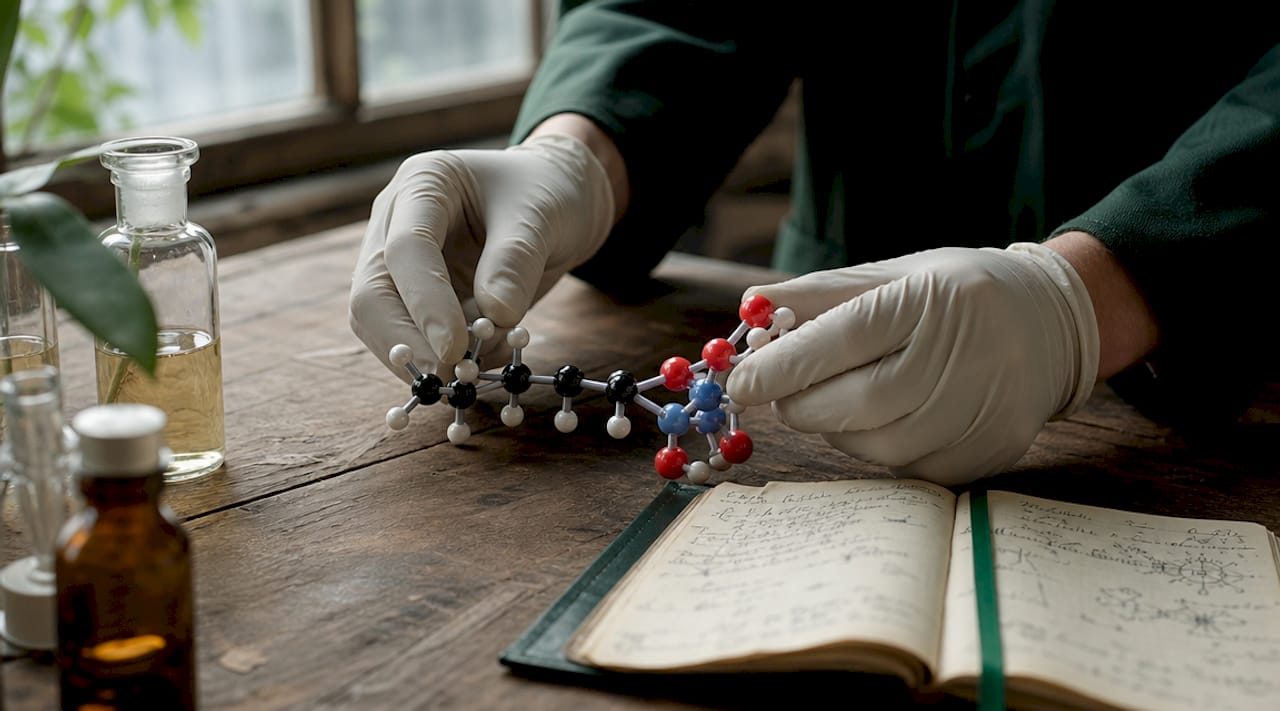
The amphiphilic structure is what makes this possible. Every emulsifier molecule has two distinct ends: a hydrophilic head that attracts water and a lipophilic tail that attracts oil. The molecule essentially acts as a molecular handshake between two phases that would otherwise refuse to mix. This structural property is the foundation of every cream, lotion, and milk you have ever applied to your skin.
The practical stakes are high. Without the right emulsifier, formulas containing oil and water separate into layers, producing unstable, unusable products. Emulsifiers are not optional additives. They are structural ingredients that determine whether a product holds together at all.
How do emulsifiers work at the molecular level?
The mechanism begins the moment oil and water are combined during manufacturing. Emulsifier molecules migrate to the oil-water interface and orient themselves with their water-loving heads facing the water phase and their oil-loving tails facing the oil phase. This orientation reduces surface tension between the two phases, which is the primary force driving separation.
Once positioned, emulsifiers form an interfacial film around each oil droplet suspended in water, or around each water droplet suspended in oil. Emulsion stability depends on droplet size distribution and the strength of this interfacial film. When the film is weak or the emulsifier concentration is insufficient, droplets collide and merge, a process called coalescence, which leads to visible separation.
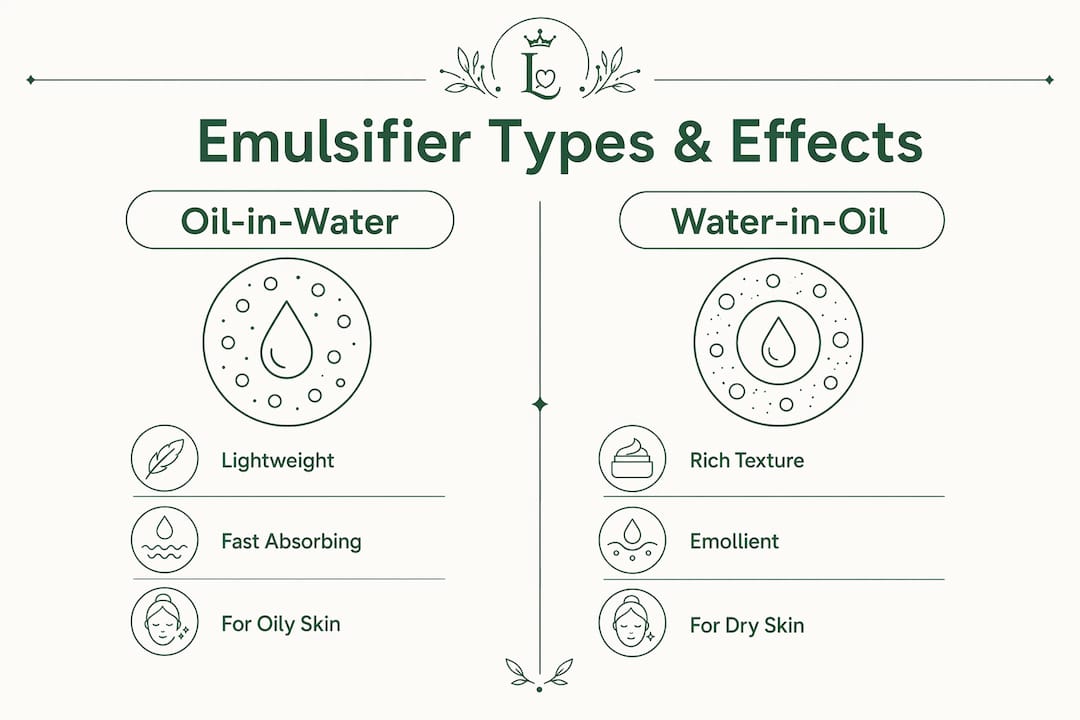
Two main emulsion architectures exist in skincare:
- Oil-in-Water (O/W): Oil droplets are dispersed in a water base. These feel lighter, absorb faster, and suit oily or combination skin. Most daily moisturizers and serums use this format.
- Water-in-Oil (W/O): Water droplets are dispersed in an oil base. These feel richer, more emollient, and provide a stronger occlusive barrier. Cold creams and heavy night balms typically use this format.
O/W emulsions are lighter and faster-absorbing; W/O emulsions are richer and more emollient. The choice of emulsion type shapes the entire sensory experience of a product before a single active ingredient is considered.
Beyond mixing, emulsifiers also influence texture, sensory performance, and active ingredient distribution throughout the formula. A well-chosen emulsifier system determines spreadability on skin, how quickly the product absorbs, and whether it leaves a residue. Formulation scientists treat emulsifiers as performance ingredients, not just structural ones.
Pro Tip: If a cream feels draggy or pills on your skin, the emulsifier system may be mismatched to the oil load in the formula. A product with a high oil content needs a more robust emulsifier system to maintain both stability and a clean skin feel.
What are the main types of emulsifiers used in skincare?
Emulsifiers are classified by their ionic charge, and that classification directly affects how they behave in a formula and on your skin.
| Type | Examples | Key Advantage | Common Use |
|---|---|---|---|
| Non-ionic | Polysorbate 60, glyceryl stearate | Mild, compatible with most ingredients | Moisturizers, sunscreens, serums |
| Anionic | Sodium stearoyl lactylate, triethanolamine stearate | Strong emulsification power | Cleansers, body lotions |
| Cationic | Behentrimonium chloride | Conditioning effect | Hair conditioners, some skin creams |
| Amphoteric | Lecithin | Skin-identical, biocompatible | Natural and clean beauty formulas |
Non-ionic emulsifiers dominate skincare formulations because of their mildness and compatibility with a wide range of other ingredients. Polysorbate 60 and glyceryl stearate appear in the majority of commercial moisturizers for exactly this reason. Lecithin, derived from sunflower or soy, is the go-to choice for formulators working in the natural and clean beauty space because it closely resembles the phospholipids found in human skin.
The Hydrophilic-Lipophilic Balance scale, known as HLB, is the tool formulators use to match an emulsifier to its intended emulsion type. HLB values of 8 to 18 suit O/W emulsions; values of 3 to 6 suit W/O emulsions. A higher HLB number means the molecule is more water-loving and better suited to dispersing oil into water. This scale is a guide rather than a hard rule. Formulators still run extensive stability testing because processing temperature, mixing speed, and oil type all affect the final result.
Natural emulsifiers like lecithin and cetearyl alcohol (derived from plant sources) appeal to clean beauty consumers but present real formulation challenges. They tend to produce softer emulsions that are more sensitive to temperature and pH changes. Synthetic emulsifiers like polysorbates offer greater stability and a longer shelf life but carry scrutiny from consumers seeking ingredient transparency.
Pro Tip: When reading a product label, look for glyceryl stearate, cetearyl alcohol, or polysorbate 80 in the first ten ingredients. Their position signals they are functioning as primary emulsifiers, not just texture modifiers.
How emulsifiers affect stability, texture, and skin feel
Stability is the first job of any emulsifier system, and it is more complex than simply keeping oil and water together. Emulsion stability depends on emulsifier type and concentration, the oil-to-water ratio, processing technique, and the use of co-emulsifiers and thickeners. A formula that looks perfect at the factory can separate within weeks if any of these variables is off.
Here is how emulsifiers shape the practical performance of a product from manufacturing to application:
- Prevent phase separation. The interfacial film formed by emulsifiers stops oil droplets from merging and rising to the surface. A stable emulsion looks uniform and applies evenly every time.
- Control droplet size. Smaller, more uniform droplets produce a smoother texture and a more elegant skin feel. High-shear mixing during manufacturing, combined with the right emulsifier, achieves this.
- Determine spreadability. The emulsifier type directly affects how a product glides across skin. O/W emulsifiers tend to produce lighter, more spreadable textures. W/O systems feel denser and require more effort to spread.
- Distribute active ingredients evenly. Vitamins, peptides, and botanical extracts need to be uniformly suspended throughout a formula to deliver consistent results. Emulsifiers make that distribution possible.
- Support co-emulsifiers and thickeners. Cetyl alcohol and stearic acid commonly support primary emulsifiers in lotion formulations. These co-emulsifiers reinforce the interfacial film and contribute to the creamy, structured texture consumers expect.
The difference between a lightweight lotion and a rich cream often comes down to the emulsifier system, not just the oil content. A lotion typically uses a lower concentration of emulsifier with a higher water ratio, producing a thinner, faster-absorbing product. A cream uses a more concentrated emulsifier system, often with co-emulsifiers, to hold a higher oil load in a stable, spreadable form.
What consumers should know when choosing products with emulsifiers
Reading a skincare label with emulsifiers in mind changes how you evaluate a product. Creams, lotions, and milks usually contain emulsifiers, while gels and serums with a water-only base often do not require them. If you see a product marketed as a “cream” but the texture feels watery or separates in the jar, the emulsifier system is likely underdeveloped.
Skin type matters when it comes to emulsifier choice:
- Oily or acne-prone skin benefits from O/W formulas with lightweight emulsifiers like polysorbate 20 or glyceryl stearate. These deliver moisture without adding excess oil to the skin surface.
- Dry or mature skin does better with W/O or high-oil O/W formulas that use richer emulsifier systems, including cetearyl alcohol or beeswax-based systems, to lock in moisture longer.
- Sensitive skin responds best to non-ionic emulsifiers, particularly lecithin and glyceryl stearate, which are less likely to disrupt the skin barrier or cause irritation.
Clean beauty consumers often seek products with natural emulsifiers, but natural does not automatically mean better or safer. Lecithin and plant-derived cetearyl alcohol are excellent choices, but they require more precise formulation to stay stable. A poorly stabilized natural formula can degrade faster and harbor microbial growth without adequate preservation.
One common misconception is that emulsifiers are irritating or harmful. The reality is that non-ionic emulsifiers are mild and compatible with most skin types. Irritation from a skincare product is far more likely to come from fragrance, preservatives, or active ingredients than from the emulsifier itself. Understanding the role of emulsifiers in skincare helps you separate real concerns from marketing noise.
Key takeaways
Emulsifiers are the structural backbone of every cream and lotion, and choosing the right system determines stability, texture, and skin compatibility in equal measure.
| Point | Details |
|---|---|
| Emulsifiers bind oil and water | Amphiphilic molecules form an interfacial film that keeps formulas stable and uniform. |
| Emulsion type shapes skin feel | O/W formulas absorb faster; W/O formulas deliver richer, longer-lasting moisture. |
| HLB guides emulsifier selection | Values 8 to 18 target O/W emulsions; values 3 to 6 target W/O emulsions. |
| Co-emulsifiers reinforce stability | Cetyl alcohol and stearic acid support primary emulsifiers in creams and lotions. |
| Skin type should guide your choice | Sensitive skin benefits from non-ionic emulsifiers like lecithin and glyceryl stearate. |
Why emulsifiers deserve more credit than they get
Most skincare conversations focus on actives: retinol percentages, vitamin C concentrations, peptide sequences. Emulsifiers almost never come up. That is a mistake, and one I have seen cost formulators and consumers alike.
I have watched brands reformulate a product by swapping one emulsifier for another, expecting no visible change, and end up with a product that feels completely different on skin, absorbs at a different rate, and fails stability testing within three months. The emulsifier molecular arrangement at interfaces creates a barrier affecting product look, feel, and durability. Even slight changes cause noticeable formulation differences. That is not a minor technical footnote. That is the entire sensory experience of the product.
The clean beauty movement has pushed brands toward natural emulsifiers, and I think that is largely a good thing. Lecithin and plant-derived cetearyl alcohol are genuinely skin-compatible ingredients. But the trade-off in formulation complexity is real. Natural emulsifiers require tighter processing controls and more sophisticated preservation strategies. Smaller brands and DIY formulators often underestimate this, and the result is products that separate on the shelf or degrade faster than expected.
My honest view is that consumers who understand emulsifiers make better purchasing decisions. When you know that a rich, stable cream requires a well-designed emulsifier system, you stop being impressed by marketing language and start looking at whether the formula actually holds together. The texture you feel when you open a jar is the direct result of formulation decisions made at the molecular level. That is worth understanding.
— Michael
Why Lordslovebutter takes a different approach to skin hydration
If you have spent time reading ingredient labels and still feel like most moisturizers are overcomplicated, Lordslovebutter offers a genuinely different perspective.
Lordslovebutter’s whipped beef tallow balm uses grass-fed tallow as its base, a naturally stable, skin-compatible fat that does not require synthetic emulsifier systems to hold together. The result is a rich, creamy balm that delivers lasting moisture without the ingredient complexity of conventional creams. It is formulated without synthetic chemicals, making it a strong choice for sensitive skin, eczema, and psoriasis. Customers consistently report improved skin texture within days. Explore the full Lordslovebutter product line and see what a clean, well-formulated balm actually feels like.
FAQ
What are emulsifiers in skincare products?
Emulsifiers are amphiphilic ingredients that stabilize mixtures of oil and water in creams, lotions, and milks. They position at the oil-water interface and form a protective barrier that prevents the two phases from separating.
Are emulsifiers safe for sensitive skin?
Non-ionic emulsifiers like lecithin and glyceryl stearate are mild and well-tolerated by most skin types, including sensitive skin. Irritation in skincare products is far more commonly caused by fragrance or preservatives than by emulsifiers.
How do I know if a product contains emulsifiers?
Look for ingredients like polysorbate 60, glyceryl stearate, cetearyl alcohol, or lecithin on the label. Creams, lotions, and milks almost always contain emulsifiers, while water-based gels typically do not.
What is the difference between O/W and W/O emulsions?
Oil-in-water emulsions are lighter and absorb faster, making them suitable for oily or combination skin. Water-in-oil emulsions are richer and more occlusive, better suited for dry or mature skin that needs longer-lasting moisture.
Can natural emulsifiers replace synthetic ones?
Natural emulsifiers like lecithin and plant-derived cetearyl alcohol are effective but require more precise formulation and stronger preservation strategies to maintain stability. They are a viable choice, but not a simpler one.

