
Chemical-free skincare means using products that exclude harmful synthetic additives like parabens, phthalates, and artificial fragrances to protect sensitive baby skin from irritation and allergic reactions. Understanding why chemical-free skincare matters for babies starts with one fact: infant skin is not just smaller adult skin. It is structurally different, more permeable, and far less equipped to handle synthetic chemicals. The American Academy of Pediatrics recommends fragrance-free, minimal-ingredient products for newborns. Parents who understand the science behind this guidance make better choices at the store shelf.
Why baby skin is more vulnerable to chemicals
Infant skin is 30% thinner than adult skin and has a less-developed outer barrier called the stratum corneum. That thinness means chemicals applied to the surface absorb faster and reach the bloodstream more easily than they would in an adult.
The stratum corneum acts as the body’s first line of defense against irritants, allergens, and moisture loss. In newborns and infants, this layer is still maturing. Until it fully develops, the skin lets more of what touches it pass through. Synthetic chemicals like parabens and phthalates take advantage of that open door.
Higher absorption rates create two problems. First, the skin itself can react with redness, dryness, or rash. Second, some chemicals may enter the bloodstream in quantities large enough to affect developing hormonal systems. This is not a theoretical risk. It is the reason pediatric dermatologists consistently recommend keeping infant skincare routines as simple as possible.

Pro Tip: Limit the number of products you apply to your baby’s skin. Fewer products mean fewer ingredients, and fewer ingredients mean a lower chance of a reaction.
| Skin characteristic | What it means for babies |
|---|---|
| Thinner stratum corneum | Chemicals absorb faster and more completely |
| Immature barrier function | Skin loses moisture more easily and reacts to irritants |
| Higher surface-to-body ratio | Proportionally more skin exposed relative to body weight |
| Developing pH balance | Skin is more sensitive to alkaline cleansers and synthetic additives |
What harmful chemicals in baby products actually do
The most common synthetic ingredients to avoid in baby skincare are parabens, phthalates, synthetic fragrances, sulfates, and artificial dyes. Each one carries a specific risk profile for infants.
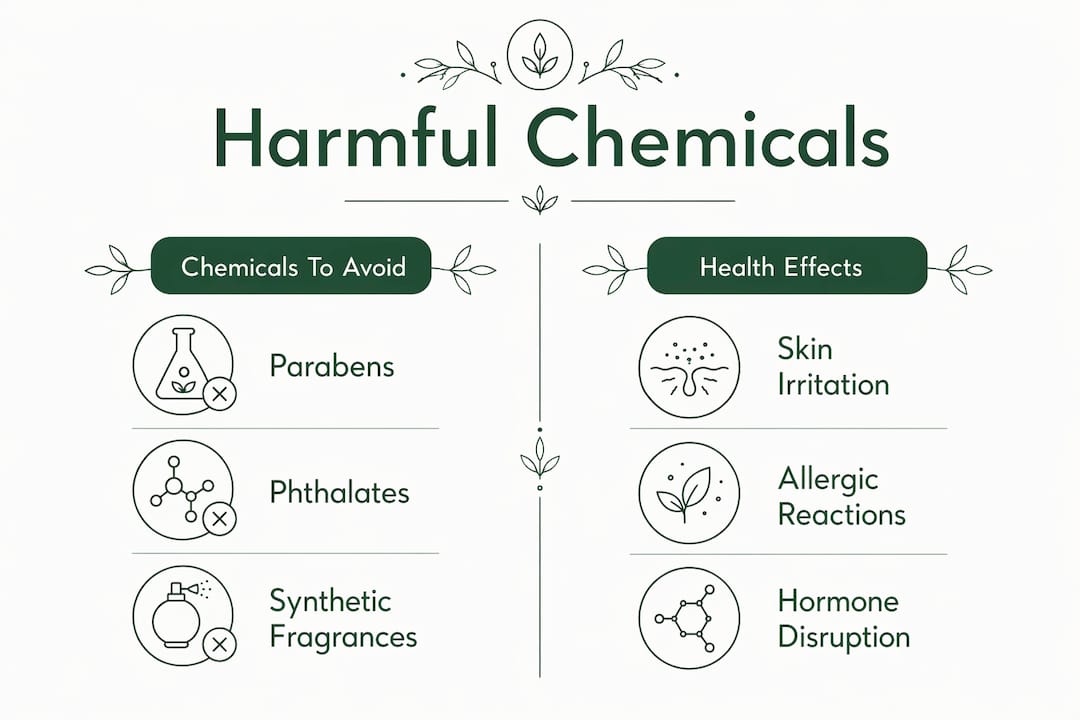
Parabens are preservatives used to extend shelf life. They mimic estrogen in the body and are classified as suspected endocrine disruptors. Phthalates are plasticizers often hidden under the label “fragrance.” They have been linked to hormonal disruption in animal studies and are found in a wide range of conventional baby lotions and washes. Sulfates, like sodium lauryl sulfate, strip the skin’s natural oils and damage the already fragile infant barrier. Synthetic dyes add color with no benefit and are a known source of contact dermatitis in babies.
The good news is that switching products produces measurable results quickly. Reducing exposure to endocrine disruptors in cosmetics lowers urinary chemical levels within just 5 days. That speed of change shows how directly skincare products affect the body’s chemical load.
- Parabens: Preservatives that disrupt hormone function; found in many conventional baby lotions and washes
- Phthalates: Often hidden under “fragrance” on labels; linked to endocrine disruption
- Synthetic fragrances: A single “fragrance” ingredient can contain dozens of undisclosed chemicals
- Sulfates: Strip natural skin oils and weaken the skin barrier
- Artificial dyes: Provide no function and are a leading cause of contact dermatitis in infants
Organic formulations tend to avoid these harsh surfactants and parabens, favoring plant-based ingredients like shea butter and aloe vera. That shift in formulation directly reduces irritation and allergen risk for babies.
Are “chemical-free” and “natural” labels actually trustworthy?
The term “chemical-free” is technically a myth. Everything is made of chemicals, including water. What the phrase really means in skincare is the absence of specific harmful synthetic additives. Consumers should look beyond marketing and check ingredient lists directly.
“Natural” carries its own complications. Unrefined botanicals and essential oils can trigger allergic reactions in infants. Lavender oil, for example, is natural but is also a common contact allergen in babies. Natural does not mean hypoallergenic, and patch testing is always recommended before full use.
The most reliable standard is what experts call intelligently designed formulations: products that combine purified natural ingredients with clinical safety testing. That standard is more meaningful than any single label claim.
Greenwashing is real and widespread. A product can be labeled “organic” or “natural” while still containing synthetic preservatives or masking fragrances. Parents who want to avoid greenwashing in baby products need to read ingredient lists, not just front-of-pack claims.
Pro Tip: Look for products with a short, readable ingredient list. If you cannot pronounce most of what is listed, that is a signal to keep looking.
- “Chemical-free” means free of harmful synthetic additives, not literally free of all chemicals
- “Natural” does not guarantee safety; unrefined plant ingredients can still cause reactions
- “Unscented” may still contain masking fragrances; only “fragrance-free” guarantees no added scents
- “Organic” on a label does not mean every ingredient is organic unless certified by a recognized body
- Dermatologically tested is a stronger signal than “natural” or “gentle” alone
How to choose and use safe skincare products for babies
Safe skincare for infants starts with the ingredient list, not the brand name or the packaging. A short list of recognizable ingredients is the single most reliable indicator of a low-risk product.
Read labels before you buy
Look for products labeled fragrance-free, not just unscented. “Fragrance-free” means no added scents or masking agents. “Unscented” can still contain masking fragrances that irritate baby skin. Beyond fragrance, avoid parabens, sulfates, phthalates, and artificial dyes. A product with five or fewer recognizable ingredients is a strong starting point.
Follow a minimal bathing routine
AAP-aligned 2026 guidance recommends bathing infants 2–3 times per week. Daily bathing strips the skin’s natural oils and weakens the barrier. Between baths, a gentle wipe-down of the face, neck folds, and diaper area is enough. Less bathing means less exposure to cleansers and less disruption to the skin’s protective layer.
Moisturize right after bathing
Apply moisturizer within a few minutes of bath time while the skin is still slightly damp. This locks in moisture before it evaporates. Choose a product with minimal ingredients and no synthetic fragrance. Ingredients like grass-fed tallow, shea butter, and beeswax support the skin barrier without synthetic additives. You can learn more about fewer ingredients for healthier skin and why simplicity protects sensitive skin.
Handle sun protection carefully
Synthetic sunscreens should be avoided entirely before 6 months of age. Before that point, shade and protective clothing are the right tools. After 6 months, mineral sunscreens containing zinc oxide or titanium dioxide are the safe choice. These sit on top of the skin rather than absorbing into it, which makes them far gentler for infants.
Patch test every new product
Apply a small amount of any new product to the inside of your baby’s wrist or behind the ear. Wait 24 hours. If there is no redness, swelling, or irritation, the product is likely safe for broader use. This step matters even with products labeled natural or organic, because natural ingredients can still cause contact dermatitis in infants.
Pro Tip: Keep a simple log of every product you use on your baby’s skin. If a reaction appears, you will know exactly what to eliminate.
Limiting product variety in infant skincare reduces cumulative chemical exposure and makes it easier to identify the cause of any reaction. The goal is not a 10-step routine. It is two or three trusted products you understand completely.
Key Takeaways
Chemical-free skincare for babies means choosing products that exclude parabens, phthalates, synthetic fragrances, and sulfates, because infant skin absorbs these chemicals faster and reacts more severely than adult skin.
| Point | Details |
|---|---|
| Baby skin absorbs more | Infant skin is 30% thinner than adult skin, making chemical absorption faster and more complete. |
| Switch products quickly | Reducing synthetic chemical exposure lowers measurable body levels within 5 days. |
| Labels can mislead | “Natural” and “chemical-free” are marketing terms; read ingredient lists and look for fragrance-free certification. |
| Less is more | Bathing 2–3 times weekly and using minimal products reduces irritation and cumulative chemical load. |
| Patch test always | Even natural or organic products can cause contact dermatitis; test on a small area for 24 hours first. |
What I have learned from watching parents navigate baby skincare
Parents walk into this with the best intentions and get buried under competing claims. Every bottle promises “gentle,” “natural,” or “pure,” and most of them contain synthetic fragrances anyway. I have seen parents spend real money on premium-labeled products that were no safer than the generic option two shelves down.
The most useful shift I have seen is when parents stop trusting the front of the package and start reading the back. That one habit changes everything. A product with six ingredients you recognize is almost always safer than one with twenty ingredients you cannot pronounce, regardless of what the front label says.
The other thing I would push back on is the idea that more products mean better care. Babies do not need a full skincare routine. They need clean skin, adequate moisture, and protection from known irritants. A single well-formulated balm applied after bathing does more good than a five-product system loaded with preservatives and synthetic scents.
Simplicity is not laziness. It is the evidence-based approach. The less-is-more principle in infant skincare is backed by AAP guidance, not just common sense. Trust that. Watch your baby’s skin. It will tell you what is working.
— Michael
Lordslovebutter: a natural option worth knowing about
Parents who have done the label-reading work and want a product that holds up to scrutiny often land on tallow-based balms. Lordslovebutter makes a whipped beef tallow balm crafted from grass-fed beef tallow and manuka honey, with no parabens, synthetic fragrances, sulfates, or artificial dyes.
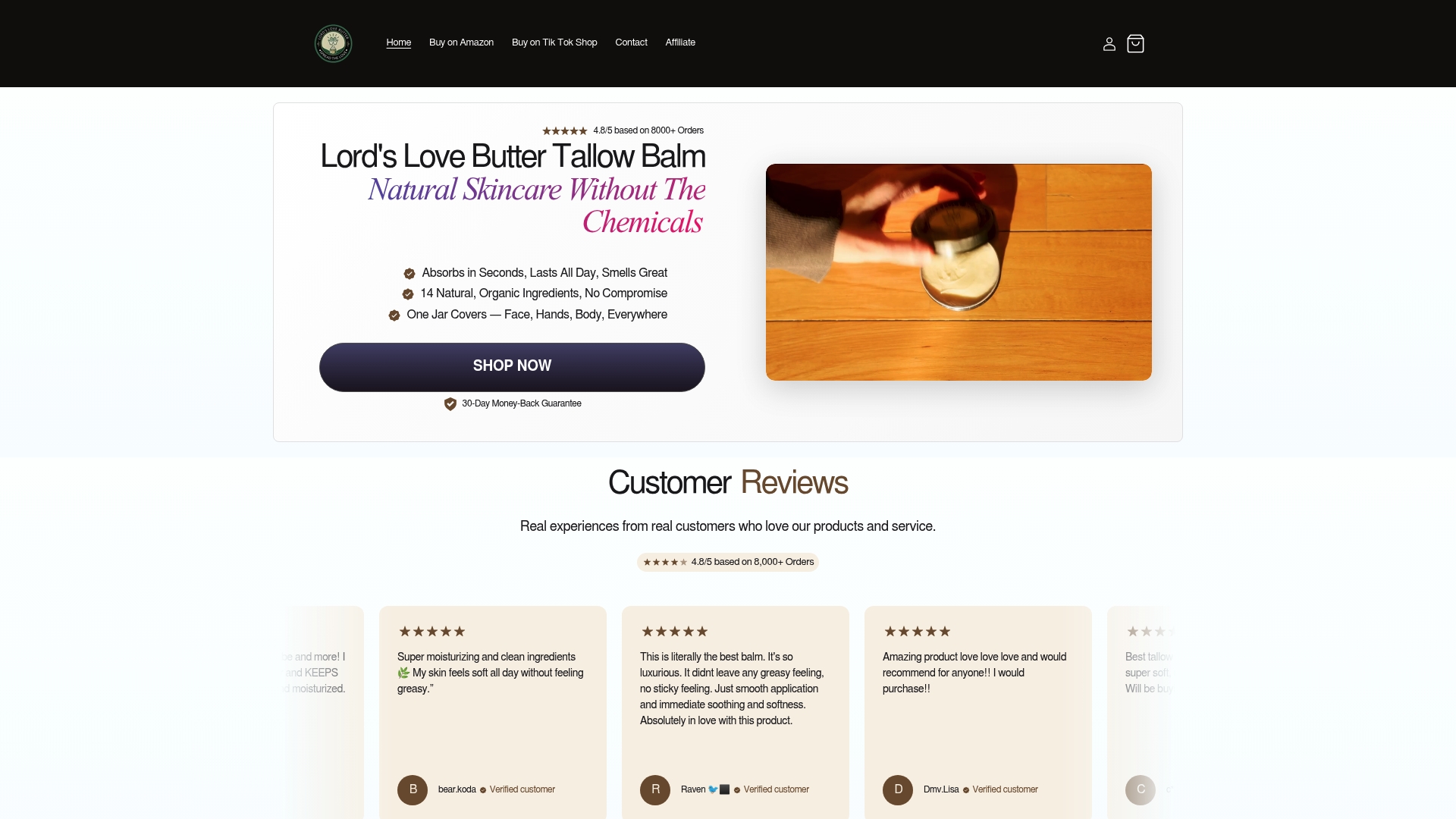
Tallow is structurally similar to the lipids found in human skin, which makes it exceptionally compatible with the skin barrier. Lordslovebutter’s formulation is designed for whole-body use, absorbs without a greasy feel, and is built around the kind of short, readable ingredient list that pediatric dermatologists recommend. For parents looking for a chemical-free baby balm that skips the synthetic additives entirely, this is a product worth examining closely.
FAQ
What does “chemical-free” actually mean in baby skincare?
“Chemical-free” is a marketing term that means a product excludes specific harmful synthetic additives like parabens, phthalates, and synthetic fragrances. Technically, all matter is chemical, so the phrase signals intent rather than a literal absence of chemistry.
How soon do babies show reactions to synthetic skincare ingredients?
Skin reactions like redness, rash, or dryness can appear within hours of applying an irritating product. Systemic effects from endocrine-disrupting chemicals like phthalates are harder to detect but measurable in urine within days of exposure.
Is “unscented” the same as “fragrance-free” for baby products?
No. “Unscented” products can still contain masking fragrances that neutralize odor but remain in the formula. Only products labeled “fragrance-free” guarantee no added scents or masking agents.
When can I start using sunscreen on my baby?
Mineral sunscreens containing zinc oxide or titanium dioxide are safe after 6 months of age. Before 6 months, the AAP recommends shade and protective clothing instead of any sunscreen product.
How do I know if a natural ingredient is safe for my baby?
Patch test every new product on a small area of skin for 24 hours before full use. Natural ingredients including essential oils and unrefined botanicals can cause contact dermatitis in infants, so testing is necessary regardless of how a product is labeled.