

Why Tallow Absorbs Faster in Lotions Than Most Oils
Tallow is defined as rendered animal fat with a fatty acid profile that closely mirrors human sebum, which is the skin’s own natural oil. That biochemical similarity is the core reason why tallow absorbs faster in lotions than most plant oils or synthetic moisturizers. Your skin recognizes tallow’s lipid structure and pulls it into the barrier rather than leaving it sitting on the surface. The result is faster absorption, deeper hydration, and a noticeably non-greasy finish. Lordslovebutter’s whipped beef tallow balm is built on exactly this principle, using grass-fed tallow to deliver moisture your skin can actually use.
Why tallow absorbs faster in lotions: the biochemical profile
Tallow’s absorption advantage starts at the molecular level. Its fat composition runs roughly 50% saturated fats, 40% monounsaturated fats, and 10% polyunsaturated fats. That ratio is strikingly close to the lipid matrix of human sebum. Your skin’s stratum corneum, the outermost protective layer, is built from a similar mix of ceramides, fatty acids, and cholesterol. When tallow arrives on the skin’s surface, the barrier treats it as a compatible building block rather than a foreign substance.
The three key fatty acids in tallow
Each fatty acid in tallow performs a specific function:
- Palmitic acid repairs the skin barrier and carries antimicrobial properties. It is one of the most abundant fatty acids in human sebum.
- Stearic acid provides structural support to the skin’s lipid layer and softens the skin’s texture noticeably.
- Oleic acid deeply moisturizes skin and enhances the absorption of fat-soluble vitamins into the skin.
These three acids work together. Palmitic and stearic acids reinforce the barrier. Oleic acid opens pathways for nutrients to travel deeper into the skin.
Fat-soluble vitamins that ride along
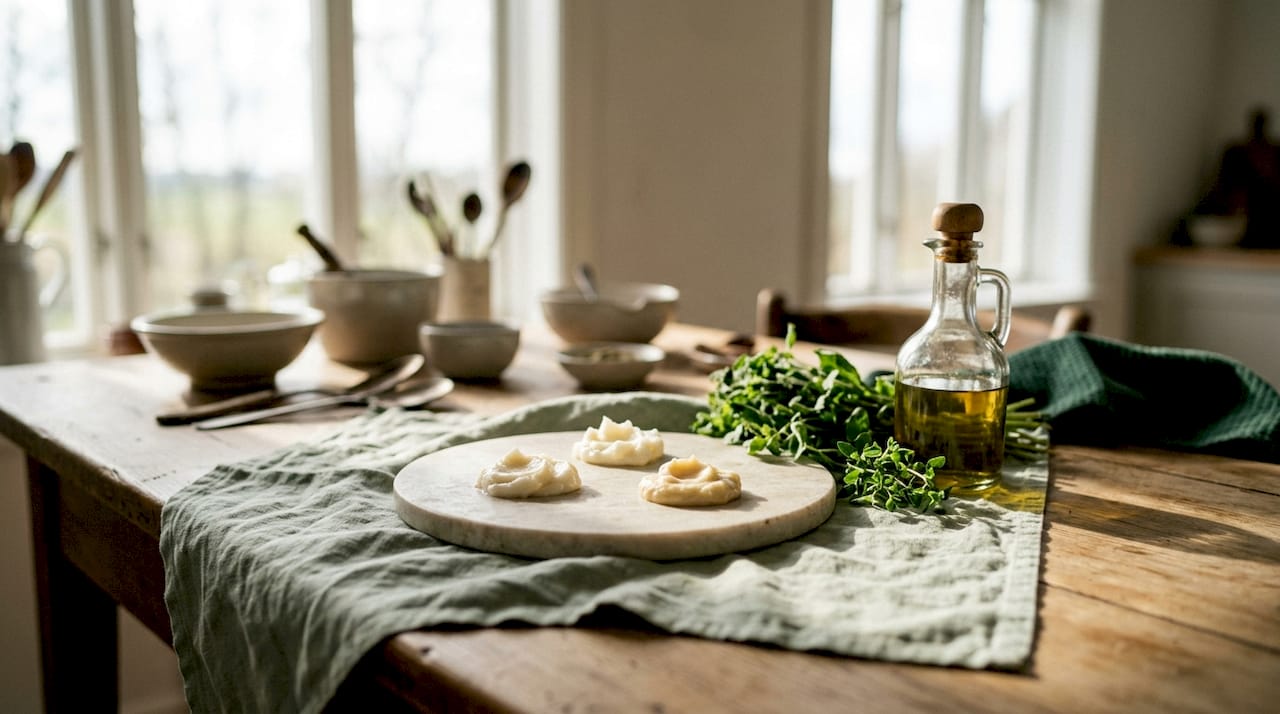
Tallow delivers vitamins A, D, E, and K naturally bound to its fat molecules. That binding matters because fat-soluble vitamins require a lipid carrier to penetrate the skin effectively. Vitamin A supports cell turnover. Vitamin D assists in skin repair. Vitamin E acts as an antioxidant that protects against oxidative damage. Vitamin K supports skin tone and reduces inflammation. Because tallow’s fats are already compatible with the skin barrier, these vitamins get delivered locally rather than sitting on top of the skin.
| Fatty Acid | Percentage in Tallow | Primary Skin Benefit |
|---|---|---|
| Palmitic acid | ~25% | Barrier repair, antimicrobial action |
| Stearic acid | ~20% | Structural support, skin softening |
| Oleic acid | ~40% | Deep moisture, vitamin absorption |
| Polyunsaturated fats | ~10% | Anti-inflammatory support |
How does tallow compare to other moisturizing ingredients?
Tallow’s absorption rate stands apart from most moisturizing agents because of bioavailability, not just texture. Many conventional lotions rely on synthetic humectants like glycerin or propylene glycol. These ingredients draw water to the skin’s surface but do not integrate into the lipid barrier. The hydration feels immediate but fades quickly because the barrier itself has not been reinforced.
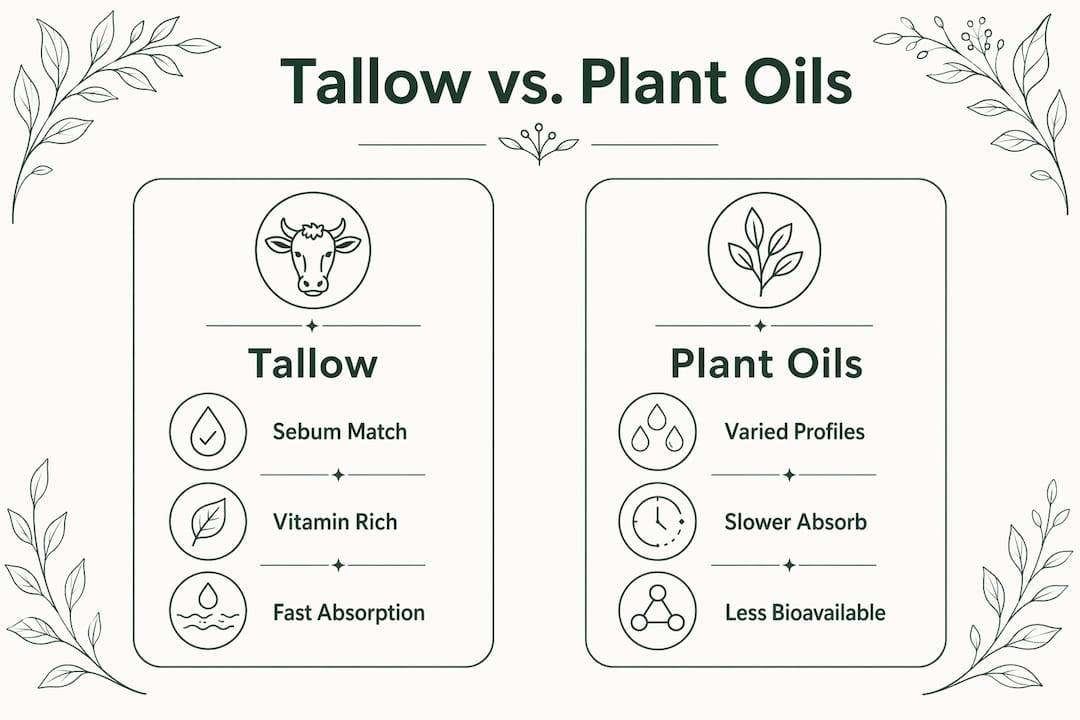
Plant-based oils present a different situation. Oils high in linoleic acid, such as rosehip or sunflower oil, absorb reasonably well but lack the saturated fat content needed to mimic sebum closely. Oils high in oleic acid, such as argan or olive oil, penetrate more deeply but can disrupt barrier integrity in some skin types. Tallow’s tallow versus other oils advantage is its balanced ratio: enough saturated fat to build structure, enough oleic acid to carry nutrients inward.
Occlusive versus emollient: why tallow does both
Moisturizing ingredients generally fall into two categories. Occlusives form a physical barrier on the skin to trap moisture. Emollients fill gaps in the skin’s lipid layer to soften and smooth. Most ingredients do one or the other. Tallow does both. Its saturated fats create a light occlusive film. Its oleic acid works as an emollient by filling in the spaces between skin cells. That dual action is rare in a single ingredient.
| Moisturizing Agent | Occlusive Effect | Emollient Effect | Sebum Similarity | Vitamin Content |
|---|---|---|---|---|
| Beef tallow | Strong | Strong | Very high | A, D, E, K |
| Petroleum jelly | Very strong | Minimal | None | None |
| Argan oil | Minimal | Moderate | Low | Vitamin E only |
| Shea butter | Moderate | Strong | Low | Vitamin A, E |
| Synthetic lotion | Variable | Variable | None | Synthetic additives |
Pro Tip: Apply tallow balm to slightly damp skin right after washing. The moisture already on your skin gives the tallow something to lock in, which speeds up the absorption process and reduces any initial heaviness.
Some lotions feel absorbed instantly because they contain high amounts of alcohol or silicone. These ingredients evaporate or form a film quickly, creating the sensation of absorption. The skin underneath, however, receives little actual nourishment. Tallow’s absorption feels slightly slower at first but delivers genuine barrier integration rather than surface-level coverage.
What role do tallow’s occlusive properties play in barrier repair?
The stratum corneum functions as the skin’s primary defense against water loss. When this layer is damaged, trans-epidermal water loss increases and the skin becomes dry, tight, and prone to irritation. Tallow acts as an occlusive emollient by forming a hydrophobic layer over the stratum corneum, which reduces that water loss and helps the barrier recover.
The saturated fats in tallow, primarily palmitic and stearic acids, are the structural drivers of this occlusive effect. They are waxy at room temperature and soften on contact with skin warmth. That physical property creates a breathable but protective film. Rendered tallow has minimal moisture content, which makes it shelf stable and resistant to bacterial growth. That same low moisture content means the product applies cleanly without introducing water that could dilute its barrier-forming effect.
Oleic acid adds a layer of complexity. It acts as a permeation enhancer by temporarily loosening the tight lipid structure of the stratum corneum, which allows other nutrients to travel deeper. This is useful for dry or damaged skin that needs deep repair. For acne-prone skin, however, oleic acid can disrupt barrier integrity and potentially worsen breakouts. Knowing your skin type before committing to any tallow product is worth the effort.
Dermatologists confirm that tallow’s natural fatty acids and vitamins contribute to a strong protective barrier and local hydration. Its effects are topical, not systemic. The nutrients stay in the skin’s outer layers where they are needed most.
People with dry or eczema-prone skin tend to see the strongest results from tallow because their barrier is already compromised. Tallow’s lipids step in to fill the structural gaps that the skin can no longer produce on its own.
- Tallow reduces trans-epidermal water loss by forming a hydrophobic film over the stratum corneum.
- Saturated fats provide the structural backbone for this occlusive effect.
- Oleic acid enhances penetration of fat-soluble vitamins A, D, E, and K into the skin.
- Tallow’s effects are local and topical. No systemic absorption occurs.
- People with acne-prone skin should patch test first due to oleic acid’s potential to disrupt barrier integrity.
How to use tallow-based lotions for the best absorption
Application technique affects how well tallow absorbs and how long its benefits last. A small amount goes a long way. Start with a pea-sized portion for the face or a dime-sized amount for larger body areas. Warm it between your palms first. Tallow softens quickly with body heat, and that warming step turns it from a waxy balm into a smooth, spreadable oil that the skin accepts more readily.
Application steps for different skin types
- Normal to dry skin: Apply tallow balm once in the morning and once at night. Use it as the final step in your routine to seal in any serums or treatments underneath.
- Very dry or cracked skin: Apply a slightly thicker layer at night and cover with cotton gloves or socks for hands and feet. The occlusion amplifies the barrier repair effect overnight.
- Sensitive skin: Start with a small patch on the inner arm for two days before applying to the face. Tallow is generally well tolerated, but individual reactions vary.
- Acne-prone skin: Use tallow sparingly and only on dry patches rather than all over. The oleic acid content can worsen congestion on oily or acne-prone areas.
- Whole-body use: Apply after showering while skin is still slightly damp. This is the most efficient method for full-body hydration with minimal product.
Grass-fed tallow matters for product quality. Grass-fed cattle produce fat with a richer nutrient profile, including higher concentrations of fat-soluble vitamins. The rendering process also affects quality. Properly rendered tallow is odor-neutral and has a smooth, consistent texture. Poorly rendered tallow can smell rancid and may contain impurities that irritate the skin.
Pro Tip: If tallow feels heavy after application, you have used too much. Reduce the amount by half and re-warm it more thoroughly before applying. A thin, even layer absorbs completely within a few minutes.
Tallow absorption: what the research actually tells us
I have spent considerable time reviewing the research on tallow and testing products on my own skin. The biochemistry is genuinely compelling. The fatty acid match between tallow and human sebum is not marketing language. It is a measurable structural similarity that explains why tallow-based products feel different from conventional lotions almost immediately.
What the research does not yet offer is a large body of clinical trials specifically on beef tallow. The lack of rigorous clinical trials on tallow is a real gap. The evidence we have comes from fatty acid research and occlusive moisturizer studies, which are strong but not the same as tallow-specific data. That distinction matters if you are managing a diagnosed skin condition. Tallow is not a medical treatment.
What I find most convincing is the practical feedback from people with chronically dry or sensitive skin. They report faster improvement in texture and hydration compared to conventional lotions, and that tracks with the biochemistry. The skin is not fighting to process a foreign lipid. It is simply using what it already knows how to use.
My caution is about product quality. Not all tallow products are equal. Grass-fed sourcing and proper rendering are not optional details. They determine whether you are applying a nutrient-rich balm or a low-quality fat with minimal benefit. Choose products where the sourcing is transparent.
— Michael
Lordslovebutter’s whipped tallow balm for fast, clean hydration
Lordslovebutter’s whipped beef tallow balm is made from grass-fed beef tallow with no synthetic chemicals, no fillers, and no artificial fragrances. The whipped texture means it warms and spreads faster than a solid balm, which speeds up absorption from the first application. It includes manuka honey for added antimicrobial and soothing properties, making it suitable for sensitive skin, eczema, and psoriasis.
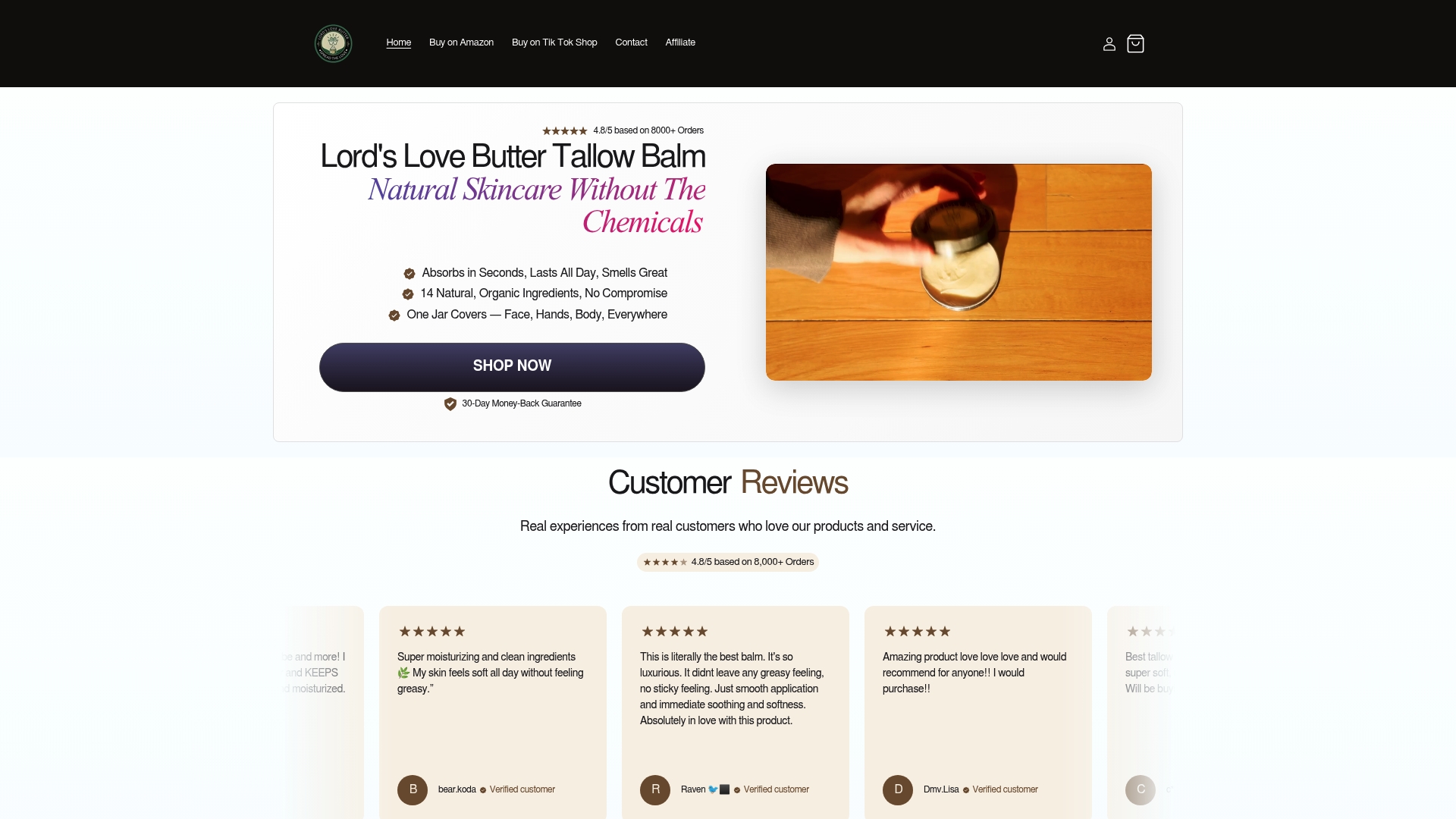
Lordslovebutter is a veteran-owned business that controls every step of its sourcing and production. Customers consistently report improved skin texture within days, particularly on dry hands, elbows, and irritated patches. The 2.4 oz tin is a practical size for daily use and travel. If you want to experience the tallow absorption rate difference firsthand, this is a straightforward place to start.
Key Takeaways
Tallow absorbs faster in lotions because its fatty acid profile mirrors human sebum, allowing the skin’s lipid barrier to incorporate it directly rather than treating it as a foreign substance.
| Point | Details |
|---|---|
| Sebum-matching composition | Tallow’s 50% saturated, 40% monounsaturated fat ratio closely mirrors human skin’s own lipid matrix. |
| Dual occlusive and emollient action | Tallow both seals moisture in and fills gaps in the skin barrier, which most single ingredients cannot do. |
| Fat-soluble vitamin delivery | Vitamins A, D, E, and K in tallow are carried directly into the skin’s outer layers by its compatible fats. |
| Topical effects only | Tallow’s hydration and barrier repair work locally in the stratum corneum, not systemically. |
| Quality sourcing matters | Grass-fed, properly rendered tallow delivers a richer nutrient profile than conventionally sourced alternatives. |
FAQ
Why does tallow absorb faster than most plant oils?
Tallow’s fatty acid ratio closely matches human sebum, so the skin incorporates it into the lipid barrier rather than treating it as a foreign substance. Most plant oils lack the saturated fat content needed to replicate that compatibility.
Is tallow lotion safe for sensitive skin?
Tallow is generally well tolerated on sensitive skin because its lipids are biocompatible with the skin’s own structure. Patch testing on the inner arm before full application is the recommended first step.
Can tallow lotion worsen acne?
Tallow’s oleic acid content can disrupt barrier integrity on acne-prone or oily skin, which may worsen breakouts. People with acne-prone skin should use tallow sparingly and only on dry or irritated patches.
What vitamins does tallow deliver to the skin?
Tallow contains vitamins A, D, E, and K, all bound to its fat molecules. These fat-soluble vitamins penetrate the skin’s outer layers and support cell turnover, repair, and antioxidant protection.
How often should you apply tallow-based lotion?
Once or twice daily is sufficient for most skin types. Very dry or cracked skin benefits from a thicker overnight application covered with cotton gloves or socks to maximize barrier repair.

