
For most people managing psoriasis plaques, whipped grass-fed tallow tends to outperform coconut oil as a first-line moisturizer, mainly because its fatty-acid profile is closer to human sebum and it sits on drier, thicker patches without clogging pores the way coconut oil often does. Neither one treats the underlying disease itself. Patch test any new oil for several days, avoid active facial breakouts until you know how your skin reacts, and consult your dermatologist before adding any product to your prescribed regimen, including products like Lord’s Love Butter.
TL;DR:
- Tallow generally provides better occlusion and moisture retention on thick, dry plaques compared to coconut oil, which absorbs faster and offers less long-lasting hydration.
- Coconut oil’s high lauric acid content increases the risk of pore clogging and breakouts, making it less suitable for facial or acne-prone areas with psoriasis.
- Both oils can feed Malassezia yeast, so they require cautious use on scalp or hairline psoriasis, especially in warm, humid conditions.
- Sourcing quality matters: choose grass-fed tallow to minimize inflammatory residues and avoid products with added fragrance, dyes, or fillers.
- Use of oils should complement, not replace, evidence-based psoriasis treatments, with proper patch testing and professional guidance before full application.
Table of Contents
- Coconut Oil vs. Tallow for Psoriasis: A Side-by-Side Look
- Why Fatty-Acid Profiles Change How These Oils Behave on Skin
- What the Research and Dermatologists Actually Say
- Comedogenicity, Yeast, and Sourcing Risks You Should Know
- How to Trial Coconut Oil or Tallow Without Making Things Worse
- Why Lordslovebutter Formulates With Grass-Fed Tallow, Not Coconut Oil
- Try a Grass-Fed Tallow Balm Built for Sensitive, Psoriasis-Prone Skin
- Where to Read More on Psoriasis Care and Home Remedies
- Sources
- FAQ
Coconut Oil vs. Tallow for Psoriasis: A Side-by-Side Look
Texture is the first thing you’ll notice. Coconut oil melts at room temperature and spreads thin, which makes it feel light but also means it doesn’t hold up well on thick, scaly plaques that need serious occlusion overnight. Whipped tallow stays semisolid at room temperature and behaves more like a true barrier balm. That heavier occlusive quality is exactly what a lot of psoriasis plaques on elbows, knees, and shins respond to, since the sealed-in moisture slows water loss through the compromised skin surface.
Where you put each oil matters as much as which one you pick. Coconut oil’s high lauric acid content makes it one of the more comedogenic natural oils on the market, meaning it’s more likely to clog pores and trigger breakouts on facial skin or areas prone to folliculitis, according to dermatology sources tracking comedogenic ratings for common carrier oils. Tallow’s comedogenic risk is more variable and depends partly on how it’s rendered and stored, but it generally carries less of that pore-clogging reputation for body use.
Here’s how the two stack up on the factors that actually matter for psoriasis-prone skin:
- Hydration and occlusion: Tallow holds moisture in longer on thick plaques; coconut oil absorbs faster but evaporates its benefit sooner.
- Scent and sensory feel: Pure rendered tallow has a faint, neutral smell; coconut oil carries a stronger tropical scent some people find pleasant and others find irritating on sensitive skin.
- Shelf stability: Tallow, properly rendered, resists rancidity well at room temperature; coconut oil is also fairly shelf-stable but can go off faster once opened if exposed to heat and light.
- Comedogenicity: Coconut oil scores high on most comedogenic scales; tallow’s risk is lower but not zero, especially on already-congested skin.
- Yeast and scalp concerns: Both fats can theoretically feed Malassezia yeast in warm, occluded areas, which matters most for scalp psoriasis and seborrheic overlap; this condition is discussed in detail in Recurrent pustular psoriasis of pregnancy and postpartum flares.
If you’re deciding tonight which jar to open, use this quick filter: reach for tallow if you have very dry, thick plaques on your body and you react badly to preservatives or synthetic fragrance in commercial lotions. Skip coconut oil entirely on your face or on any area where you already break out, and be cautious with either oil on active, weeping, or infected-looking lesions.
Why Fatty-Acid Profiles Change How These Oils Behave on Skin
The difference between these two oils comes down to chemistry, not marketing. Coconut oil is roughly 45 to 50% lauric acid and heavy in myristic acid, both short-to-medium chain saturated fats that penetrate skin quickly but don’t replicate what your skin’s own oil, sebum, is made of. Tallow leans on palmitic, stearic, and oleic acid, a long-chain fatty-acid mix that more closely mirrors human sebum’s composition, which is why some skincare researchers describe it as theoretically more “biocompatible” with skin lipids, even though robust head-to-head clinical trials confirming that advantage are still lacking.
That chemistry translates into three distinct jobs any topical fat can do:
- Occlusion — forming a physical layer on the skin surface that slows transepidermal water loss. Tallow does this more heavily thanks to its higher melting point and thicker consistency.
- Emolliency — filling in gaps between dry, flaking skin cells to smooth texture and reduce the rough feel of scaling. Both oils do this, though coconut oil’s fast absorption means the effect fades quicker.
- Limited penetration — some fatty acids move into the upper layers of the stratum corneum, but neither oil penetrates deeply enough to reach the immune cells actually driving psoriasis.
That last point is the one worth sitting with. Psoriasis is driven by an overactive immune response that tells skin cells to multiply far faster than normal, and no topical fat, however well matched to your sebum, interrupts that signaling. Matching lipid profiles can support a healthier skin barrier and reduce the dryness and cracking that make plaques itch and hurt worse. It does not touch the underlying keratinocyte hyperproliferation that defines the disease. If you want a deeper look at how fatty acids support barrier repair generally, the role of omega fatty acids in skin repair covers the broader mechanism in more detail.
What the Research and Dermatologists Actually Say
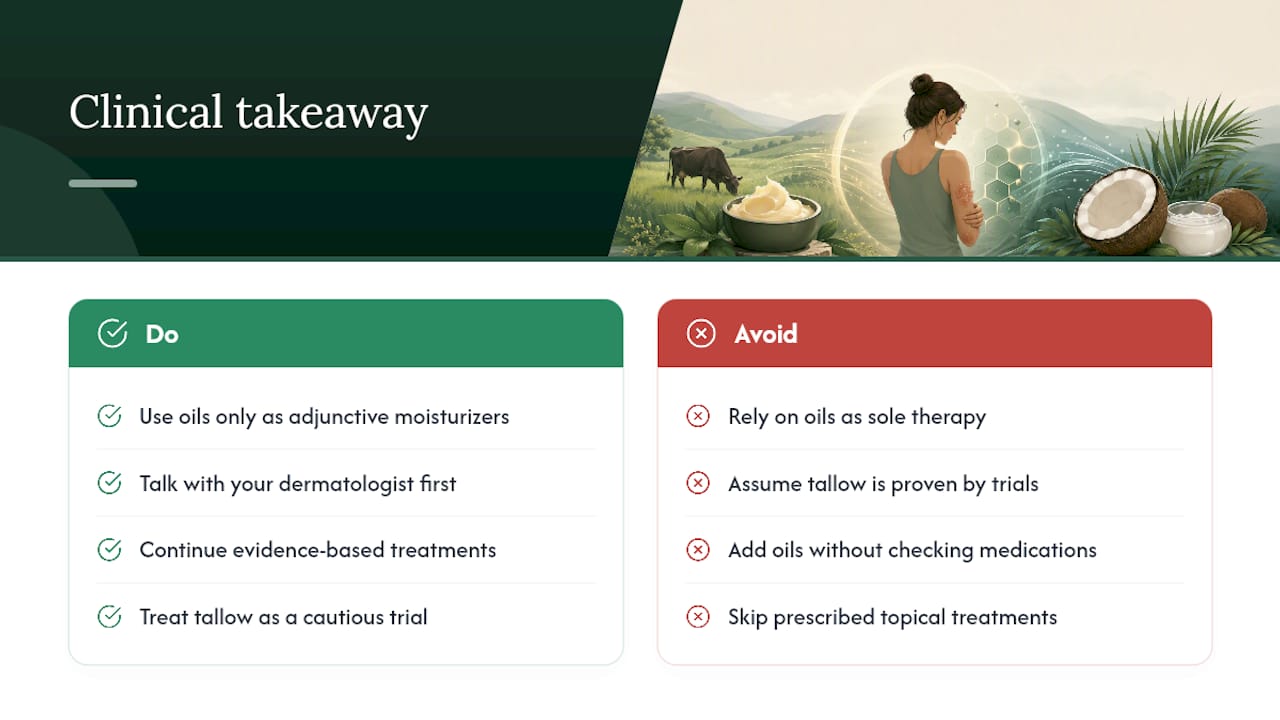
The clearest, most consistent message from clinical sources is also the least exciting one: moisturizers, tallow and coconut oil included, relieve symptoms without treating the disease. The National Psoriasis Foundation’s clinical guidance frames both oils the same way it frames any emollient, as supportive care for dryness and scaling rather than a therapy that changes disease course.
Psoriasis is driven by immune dysfunction that topical moisturizers cannot correct. Emollients like tallow and coconut oil can reduce dryness and improve comfort, but they work alongside, not in place of, evidence-based treatment.
That framing matters because a lot of the enthusiasm around beef tallow specifically has outpaced the science backing it. Board-certified dermatologists interviewed about the tallow skincare trend have pointed out that its popularity has grown much faster than any clinical evidence supporting it, and they recommend treating it as a cautious trial rather than a proven fix.
On the research side, a systematic review of plant-based and natural compounds for psoriasis found mixed but occasionally encouraging results for natural adjuncts like PUFAs and aloe vera, mostly from small trials that fall short of the sample sizes needed for firm conclusions. Tallow specifically hasn’t been studied in anything resembling a large randomized controlled trial, so most of what gets said about it, including in this article, rests on fatty-acid theory and patient-reported experience rather than head-to-head clinical data.
The practical takeaway holds regardless of which oil you’re drawn to: treat either one as a supportive adjunct. If you’re using systemic biologics, topical corticosteroids, or vitamin D analogs, talk with your dermatologist before layering a new oil into your routine, since even a benign-seeming moisturizer can change how a prescribed topical absorbs.
Comedogenicity, Yeast, and Sourcing Risks You Should Know
Coconut oil’s biggest liability is pore-clogging. Its high lauric acid content makes it one of the more comedogenic oils tested in dermatology literature, so anyone with active acne, folliculitis, or facial psoriasis in oil-gland-dense areas should be cautious about using it there, even though it can work fine on drier body plaques with fewer sebaceous glands.
Both oils carry a secondary, less-discussed risk: feeding Malassezia, the yeast implicated in seborrheic dermatitis and some scalp flare-ups. Saturated fats are a food source for this yeast, so if your psoriasis overlaps with a scalp or hairline flare that looks flaky and inflamed rather than classically plaque-like, either oil applied heavily and left on too long could make things itchier before it makes them better.
Sourcing changes the risk profile too, particularly for tallow:
- Choose grass-fed tallow when possible, since grain-fed animal fat can carry a less favorable fatty-acid balance and potentially store more inflammatory residue from feed.
- Avoid heavily scented or dyed versions of either oil. Added fragrance is one of the more common irritants for already-compromised skin barriers.
- Smell the product before use. Rancid fat has a sharp, sour odor that’s easy to catch and means the batch should be tossed.
- Store both oils in a cool, dark spot. Heat speeds up oxidation and shortens shelf life for coconut oil and tallow alike.
Pro Tip: Flip the jar over before you buy. If the ingredient list has more than three or four items, or includes anything you can’t pronounce alongside the tallow or coconut oil, that’s usually a sign of filler oils or synthetic stabilizers, not a purer product.
How to Trial Coconut Oil or Tallow Without Making Things Worse
Start small and slow, no matter which oil you choose.
- Patch test first. Apply a dime-sized amount to a small patch of unaffected skin, like the inner forearm, and wait 48 hours before using it anywhere else.
- Apply to damp skin. A thin layer locks in more moisture than a thick layer on dry skin, and damp skin helps the oil spread without excess.
- Use overnight occlusion on stubborn plaques. Apply at night, and if you want extra sealing, cover with breathable cotton clothing rather than plastic wrap.
- For scalp psoriasis, oil before shampooing. Massage in 20 to 30 minutes before washing, then follow with your regular medicated shampoo so the oil doesn’t block the active ingredient from reaching the scalp.
- Time it around prescribed topicals. Apply prescription treatments first, let them absorb for the time your dermatologist recommends, then follow with oil rather than mixing the two together.
- Stop immediately if you see signs of infection, increased redness, pus, rapid spreading, or fever, and contact your clinician rather than continuing to self-treat.
| Step | What to do | Why it matters |
|---|---|---|
| Patch test | Small amount on forearm, wait 48 hours | Confirms no allergic or irritant reaction before wider use |
| Application | Thin layer on damp skin | Improves absorption without excess residue |
| Scalp use | Oil pre-shampoo, wash out fully | Prevents buildup that can worsen flaking |
| Combining with meds | Apply prescribed topical first, oil after | Avoids diluting or blocking active ingredients |
Why Lordslovebutter Formulates With Grass-Fed Tallow, Not Coconut Oil
We built Lord’s Love Butter around grass-fed tallow because the fatty-acid case for it held up better than coconut oil’s did for the sensitive, compromised skin our customers describe, including eczema and psoriasis-prone patches… Customers have shared reports of softer, less flaky patches after consistent use, though these personal experiences should be considered anecdotal and not as clinical evidence.
The formula is chemical-free and designed for whole-body use, intended as a supportive complement to prescribed psoriasis routines, not a replacement. Apply it as a nightly barrier step after any medicated treatment has absorbed, not instead of dermatologist-prescribed therapies.
— Michael
Try a Grass-Fed Tallow Balm Built for Sensitive, Psoriasis-Prone Skin
Lordslovebutter is the alternative to synthetic, fragrance-loaded lotions for anyone comparing coconut oil vs tallow psoriasis routines. Our Whipped Beef Tallow Balm with Manuka Honey & Propolis is grass-fed, free of synthetic chemicals, and formulated for whole-body use, including the thicker, drier plaques that heavier oils handle better than thin, fast-absorbing ones.
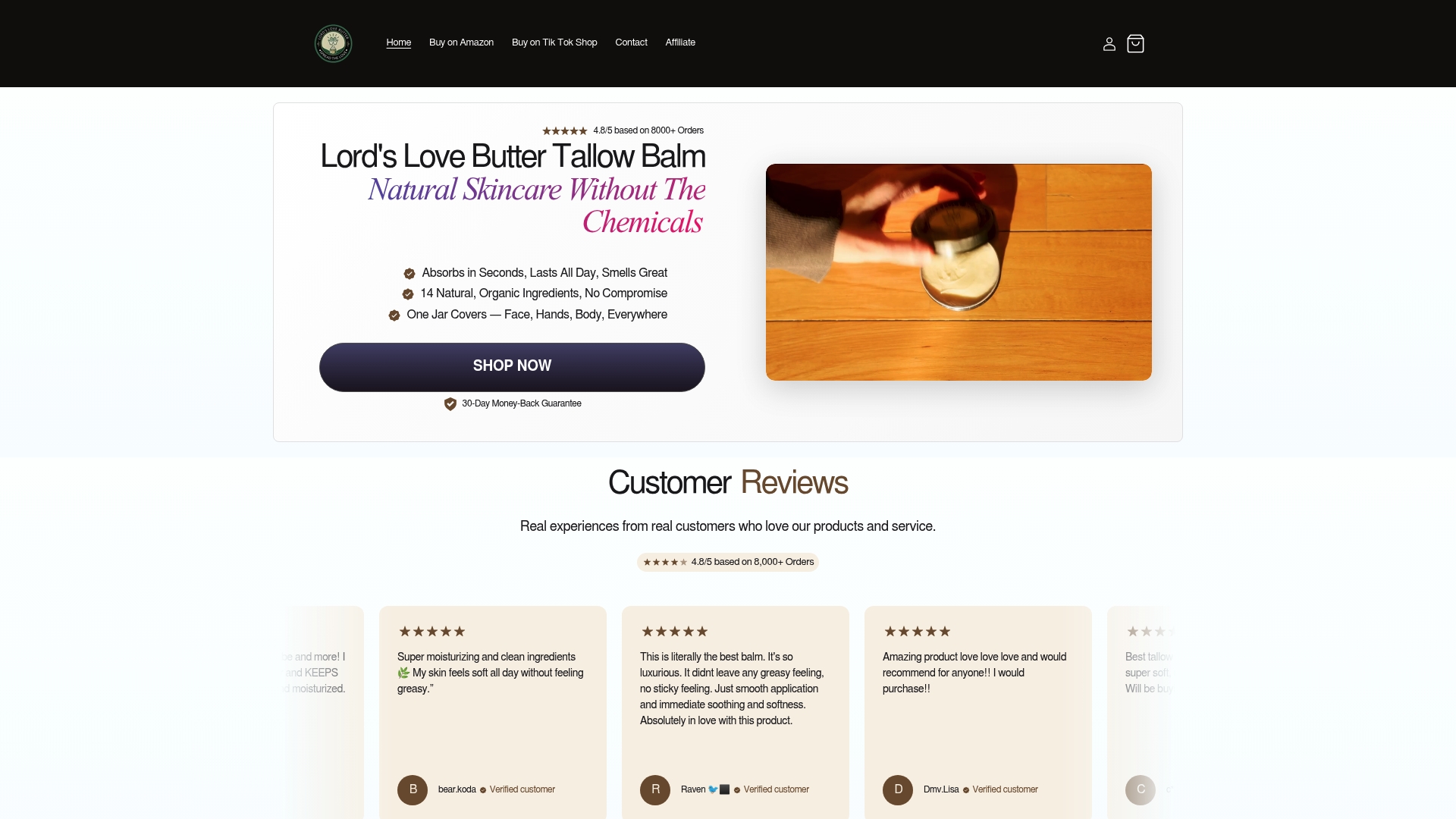
If you’re not ready to commit to a full jar, start with the 2.4 oz travel tin and patch test it on a small area for a few days before working it into your nightly routine. For a closer look at how it’s sourced and what’s actually in the formula, the full product page breaks down the ingredient list in detail. If you’re on a prescribed biologic or topical steroid, check with your dermatologist before adding it in, and if lips are dry and cracked alongside your plaques, the Mint Tallow Lip Balm covers that on its own. Ready to trial it properly? Grab the travel tin, patch test tonight, and give it a week before judging the results.
Where to Read More on Psoriasis Care and Home Remedies
For clinical framing on what moisturizers can and can’t do, the National Psoriasis Foundation’s guidelines are the most direct patient resource available. The Cleveland Clinic’s overview of home remedies covers clinician-level caution on unregulated topical options. For a broader look at natural compound research, the PMC systematic review lays out where evidence is strongest and where it’s still thin.
This article is general information, not a substitute for advice from a qualified doctor. Consult a qualified healthcare professional about your own circumstances before acting on anything here.
Sources
- National Psoriasis Foundation: Clinical guidance / psoriasis information
- Cleveland Clinic: Home remedies for psoriasis — clinician guidance
- PMC: Systematic review on plant-based approaches and natural compounds for psoriasis
FAQ
Which is better for my skin, beef tallow or coconut oil?
For most psoriasis-prone or dry, compromised skin, grass-fed tallow tends to work better as a nightly barrier moisturizer because its fatty-acid profile is closer to human sebum. Coconut oil can still help on non-facial body plaques, but its higher comedogenic risk makes it a poorer fit for anyone prone to breakouts.
What type of oil is best for psoriasis?
There’s no single oil proven to treat psoriasis, since the disease is immune-driven and moisturizers only manage symptoms like dryness and scaling, according to the National Psoriasis Foundation. Heavier, sebum-like fats such as tallow tend to hold moisture longer on thick plaques than lighter oils like coconut oil.
Why don’t dermatologists like beef tallow?
It’s not that dermatologists dislike tallow outright. Many simply point out that its popularity has outpaced the clinical evidence behind it, and they recommend patch testing and clinician oversight rather than treating it as a proven remedy.
What are people saying about the tallow and honey balm for psoriasis?
Some customers report experiencing softer, less flaky skin within days of nightly use of Lord’s Love Butter’s Manuka honey and tallow balm on dry patches. These individual accounts are anecdotal and not from clinical studies. The balm should be used as a supportive step alongside prescribed psoriasis treatments, not as a replacement.
Can I use tallow or coconut oil alongside my prescribed psoriasis medication?
Yes, in most cases, but timing matters. Apply your prescribed topical first, let it fully absorb, then follow with the oil, and check with your dermatologist first if you’re using a systemic biologic or a strong topical steroid, per Cleveland Clinic guidance.