
Tallow can soothe psoriasis by softening scale and locking in moisture, but it is not a proven treatment for the underlying immune condition that causes plaques in the first place. No high-quality human trial has tested plain beef tallow against psoriasis, so any relief you feel is symptomatic, not disease-modifying. Patch test any new tallow product before applying it broadly, and never stop a prescribed treatment without talking to your dermatologist first.
TL;DR:
- No controlled clinical trial has tested beef tallow specifically for reducing psoriasis severity or symptoms.
- Most online enthusiasm stems from personal reports and anecdotal support rather than peer-reviewed scientific evidence.
- Tallow may soften scale and improve hydration temporarily but does not influence the immune mechanisms driving psoriasis plaques.
- Using high-quality, unscented, grass-fed tallow and conducting a patch test is essential to reduce allergy or irritation risks.
- Expect quick relief of discomfort and itch within days, but significant changes in plaques generally take several weeks of consistent application.
Table of Contents
- What Does the Research Say About Tallow for Psoriasis?
- Why Tallow Feels Soothing: Fatty Acids, Vitamins, and the Skin Barrier
- Is It Safe? Risks, Reactions, and a Patch-Test Protocol
- How Do You Actually Trial Tallow on a Psoriasis Plaque?
- What Real Users and Lord’s Love Butter’s Experience Show
- Should You Actually Try It? A Straight Answer
- Want to Try a Vetted Tallow Balm Instead of Guessing With Homemade?
- Sources
- FAQ
What Does the Research Say About Tallow for Psoriasis?
Here’s the honest state of the science: there isn’t much of it, at least not aimed directly at psoriasis. A 2025 cross-sectional analysis of social-media claims about beef tallow found something worth sitting with. The volume of posts recommending tallow for acne, eczema, and psoriasis outpaces the clinical evidence behind those claims by a wide margin, and many of the people making those claims had a financial stake in the answer being yes.
That matters because psoriasis sufferers searching “tallow for psoriasis” are often landing on content built to sell them something, not to inform them. The researchers behind that analysis found that promoters frequently lacked healthcare credentials and rarely cited any supporting research at all.
A separate review of the dermatology literature through August 2026 came to a similarly restrained conclusion: no controlled human trial has tested plain beef tallow as a psoriasis treatment. The same review notes tallow may soften scale and improve day-to-day comfort, but comfort is not the same as clearing a lesion or interrupting the immune signaling that drives one.
Where the science gets more interesting is at the component level, not the product level. Researchers studying resolved psoriasis lesions found that skin rich in oleic acid showed a lower T-cell-driven IL-17 signature, the inflammatory pathway central to plaque formation. Oleic acid happens to be one of the dominant fatty acids in beef tallow.
That is a real and interesting data point. It is also not a study of tallow. It is a study of a fatty acid found in tallow, measured in a lab context, under conditions nobody has replicated with a jar of whipped balm and a psoriasis plaque on someone’s elbow. Component evidence gives you a reason to believe something might work. It does not prove that a finished product, applied at home, produces the same effect.
Three points worth holding onto if you’re evaluating any claim you read about tallow and psoriasis:
- No randomized, controlled human trial has tested beef tallow specifically against psoriasis symptoms or severity.
- Most of the enthusiasm you see online traces back to individual reports, not peer-reviewed outcomes data.
- Financial bias is common enough in this space that dermatology researchers flagged it as a distinct concern, not a side note.
None of this means tallow is useless. It means the honest label for tallow is “plausible moisturizer with anecdotal support,” not “natural cure.” That distinction should shape how you use it.
Why Tallow Feels Soothing: Fatty Acids, Vitamins, and the Skin Barrier
Tallow’s main fatty acids, oleic, stearic, and palmitic acid, closely resemble the lipid mix already found in human sebum. That similarity is likely why so many people describe tallow as absorbing “like their own skin” rather than sitting on top of it the way some plant oils do.
Those fatty acids do two practical things once applied to a psoriasis plaque. First, they occlude the skin surface, which slows transepidermal water loss, the process by which moisture escapes through damaged or thickened skin. Psoriasis plaques already struggle to hold water because the barrier is disrupted, so reducing that water loss can genuinely soften scale and ease the tight, cracked feeling that makes flares miserable. Second, the fat content helps mechanically loosen built-up scale, making it easier to shed without picking or scratching, which itself can trigger new plaques through a mechanism called the Koebner phenomenon.
Tallow also carries fat-soluble vitamins, including small amounts of vitamin A and vitamin D, in a lipid base that helps them stay stable. That said, don’t confuse this with medical-grade retinoid or vitamin D analog treatments. Prescription options like calcipotriene deliver concentrated, standardized doses formulated specifically to modulate skin cell turnover. Tallow’s vitamin content is incidental, not therapeutic in that same sense.
A few things to keep straight when you’re weighing tallow’s role:
- It can reduce water loss and soften scale, which often eases itch and discomfort within days.
- It does not appear to modulate the T-cell and cytokine activity that drives psoriasis at the immune level.
- Its vitamin content is present but nowhere near the concentration or delivery precision of prescription topicals.
Symptomatic relief and disease control are two different jobs. Tallow does the first reasonably well. It was never built to do the second.
Is It Safe? Risks, Reactions, and a Patch-Test Protocol
The biggest risks with tallow aren’t exotic. They’re the same ones you’d expect from any new topical: contact dermatitis, clogged pores, and, if you’re using homemade or poorly rendered tallow, contamination.
Dermatologists interviewed about the tallow trend have been consistent on one point. Raw or low-quality tallow can carry impurities and lacks any formulation standard, which raises the odds of irritation, especially on skin that’s already inflamed from a psoriasis flare. Poor rendering or filtration can leave behind protein residues or rancid fat, both of which are more likely to trigger a reaction than clean, properly processed tallow.
There’s also the acne question. Facial application in particular carries a real risk for people who are already acne-prone, since tallow can be comedogenic in some individuals even though it isn’t for others. Psoriasis on the face is less common than on elbows, knees, or the scalp, but if you’re considering it, treat facial trials with extra caution.
Here’s a practical patch-test protocol before you use tallow anywhere near an active plaque:
- Apply a pea-sized amount to a small area of unaffected skin, like the inner forearm.
- Wait 48 to 72 hours, checking twice a day for redness, swelling, bumps, or itching beyond baseline.
- If the area stays calm, apply a small amount directly to one psoriasis plaque and monitor for another 3 to 5 days before expanding use.
- Stop immediately if you notice increased redness, new pustules, or a spreading rash, and switch back to your regular routine.
Pro Tip: Keep a phone photo log of the patch-test site on day one, day three, and day seven. Subtle changes in redness or texture are much easier to catch in side-by-side photos than in memory.
One rule overrides everything else here: never taper or stop a prescribed topical steroid, biologic, or phototherapy regimen on the assumption that tallow is doing the same job. If you want to adjust your treatment plan, that conversation belongs with your dermatologist, not your skincare cabinet.
How Do You Actually Trial Tallow on a Psoriasis Plaque?
Start with an unscented, grass-fed, cosmetic-grade tallow. Skip anything with added essential oils or fragrance, since fragrance compounds are among the most common topical irritants, and inflamed psoriasis skin has less tolerance for them than healthy skin does. A fragrance-free formulation removes one entire category of risk before you even start.
Application is simple, but the details matter. Warm a small amount of tallow between your fingers until it turns from solid to a soft, spreadable texture, then apply it to slightly damp skin right after a shower or bath. Damp skin holds moisturizer better than dry skin, which helps trap water underneath the fat layer rather than just coating the surface. Most people find once or twice daily works well, using a thin layer for small plaques and slightly more for larger, thicker patches on the elbows or knees.
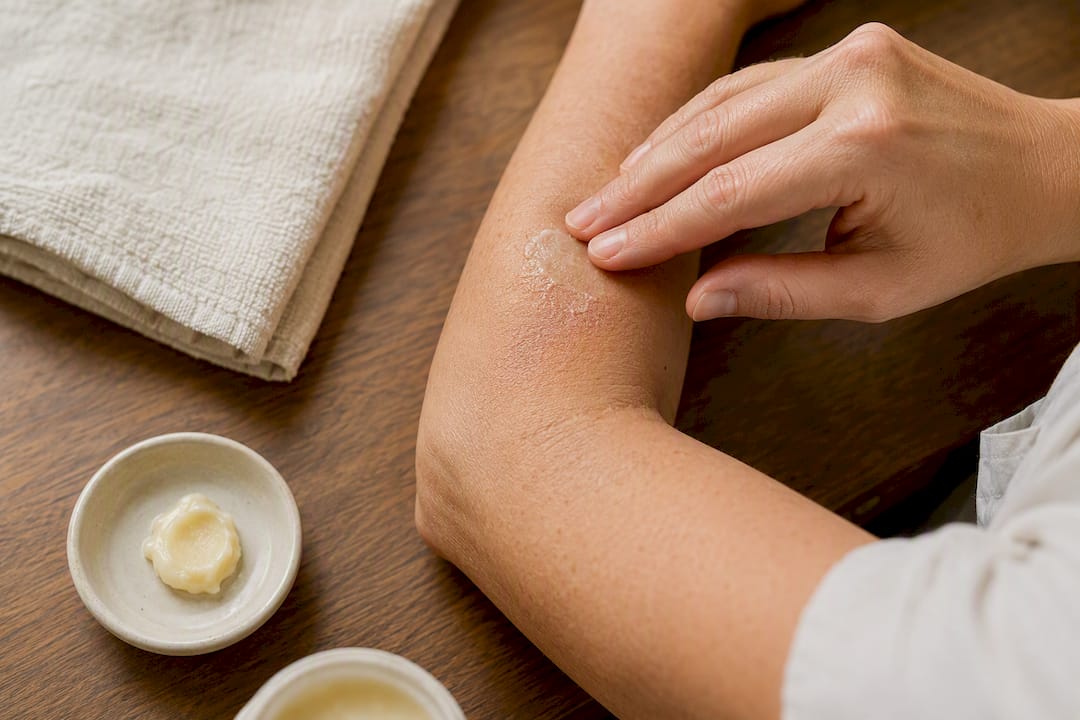
For the scalp, part the hair in sections and massage a small amount directly onto plaques rather than saturating the whole scalp, which can leave hair looking greasy without adding benefit. If you’re trying it on the face, use a noticeably smaller amount than you would on the body and watch closely for new breakouts over the following week.
What can you realistically expect?
- Comfort and itch relief often show up within days of consistent use, since occlusion and hydration work fast.
- Visible changes in plaque thickness typically take 3 to 6 weeks of consistent application, if they happen at all.
- Some plaques may not respond meaningfully to moisturization alone, particularly thick, long-standing lesions that usually need medical therapy.
Set your expectations around comfort, not cure, and you won’t be disappointed by week two.
What Real Users and Lord’s Love Butter’s Experience Show
Michael built Lord’s Love Butter as a veteran-owned brand around one idea: skin that’s already struggling doesn’t need more chemicals thrown at it. The balm is whipped from grass-fed beef tallow with no synthetic fillers, and it was designed from day one with sensitive, reactive skin in mind, including eczema and psoriasis-prone skin.
Customer feedback collected through the brand’s own blog and product reviews describes a fairly consistent pattern: noticeably softer, less flaky skin texture within days of starting regular use. That’s worth sharing, and it’s also worth being straight about what it is and isn’t. These are customer reports, not clinical trial data, and they carry the same selection bias any testimonial does. People who had a good experience are more likely to write about it than people who didn’t notice a difference.
What the brand does offer beyond anecdotes:
- Detailed patch-testing guidance built into product pages and blog posts, not buried in fine print.
- Case-study style write-ups comparing tallow against other moisturizing approaches for eczema and dry, irritated skin.
- Clear formulation notes so you know exactly what’s in the jar before it touches inflamed skin.
If you’re curious but cautious, that combination, real product transparency plus a mandatory patch-test mindset, is the right way to approach any new topical for psoriasis, tallow included.
Should You Actually Try It? A Straight Answer
My honest read on tallow for psoriasis is that the enthusiasm has outrun the evidence, but that doesn’t mean the enthusiasm is baseless. The fatty acid profile gives it real mechanical value as a barrier-repair moisturizer, and plenty of people genuinely feel better using it. The mistake is treating comfort as proof of treatment. Patch test first, choose an unscented grass-fed formulation, keep close watch on how your skin responds over the first week, and don’t let a soothing balm talk you into skipping medication that’s actually managing your immune response. Used that way, tallow earns a reasonable spot in a psoriasis routine, just not the top spot.
— Michael
Want to Try a Vetted Tallow Balm Instead of Guessing With Homemade?
Homemade tallow varies wildly in quality depending on how it’s rendered and filtered, and inconsistent batches are exactly what dermatologists warn against when they flag contamination risk. A commercially prepared, whipped beef tallow balm skips that guesswork entirely, since every batch goes through the same process instead of varying jar to jar.
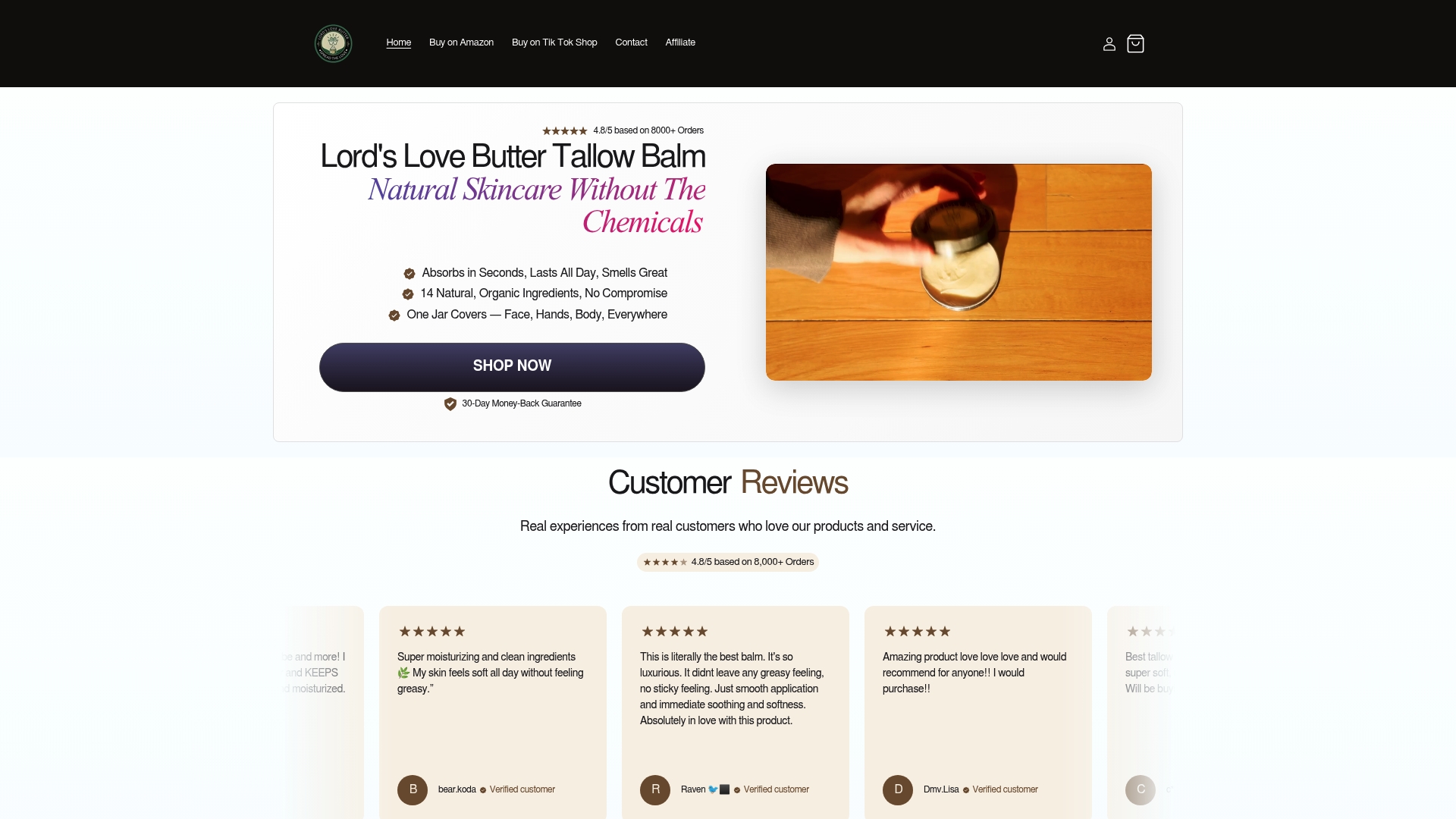
Before buying anything, check for three things: a grass-fed source, no added fragrance, and a full ingredient list you can actually read. Lord’s Love Butter’s lightweight balm option is a reasonable starting point for sensitive or psoriasis-prone skin, since it’s formulated to absorb without heaviness. If you’d rather start small before committing to a full jar, the 2.4 oz travel tin is sized for exactly the kind of patch test this article recommends, giving you enough product to trial a plaque or two without buying a full-size jar sight unseen. Once you know it agrees with your skin, the full 2.4 oz jar covers ongoing daily use, and the mint lip balm stick is worth a look if dry, cracked lips are part of your flare pattern too. Grab a travel tin, run the patch test, and see how your skin responds before scaling up.
Sources
- Beef Tallow‑Based Skincare Claims in Social Media: A Cross‑Sectional Analysis
- Beef Tallow for Skin: What the Science Says - Scenic Dermatology
- Dermatologists share their verdict on beef tallow in skincare - ABC News
This article is general information, not a substitute for advice from a qualified doctor. Consult a qualified healthcare professional about your own circumstances before acting on anything here.
FAQ
Is Tallow Good for Psoriasis, or Just Marketing Hype?
Tallow can moisturize and soften psoriasis scale, but no clinical trial has shown it treats the underlying condition, so treat it as a comfort measure rather than a cure.
What Type of Oil Is Best for Psoriasis?
There’s no single best oil backed by strong clinical evidence; occlusive, fatty-acid-rich options like tallow and certain plant oils can support hydration, but prescription treatments remain the only proven way to manage plaques.
Why Are Some Dermatologists Cautious About Tallow?
Dermatologists point to a lack of formulation standardization and the risk that raw or poorly rendered tallow can irritate skin or clog pores, especially on sensitive or acne-prone skin.
How Do I Tell a Tallow Reaction Apart From a Psoriasis Flare?
A tallow reaction typically appears as new redness, bumps, or itching in the exact area of application within a few days, while a psoriasis flare usually follows your existing plaque pattern and can appear with or without any new product.
Can I Use Tallow Alongside My Psoriasis Medication?
Yes, tallow can generally be layered with prescribed topicals once fully absorbed, but always check with your dermatologist first, since some medications need direct skin contact without a barrier on top.