

Signs Your Eczema Barrier Is Healing: What to Look For
Yes, you can usually tell your skin barrier is healing before a flare fully disappears. The most reliable signs are less oozing, redness fading from angry red to dusky pink or brown, skin shifting from wet and raw to dry and flaky, itching that grows milder and less frequent, and moisturizer that starts lasting longer between applications. Mild irritation often turns a corner within a short period; moderate flares usually require a few weeks of consistent care; severe or chronic patches can take a prolonged time to heal. Track these signs weekly, keep supporting the barrier with gentle care, and call a clinician if you spot yellow crusting, spreading redness, or no improvement at all.
- Oozing and weeping slow down or stop
- Redness fades from bright red toward pink, brown, or your normal skin tone
- Skin texture moves from raw/wet to dry, flaky, or scaly
- Itching becomes milder and less constant
- Moisturizer sits on the skin longer instead of absorbing instantly
- Skin feels less tight, less hot, and slightly more flexible
Key Takeaways
Barrier repair shows up as less oozing, fading redness, drier texture, calmer itch, and moisturizer that lasts longer, generally occurring over a period of weeks depending on flare severity.
| Point | Details |
|---|---|
| Watch the itch trend | Gradual, mild itch signals healing; constant, intense itch signals an active flare. |
| Track texture, not just color | Skin moving from wet/weeping to dry/flaky is a stronger repair signal than redness alone. |
| Know your red flags | Yellow crusting, spreading redness, or fever means see a clinician, not wait it out. |
| Match timeline to severity | Mild flares may resolve relatively quickly; severe or chronic cases can require months to improve. |
| Support repair with occlusive balms | Products like Lordslovebutter’s whipped tallow balms help lock in moisture during the dry, flaking phase. |
This article is general information, not a substitute for advice from a qualified doctor. Consult a qualified healthcare professional about your own circumstances before acting on anything here.
Table of Contents
- What Skin Barrier Healing Actually Means in Eczema
- The Stages of Eczema Healing: What Each Phase Looks Like
- What Are the Concrete Signs Your Skin Barrier Is Repairing?
- When Your Skin Barrier Isn’t Healing: Red Flags to Watch
- How to Support Barrier Repair Day to Day
- How Long Does Barrier Repair Actually Take?
- What Does the Clinical Evidence Say About Healing Signs?
- A Practical View From Someone Who Formulates for This Skin
- A Simple, Gentle Option While Your Barrier Recovers
- Sources
What Skin Barrier Healing Actually Means in Eczema
Your skin barrier lives in the outermost layer, the stratum corneum, a brick-and-mortar structure of dead skin cells (bricks) held together by a lipid matrix (mortar) made of ceramides, cholesterol, and fatty acids. That mortar does one job that matters most for eczema: it controls transepidermal water loss (TEWL), the rate at which water escapes through your skin into the air. When the lipid matrix is intact, water stays in and irritants stay out.
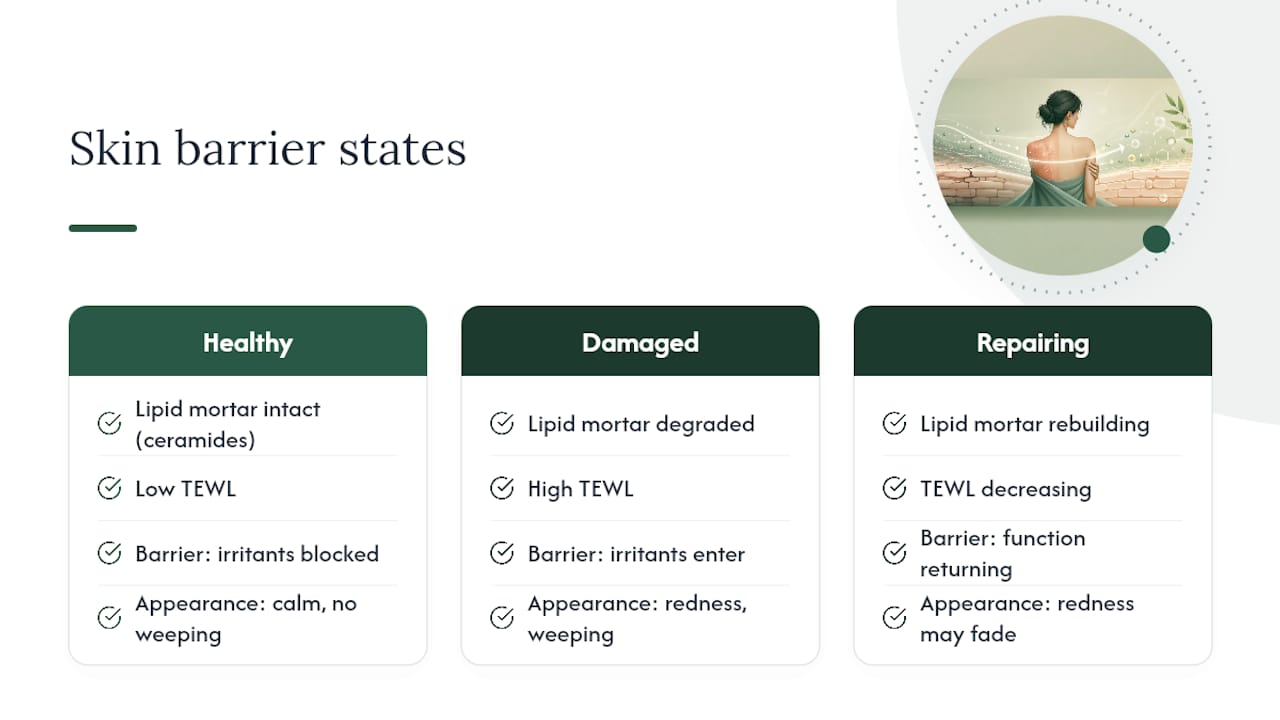
Eczema breaks that mortar down. Inflammation degrades the lipid layer, cracks open microscopic gaps, and in active flares causes visible weeping where fluid escapes through broken skin. Here’s the part people miss: redness fading doesn’t always mean the mortar is rebuilt. A patch can look calmer while TEWL is still elevated underneath, which is why some flares seem to “come back” a week after they looked resolved. Real repair is a function change, not just a color change, according to the NCBI Bookshelf’s overview of atopic dermatitis.
Pro Tip: Dermatology offices sometimes use TEWL meters and corneometry devices to measure barrier function directly, and while you won’t have one at home, you can approximate the same idea by timing how long your skin stays soft after moisturizing. A jump from 30 minutes to 3 hours is a real signal.
The Stages of Eczema Healing: What Each Phase Looks Like
Eczema doesn’t heal in a straight line. It moves through recognizable stages, and knowing which one you’re in stops you from panicking over normal transitions.
Acute stage. This is the active flare: bright red, swollen, sometimes weeping or oozing skin. It can feel hot to the touch and itches intensely, often disrupting sleep. This is when the barrier is most compromised and most vulnerable to infection.
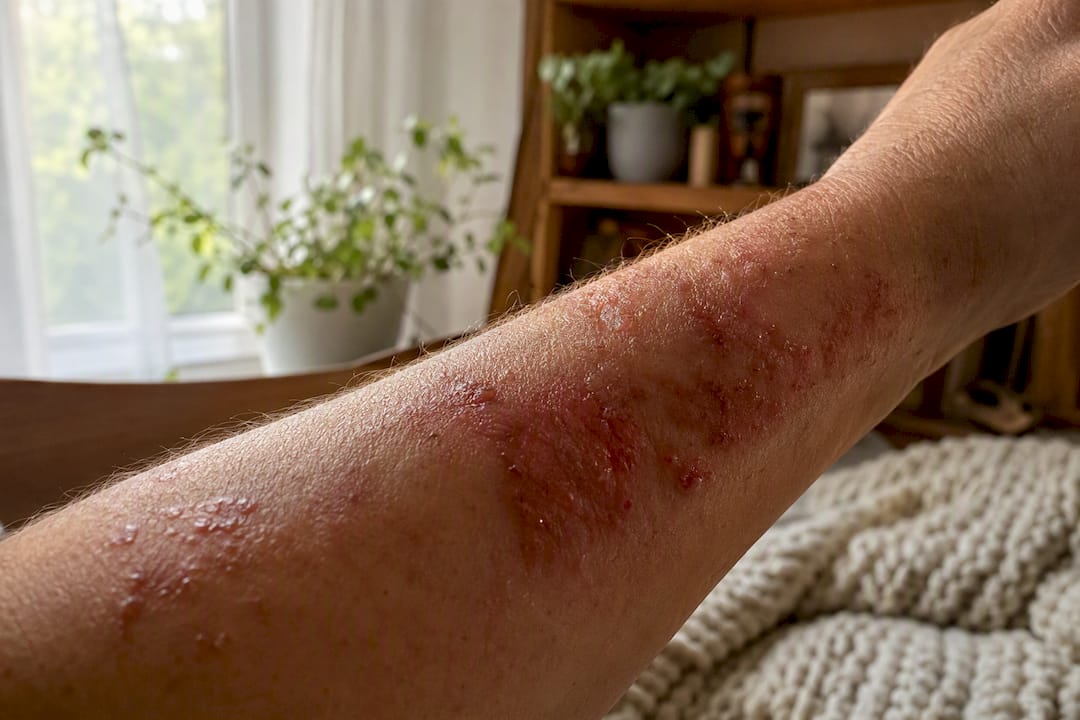
Subacute stage. The oozing dries up and the skin starts crusting or forming a thin scale. Redness dulls from fire-engine red to a duller pink or reddish brown. Itch usually persists here but with less intensity, and you may notice small flakes shedding as new skin cells replace damaged ones.
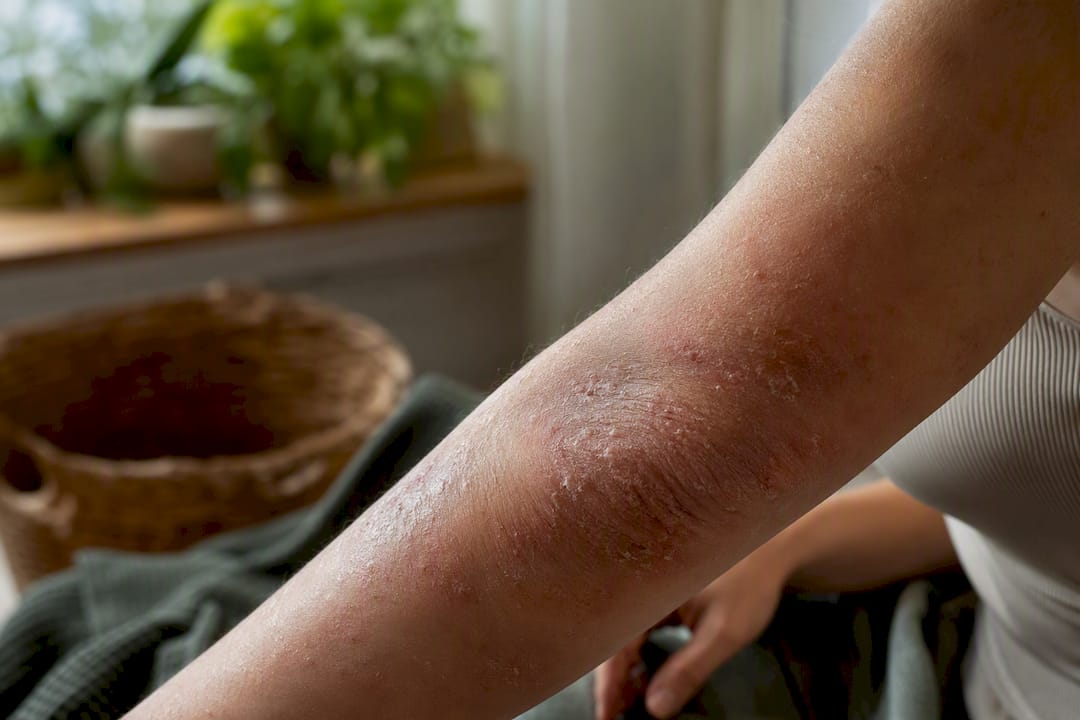
Chronic or recovery stage. Active inflammation has largely resolved. What’s left is often dry, thickened skin (called lichenification) from prior scratching, along with lighter or darker patches where inflammation used to be. This pigment change isn’t a failure to heal. It’s a separate, slower process that can trail behind actual barrier repair by weeks or months, per findings reviewed on PubMed.
One thing that trips people up: itch can briefly spike during the subacute stage as scabs tighten and new skin forms underneath. That’s a mechanical irritation, not necessarily a sign the flare is worsening. Scab formation itself is often a sign of drying out, which is progress, not regression, according to guidance from Medical News Today.
- Acute: red, swollen, weeping, high itch, hot to the touch
- Subacute: drying, crusting, flaking, moderate and decreasing itch
- Chronic/recovery: calmer inflammation, dry or thickened skin, lingering pigment changes
Pro Tip: Photograph the same patch every three to four days, same time of day, same lighting near a window, same distance from the camera. Include a small object like a coin for scale. Side-by-side comparisons over two weeks show trends that a single glance in the mirror will not.
What Are the Concrete Signs Your Skin Barrier Is Repairing?
Cosmetic improvement and true barrier repair aren’t the same thing, and telling them apart comes down to specific, testable observations rather than a general “it looks better” impression.
- Less oozing or weeping. Fluid loss through broken skin is one of the clearest markers of an unrepaired barrier, so its absence is meaningful.
- Reduced heat at the site. Active inflammation runs warm; a patch that no longer feels noticeably hotter than surrounding skin is calming down.
- Itch that’s milder and less frequent. A gradual drop in itch intensity signals the barrier regaining some protective function, while itch that stays intense and unrelenting usually points to an active flare rather than recovery, based on findings from Medical News Today.
- Dry, flaky texture replacing wet or blistered skin. This shift shows the surface is closing over rather than staying open.
- Shrinking rash size or lower elevation. Flat, smaller patches beat raised, spreading ones.
- Better elasticity, less cracking. Skin that bends without splitting has more functional lipid content than skin that fissures.
- Moisturizer lasting longer. If you used to reapply every hour and now go three or four, your barrier is retaining more of what you put on it.
Two quick home checks help confirm what you’re seeing. First, a gentle pinch test: lightly pinch a small fold of skin and release it. Skin that snaps back quickly has more elasticity than skin that stays tented. Second, a moisturization longevity check: apply your usual product and note when the area starts feeling tight or dry again. Longer intervals over successive weeks are a genuine improvement, not just wishful thinking.
The itch distinction matters most. Healing itch tends to be mild, intermittent, and tied to dryness or scab tightening. A new or worsening flare brings itch that’s intense, constant, and paired with fresh redness or spreading beyond the original patch.
When Your Skin Barrier Isn’t Healing: Red Flags to Watch
Some signs mean the barrier isn’t repairing at all, and they call for a clinician rather than more patience.
- Yellow or honey-colored crusting, which often signals secondary bacterial infection
- Persistent oozing or new drainage that hasn’t slowed after a reasonable stretch of consistent care
- Redness that keeps expanding rather than shrinking
- Increasing warmth, swelling, or pain at the site
- Fever alongside a worsening skin patch
- No visible improvement after weeks of following a treatment plan as directed
These signs commonly point to a secondary bacterial infection, ongoing exposure to an unidentified trigger, an emollient routine that’s too thin or infrequent, or misuse (overuse or underuse) of prescribed topical steroids, according to Cleveland Clinic’s guidance on infected eczema.
Pro Tip: If you see honey-colored crusting or drainage that smells off, don’t wait it out. See a clinician promptly. Infected eczema often needs antibiotics or a revised topical plan before the barrier can resume repairing itself.
How to Support Barrier Repair Day to Day
Supporting repair comes down to a handful of habits done consistently, not a complicated regimen.
- Cleanse gently. Use lukewarm water and a fragrance-free, low-lather cleanser. Skip hot showers and vigorous scrubbing, both of which strip lipids you’re trying to rebuild.
- Moisturize immediately after washing. The “soak and seal” method, applying a rich moisturizer within a few minutes of patting skin dry, traps water in the stratum corneum rather than letting it evaporate.
- Stick to a schedule, not a feeling. Apply emollients at set times (morning, after showering, before bed) instead of only when skin feels dry.
- Use prescribed topicals exactly as directed. Under or overusing a steroid cream disrupts the “get control and keep control” approach clinicians favor: calm active inflammation first, then maintain hydration to prevent relapse, per Healthgrades’ overview of eczema healing stages.
- Try wet-wrap therapy if your clinician recommends it for stubborn or severe patches.
Avoid harsh soaps, added fragrance, alcohol-based products, and excessive layering of actives while skin is actively healing, following gentle, nonirritating naturopathic approaches to support your barrier’s recovery. Favor minimal-ingredient moisturizers, apply while skin is still damp, and patch-test anything new on a small area for 48 hours before using it broadly.
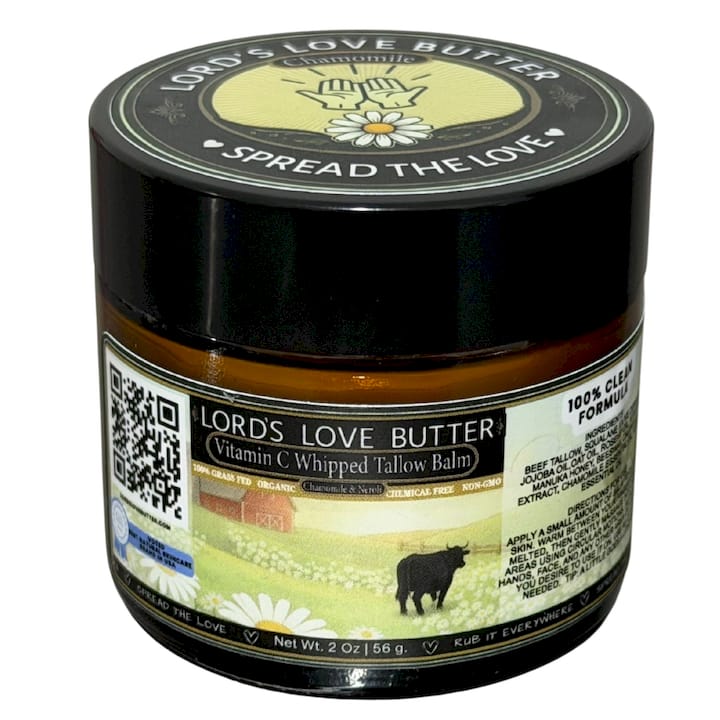
Occlusive, lipid-rich balms are particularly useful during the dry, flaking phase because they slow water loss through skin that’s already compromised. For readers looking for that kind of coverage, Lordslovebutter’s Beef Tallow Sun Balm Stick with Zinc Oxide offers physical protection alongside hydration, while the Vitamin C Whipped Beef Tallow Balm with Manuka Honey & Squalane suits maintenance once acute inflammation has settled. Always patch-test first, and understanding why eczema skin loses moisture in the first place helps explain why consistent occlusion matters so much.
Pro Tip: Store balms away from direct heat, which can separate the lipid structure. When layering with a prescription topical, apply the medication first, wait a few minutes for absorption, then seal with your moisturizer.
How Long Does Barrier Repair Actually Take?
Timelines vary by severity, and expecting overnight results sets you up for false discouragement.
- Mild irritation: days to about two weeks
- Moderate flares: roughly two to six weeks of consistent care
- Severe or chronic patches: several weeks to a few months, especially with lichenification or repeated flares
Infection, ongoing irritant exposure, and inconsistent treatment all stretch these ranges. Compare photos taken under the same lighting and distance week to week rather than trusting daily glances, which are too noisy to show real trends. One more thing worth remembering: leftover pigment changes, lighter or darker patches where inflammation used to sit, can persist well after the barrier itself has recovered. That’s a cosmetic remnant, not proof the healing failed, a distinction supported by dermatology literature on chronic eczema features.
What Does the Clinical Evidence Say About Healing Signs?
- Itch intensity tracks disease activity closely: sharp, constant itch usually means an active flare, while itch that fades gradually is one of the more dependable signs of barrier recovery, per Medical News Today.
- The acute, subacute, and chronic framework is the standard clinical model for describing how eczema lesions progress and resolve.
- Clinicians flag yellow crusting, spreading redness, and non-response to treatment as the core criteria for suspecting infection and considering antibiotics.
Eczema is best understood as a chronic, relapsing condition managed through trigger avoidance and consistent barrier care, not a problem that gets solved once and stays solved, according to the National Eczema Association.
This article offers general information and isn’t a substitute for an individual diagnosis or treatment plan from a dermatologist or your primary care provider.
A Practical View From Someone Who Formulates for This Skin
I’ve watched customers describe the same pattern over and over: the oozing stops first, then the redness dulls, then the itch finally lets up, usually in that order. It tracks with what the research says about staged healing. Lordslovebutter formulates with sensitive, reactive skin in mind, but patch-test any new balm, especially on skin that’s still actively flaring.
A Simple, Gentle Option While Your Barrier Recovers
Once the oozing has stopped and skin has moved into the dry, flaky phase, a rich occlusive balm is often the single most useful thing you can add to a routine. Lordslovebutter’s whipped beef tallow balms are formulated without synthetic fragrance or filler ingredients, closely mirroring the lipid composition your skin is trying to rebuild, which is why they layer well over prescribed topicals rather than fighting them.
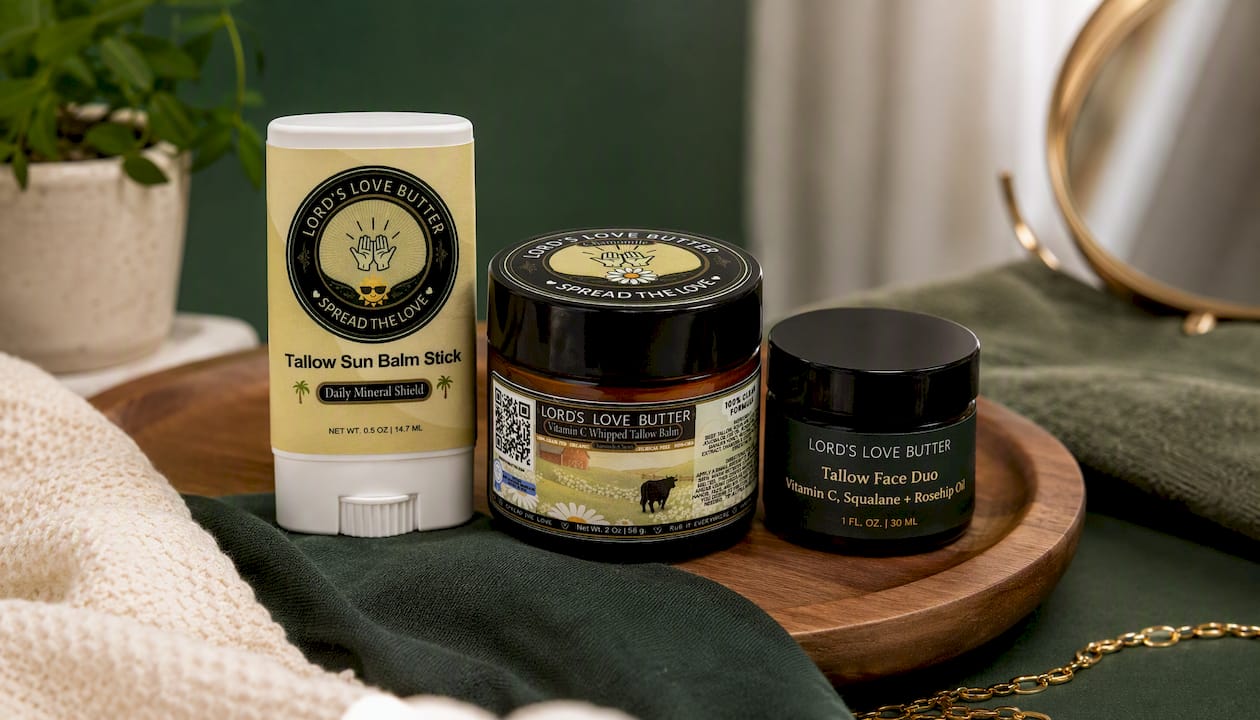
Apply a thin layer while skin is still damp from a shower, and if you’re using a prescription cream, let it absorb for a few minutes first. For facial or delicate areas, the Tallow Face Duo with Vitamin C, Squalane, and Rosehip Oil offers a lighter option built for daily maintenance rather than heavy occlusion. Patch-test any new product on a small area for 48 hours before wider use, and hold off on introducing anything new if skin is still open or heavily weeping. That’s a job for a clinician first. Once your skin has moved past the acute stage, browse Lordslovebutter’s balm options and pick the one that matches where your skin actually is right now.
Sources
- Does eczema itch when healing? | Medical News Today
- Infected eczema | Cleveland Clinic
- Eczema healing stages and support | Healthgrades
- Atopic Dermatitis (Eczema) — NCBI Bookshelf
- Eczema facts | National Eczema Association

