

Tallow and Zinc Sunscreen: Does It Actually Protect You?
A tallow and zinc sunscreen can provide real, broad-spectrum UV protection — but only when zinc oxide is the listed active ingredient, the formula has been properly made and tested, and you apply it correctly. Tallow is the moisturizer. Zinc oxide is what blocks the sun.
The short version:
- Zinc oxide is the only UV filter in these products. Tallow contributes nothing to SPF — it softens, hydrates, and helps the formula spread.
- A product earns the label “sunscreen” (not just “sun balm”) when it lists a zinc oxide percentage, carries a broad-spectrum claim, and has a validated SPF value from lab testing.
- Non-nano zinc oxide labeling, grass-fed tallow sourcing, and clear reapplication instructions are the trust signals worth looking for.
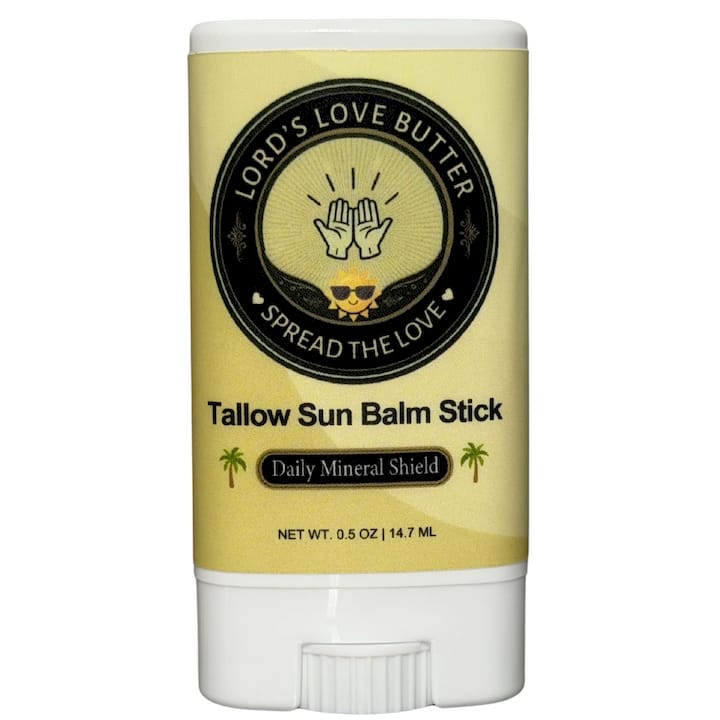
- For a ready-to-buy option that checks those boxes, Lordslovebutter’s Beef Tallow Sun Balm Stick with Zinc Oxide is the considered in-category choice.
Table of Contents
- What is a tallow and zinc sunscreen, exactly?
- How zinc oxide protects you and what tallow actually does
- What to check on the label before you buy
- Who benefits most from a tallow + zinc combination
- Limitations and dermatologist cautions you should know
- How to apply tallow + zinc sunscreen so it actually works
- How to choose a tallow + zinc product without getting burned
- Why Lordslovebutter’s Beef Tallow Sun Balm is worth a close look
- Where to buy and what to expect on price
- Key Takeaways
- Why we make a tallow + zinc sun balm
- Lordslovebutter’s Beef Tallow Sun Balm: formats and how to order
- Useful sources and further reading
What is a tallow and zinc sunscreen, exactly?
The name describes the formula directly: rendered beef tallow as the base, zinc oxide as the active UV filter. That two-ingredient core is what separates this category from conventional mineral sunscreens, which typically use synthetic emollients like caprylic/capric triglyceride or dimethicone instead of tallow.
Each ingredient has a distinct job:
- Zinc oxide — is a physical, broad-spectrum UV filter recognized by the FDA as a safe and effective active ingredient for sunscreens in the U.S. It sits on the skin surface and reflects or scatters both UVA and UVB radiation. Concentration directly affects SPF.
- Beef tallow — is an occlusive emollient. It softens skin, reduces transepidermal water loss, and gives the formula its balm-like texture. Its fatty-acid profile — rich in oleic, palmitic, and stearic acids — closely mirrors human sebum, which is why it absorbs readily without the synthetic-coating feel many people dislike.
One point that cannot be overstated: tallow provides zero UV protection on its own. No amount of grass-fed sourcing, traditional use history, or fatty-acid similarity to sebum changes that. If a product does not list zinc oxide as an active ingredient with a stated percentage, it is a moisturizing balm — full stop.
The EWG’s sunscreen guidance reinforces this distinction: a product claiming sun protection must list a recognized active ingredient, an SPF value, and broad-spectrum labeling to be treated as a sunscreen under U.S. rules.
How zinc oxide protects you and what tallow actually does
Zinc oxide works as a physical blocker. Unlike chemical UV filters that absorb UV energy and convert it to heat, zinc oxide particles sit on the skin surface and scatter incoming UVA and UVB radiation before it penetrates. Higher zinc oxide concentration generally produces higher SPF, though the relationship is not perfectly linear — particle size, coating, and how evenly the product spreads all affect real-world performance.
Tallow’s contribution is more about the experience of wearing the product. Because its fatty-acid profile mimics skin sebum, it absorbs without leaving a heavy film, and its occlusive nature helps lock in moisture under the zinc oxide layer. For very dry or compromised skin, that barrier support is genuinely useful — not just a marketing claim.
Where formulation gets complicated is at the intersection of these two ingredients. Zinc oxide particles need to be evenly dispersed throughout the base to deliver consistent coverage. If the tallow base is too soft at body temperature, the product can migrate, pool, or apply unevenly — which means some patches of skin get more zinc oxide than others. Dermatologists quoted in medical reporting note that proper homogenization, appropriate emulsifiers, and validated SPF testing are what separate a functional mineral sunscreen from a tallow balm with zinc stirred in.
Pro Tip: When applying a balm-format zinc sunscreen, warm a small amount between your palms first. This softens the tallow slightly and helps the zinc oxide disperse more evenly as you spread it, reducing the chance of patchy coverage or a visible white cast on the skin.
A few things that affect real-world protection:
- Tallow’s richness can reduce how well the product adheres to skin during sweating or water exposure, especially in formulas without added water-resistance agents.
- Non-nano zinc oxide (particles larger than 100 nanometers) stays on the skin surface rather than penetrating, which is the preferred choice for both safety and efficacy.
- Improper mixing during manufacturing — not just application — is the most common reason an artisan tallow + zinc product underperforms its claimed SPF.
What to check on the label before you buy
Not every tallow + zinc product is formulated to the same standard. The label tells you most of what you need to know before opening the jar.
Zinc oxide concentration
Mineral sunscreens typically use zinc oxide in a range that delivers meaningful SPF when properly formulated. The exact percentage varies by product, but the concentration should always be stated on the label as an active ingredient with a percentage. If it is missing, the product has not been regulated as a sunscreen. The EWG’s sunscreen reports consistently flag the importance of active-ingredient transparency as a baseline for evaluating any sunscreen claim.
Non-nano labeling and particle size
“Non-nano” means the zinc oxide particles are larger than 100 nanometers. This matters for two reasons: non-nano particles are less likely to penetrate skin, and they tend to produce more visible coverage (the classic white cast). Some brands use coated zinc oxide to reduce that cast while keeping particle size in the non-nano range. If a product claims to be “invisible” with non-nano zinc, ask how — the answer is usually a coating or a very thin application layer, which can reduce effective SPF.
The full label checklist
| Label element | What to look for | Red flag |
|---|---|---|
| Active ingredient | “Zinc oxide X%” listed under “Active Ingredients” | No active ingredient section at all |
| Broad-spectrum claim | “Broad Spectrum SPF [number]” on front label | “Sun balm” or “sun protection” with no SPF number |
| Testing disclosure | Lab-tested SPF or third-party testing mentioned | No testing reference anywhere |
| Non-nano statement | “Non-nano zinc oxide” in ingredient list or label copy | Particle size not mentioned |
| Water resistance | “Water resistant (40 min)” or “(80 min)” if claimed | Water-resistance claim with no time stated |
| Reapplication guidance | “Reapply every 2 hours” on directions | No reapplication instructions |
| Shelf life / storage | Expiration date or “best by” and storage temp | No date, no storage guidance |
Ingredients to prefer or avoid
Grass-fed tallow sourcing is a meaningful trust signal for this audience: grass-fed beef fat tends to have a higher concentration of fat-soluble vitamins and a more favorable fatty-acid ratio than conventionally raised alternatives. Lordslovebutter uses grass-fed tallow across its line, which is consistent with what buyers in this category are looking for.
Avoid formulas with heavy fragrance (especially citrus essential oils, which can be photosensitizing), unstable oils like unrefined rosehip or flaxseed (they oxidize quickly and can irritate skin), and products with no stated preservative system if they contain any water phase.
Zinc percentage callout: Mineral sunscreens formulated for meaningful SPF protection typically use zinc oxide in a concentration range that achieves SPF 30 or higher when the product is properly made and applied at the right thickness. A product listing zinc oxide below roughly 15% is unlikely to reach SPF 30 without additional UV filters. Above 25%, white cast becomes a practical concern for most skin tones. Most tested tallow + zinc formulas use zinc oxide in a moderate concentration range that is known to produce effective sun protection when properly formulated.
Who benefits most from a tallow + zinc combination
The combination solves a specific problem: people who want mineral sun protection without the synthetic emollient base that most conventional zinc oxide sunscreens use. That is a real and underserved need.
The benefits of combining tallow and zinc oxide:
- Moisturizing and barrier repair alongside UV protection, which means one product does two jobs for dry or compromised skin.
- Shorter ingredient lists — relevant for people with multiple sensitivities who react to preservatives, silicones, or synthetic emulsifiers.
- Non-nano zinc oxide is generally considered reef-safe compared to chemical UV filters like oxybenzone, subject to local guidance and ongoing regulatory review.
- Compatibility with sensitive skin when the formula is fragrance-free and uses minimal additives. Tallow’s sebum-like profile makes it one of the better-tolerated bases for reactive skin types.
Who it suits best:
- People with very dry, flaky, or eczema-prone skin who find conventional sunscreens drying or irritating. The tallow vs. prescription creams comparison is worth reading if you are managing a diagnosed skin condition alongside sun protection.
- Parents looking for simpler ingredient lists for children’s daily skincare (with age-specific caveats covered in the next section).
- Outdoor enthusiasts doing low-to-moderate sweat activities — hiking, gardening, walking — where a balm-format product stays comfortable.
- Lip protection: a tallow + zinc lip balm stick covers one of the most sun-neglected areas on the face.
Where it is less ideal: heavy water sports, prolonged swimming, or high-sweat activities where a water-resistant, lotion-format sunscreen holds up better. Tallow-rich formulas tend to need more frequent reapplication in those conditions.
Limitations and dermatologist cautions you should know
The most important limitation is also the simplest: beef tallow is an emollient, not a UV filter. Dermatologists are consistent on this point. Tallow does not enhance SPF, does not block UV radiation, and cannot compensate for insufficient zinc oxide concentration. A product marketed as a “tallow sun balm” with no stated SPF is a moisturizer, regardless of how it is positioned.
“Formulating an effective sunscreen requires homogenization, appropriate emulsifiers, and validated SPF testing. Untested balms may not perform as advertised.” — Dermatologists quoted in Scripps Health reporting on beef tallow in skin care.
Additional cautions worth knowing:
- Acne-prone skin: Tallow is comedogenic for some people. If you are prone to breakouts, patch-test on a small area before applying to your full face.
- Allergic reactions: Beef-derived ingredients can trigger reactions in people with specific food or animal-product sensitivities. Check with a dermatologist if you have known sensitivities.
- Untested SPF claims: In the U.S., a product that makes an SPF claim is regulated as an over-the-counter drug by the FDA and must meet testing and labeling requirements. A product sold as a “sun balm” or “natural sun protection” without a stated SPF value is not subject to those requirements and has not been validated. Treat it as a moisturizer.
- Children under 6 months: The FDA and American Academy of Pediatrics recommend keeping infants under 6 months out of direct sun and using protective clothing rather than sunscreen. For older children, use pediatric-approved, tested sunscreens. Lordslovebutter’s guide on tallow for kids covers age-appropriate use in more detail.
This article is general information, not medical or dermatological advice. Confirm current FDA sunscreen regulations and suitability for your skin condition with a qualified professional.
How to apply tallow + zinc sunscreen so it actually works
Application technique matters more with balm-format sunscreens than with lotions, because the thickness and evenness of coverage directly affect how much UV protection you get.
- Reapply every 2 hours — during sun exposure. This is not optional — the EWG’s guidance on SPF claims emphasizes that no SPF value eliminates the need for reapplication, and high-SPF marketing can create a false sense of all-day protection.
Pro Tip: For face crease areas — around the nose, under the eyes, along the jawline — use a fingertip rather than the stick directly. Press and blend rather than wipe, which prevents the product from sitting in creases and leaving uneven coverage. Check out these application tips for more on getting an even finish with tallow-based balms.
How to choose a tallow + zinc product without getting burned
The market for natural mineral sunscreens includes products that genuinely meet sunscreen standards and products that borrow the language without the testing. Here is how to tell them apart.
The buying checklist:
- Zinc oxide percentage listed under “Active Ingredients” on the label
- “Non-nano” stated for zinc oxide particle size
- “Broad Spectrum SPF [number]” on the front label
- Evidence of SPF testing: lab-tested claim, third-party testing disclosure, or FDA OTC drug labeling format
- Water-resistance time stated if the product claims water resistance
- Clear reapplication instructions (every 2 hours minimum)
- Expiration date or shelf-life guidance
- Preservative system or stability notes if the formula contains water
Red flags that should stop you:
- “Sun balm” or “natural sun protection” language with no SPF number
- Zinc oxide listed in the inactive ingredients section (or not listed at all)
- Claims that tallow, coconut oil, or any other plant or animal oil provides SPF
- No independent testing or lab reference anywhere on the product or brand site
- Heavy fragrance, especially citrus-based essential oils
- No usage or reapplication directions
Where to verify: Contact the brand directly and ask for SPF testing documentation. A brand selling a genuine sunscreen should be able to point you to lab results or a testing reference. If they cannot, treat the product as a moisturizing balm and use a tested sunscreen for sun protection.
Why Lordslovebutter’s Beef Tallow Sun Balm is worth a close look
Lordslovebutter’s Beef Tallow Sun Balm Stick with Zinc Oxide is the brand’s answer to the question this article started with: can you get real mineral sun protection from a tallow-based formula?
The product pairs grass-fed beef tallow with zinc oxide in a stick format designed for daily use. Key formulation signals:
- Zinc oxide listed as the active ingredient with a stated percentage — the baseline requirement for a product to be treated as a sunscreen rather than a cosmetic balm.
- Grass-fed tallow sourcing, which Lordslovebutter uses across its entire line. The sourcing difference between grass-fed and conventionally raised tallow is real: grass-fed fat tends to carry a more favorable nutrient profile, and for an audience that cares about ingredient provenance, it is a meaningful signal. More on how grass-fed tallow differs from conventional.
- Stick format for clean, no-mess application — practical for face and body use, and easy to reapply on the go.
- Veteran-owned brand with a direct-to-consumer model, which means you are buying from the people who formulated it, not a third-party reseller.
The brand also offers complementary formats: a Mint Beef Tallow Lip Balm Stick for lip protection, a Whipped Beef Tallow Balm with Manuka Honey for whole-body hydration, and an Original Beef Tallow Balm Lite with Manuka Honey for those who want a lighter daily finish.
As with any sunscreen, follow the usage and reapplication guidance on the label. The product’s protection depends on applying it correctly, not just buying it.
Where to buy and what to expect on price
Natural mineral sunscreens made with grass-fed tallow and non-nano zinc oxide are small-batch products. They cost more than mass-market drugstore sunscreens, and that gap is mostly explained by ingredient sourcing, batch size, and the testing required to make a legitimate SPF claim.
Pricing expectations:
- Small-batch tallow + zinc sunscreens typically run higher than conventional drugstore mineral sunscreens, reflecting handcrafted production and quality ingredient sourcing.
- Stick formats are generally priced per ounce at a premium over jar formats because of the packaging and application convenience.
- Bundle purchases from direct-to-consumer brands often reduce the per-unit cost.
Where to buy:
- Direct from Lordslovebutter at lordslovebutter.com is the most reliable option. You get the current formulation, accurate product information, and direct customer support from the brand.
- Natural retailers and marketplaces carry some tallow skincare products, but product freshness, storage conditions, and listing accuracy vary. For a product with an active SPF claim, buying direct reduces the risk of receiving an old or mislabeled batch.
Shipping and returns: Lordslovebutter ships direct-to-consumer across the U.S. Processing times for small e-commerce brands typically run a few business days before shipping. Check the brand’s current shipping and return policy on the website before ordering, as small-batch brands update these terms more frequently than large retailers.
Key Takeaways
Tallow and zinc sunscreen works when zinc oxide is the tested active ingredient — tallow moisturizes, but only zinc oxide blocks UV radiation.
| Point | Details |
|---|---|
| Zinc oxide is the only UV filter | Tallow provides no SPF; only products listing zinc oxide as an active ingredient with a stated percentage qualify as sunscreens. |
| Label signals to verify | Look for broad-spectrum SPF claim, non-nano zinc oxide, lab-tested SPF, and clear reapplication instructions before buying. |
| Apply generously and reapply | Thin application reduces effective SPF; reapply every 2 hours and immediately after swimming or heavy sweating. |
| Know the limitations | Tallow can clog pores for acne-prone skin; untested “sun balms” without SPF claims are moisturizers, not sunscreens. |
| Lordslovebutter’s Sun Balm Stick | The Beef Tallow Sun Balm Stick with Zinc Oxide lists zinc oxide as an active ingredient and uses grass-fed tallow, making it a considered in-category option for natural mineral protection. |
Why we make a tallow + zinc sun balm
Most of the natural sunscreen conversation focuses on what to avoid: oxybenzone, synthetic emulsifiers, long ingredient lists. What gets less attention is what a genuinely simple mineral formula can do when it is built around ingredients that actually belong on skin.
The decision to develop a tallow + zinc sun balm at Lordslovebutter came from the same place as the rest of the line: the people we make products for have skin that reacts to most of what is on the shelf. Eczema-prone skin, sensitive skin, skin that has been through the cycle of prescription creams and synthetic moisturizers and still needs something better. Tallow works for those people because it is structurally close to what skin already produces. Zinc oxide works because it is the most straightforward, well-understood mineral UV filter available.
What I want readers to take away from this article is the distinction that actually matters: the tallow is not doing the sun protection. The zinc oxide is. A product that blurs that line — that implies tallow itself shields you from UV — is not being straight with you. We list our zinc oxide percentage because that is what an honest sunscreen label looks like. The tallow is there because it makes the product genuinely good for your skin, not because it adds to the SPF number.
Veteran-owned means we built this for people who want to know exactly what they are putting on their skin and why. That starts with the label.
Lordslovebutter’s Beef Tallow Sun Balm: formats and how to order
Grass-fed tallow plus tested zinc oxide in a clean stick format — that is what Lordslovebutter’s Beef Tallow Sun Balm Stick with Zinc Oxide delivers, without the synthetic emollient base that most conventional mineral sunscreens rely on.
The Sun Balm Stick is the primary format for daily mineral protection. For customers who want to pair it with a whole-body hydration option, the Whipped Beef Tallow Balm with Manuka Honey in the 2.4 oz tin covers barrier repair and deep moisture for the rest of your routine. The Mint Beef Tallow Lip Balm Stick handles lip protection specifically. All three ship direct from Lordslovebutter across the U.S.
Head to the Sun Balm Stick product page to check current pricing, available bundle options, and add it to your cart.
Useful sources and further reading
- An ingredient used to fry your food is making its way into sunscreen
- EWG sunscreen report executive summary
- Beef Tallow Sun Balm Stick with Zinc Oxide | Daily Mineral Shield – Lord’s Love Butter
- Tallow vs Synthetic Moisturizer for Kids: 2026 Guide – Lord’s Love Butter
Recommended
- Beef Tallow Sun Balm Stick with Zinc Oxide | Daily Mineral Shield – Lord’s Love Butter
- How Tallow Protects from Wind: Natural Skin Shield – Lord’s Love Butter
- Tallow vs Synthetic Moisturizer for Kids: 2026 Guide – Lord’s Love Butter
- Tallow vs Prescription Creams: What Skin Needs to Know – Lord’s Love Butter

