

Barrier Repair, Not Pigment Removal: Tallow for Sun Spots
Tallow can improve skin barrier function and make discoloration look less pronounced by smoothing texture and adding moisture, but it is not a proven treatment for existing sun spots. No controlled clinical trial shows beef tallow alone fades established hyperpigmentation. If you’re trying it, keep expectations tied to hydration and comfort, not pigment correction, and never skip daily sunscreen. The sections below cover the actual evidence, how to use tallow safely, and where it fits alongside ingredients that do target pigment.
TL;DR:
- Tallow primarily improves skin texture, hydration, and barrier function but has no proven ability to fade or treat existing sun spots.
- Its fatty acids act as emollients and occlusives, supporting skin comfort but not interfering with melanin production or accelerating pigment fading.
- Using tallow can enhance moisture retention and make discoloration less visible through smoothing and light reflection, especially for dry, sun-exposed skin.
- Expect at least 8 to 12 weeks of regular use of actives like vitamin C or retinoids for actual pigment reduction, as tallow alone does not inhibit pigment synthesis.
- For safe and effective results, patch test when introducing, apply over cleansed skin, layer actives first, and always use broad-spectrum sunscreen daily.
Table of Contents
- What Does the Research Actually Say About Tallow and Dark Spots?
- How Does Tallow Affect Sun-Damaged Skin?
- How Do You Use Tallow for Sun-Damaged Skin Safely?
- What Can’t Tallow Do, and What Actually Fades Sun Spots?
- How Lord’s Love Butter Formulates for Sun-Damaged, Sensitive Skin
- Grass-Fed Tallow vs. Conventional: Does the Source Matter?
- Tallow vs. Other Natural Remedies for Sun Spots
- Recommended Formulations for Tallow Plus Pigment-Fading Ingredients
- How Do Sun Spots Actually Form on Skin?
- My Take: Use Tallow for What It’s Actually Good At
- Recommended Lord’s Love Butter Products for a Tallow Routine
- Sources
What Does the Research Actually Say About Tallow and Dark Spots?
Search “tallow for dark spots” and you’ll find plenty of enthusiasm and almost no clinical backing. Dermatology outlets have started pushing back on the trend directly. Dermatology Times reports there’s no robust clinical evidence that beef tallow alone removes or cures sun spots. Dermatologists quoted in that coverage describe tallow’s actual job as an emollient and occlusive moisturizer, not a melanin-targeting treatment.
That distinction matters more than it sounds. An emollient softens and smooths skin. An occlusive seals moisture in. Neither process interferes with how melanocytes produce pigment, which is the actual mechanism behind sun spots. So when someone posts a “before and after” showing a spot looking lighter after weeks of tallow use, better hydration and improved light reflection off smoother skin are the more likely explanations, not a chemical change in pigment.
Where does the “manuka honey for dark spots” comparison come from, then? A 2025 clinical study looked at a face serum built around manuka honey, royal jelly, and bee venom and found real, measurable results: 60.6% of participants showed improved skin brightness by week eight, with multiple parameters improving starting at week two. That’s a legitimate data point, but it’s easy to misread. The serum wasn’t tallow, and it wasn’t manuka honey alone either. It was a multi-ingredient formula, and researchers can’t isolate which component (or which combination) drove the brightening effect.
MD Anderson Cancer Center adds a caution worth sitting with: tallow can be an intense moisturizer for very dry skin, but it may be comedogenic, meaning it can clog pores in people prone to acne. The center notes tallow isn’t a first-line, research-backed option for treating pigmentation. That’s not a dismissal of tallow. It’s a request to use it for what it’s actually good at.
What tallow realistically delivers, based on current evidence:
- Improved softness and reduced flaking on dry, sun-exposed skin
- Better moisture retention, especially in cooler or low-humidity conditions
- A visual smoothing effect that can make texture-related discoloration look less severe
- Support for a compromised skin barrier, which sun damage tends to weaken
What tallow has not been shown to do:
- Break down or disperse melanin clusters in existing sun spots
- Inhibit tyrosinase, the enzyme that drives pigment production
- Match the depigmenting action of ingredients formulated specifically for pigment correction
A majority of participants in a clinical trial of a manuka honey, royal jelly, and bee venom serum showed improved skin brightness by week eight, but the formula combined multiple active ingredients, not honey alone, and it did not test tallow.
Timelines matter here too. Research on topical actives for pigment correction generally shows measurable change in an 8 to 12 week window, assuming the product contains an ingredient that actually interrupts pigment production. If you’re using tallow with that same patience, expect softer, better-hydrated skin, but don’t be surprised if the sun spot itself looks the same shade after three months. That’s consistent with what the evidence shows tallow can and can’t do.
How Does Tallow Affect Sun-Damaged Skin?
Tallow’s fatty-acid profile is close to the composition of human sebum, the oil your skin naturally produces. That similarity is why tallow tends to absorb well and feel less foreign on skin than some plant oils. A scoping review of tallow’s biocompatibility with skin notes its fatty acids function as effective emollients and occlusives, and some fat-soluble vitamins present in tallow may offer additional skin support, though the evidence there is still thin.
Occlusion is the real mechanism worth understanding. When you apply tallow, it forms a semi-permeable layer on the skin’s surface that slows water loss through evaporation. For sun-damaged skin, which often loses barrier function along with pigment changes, that occlusive layer can make a visible difference in flakiness, tightness, and overall dryness within days. This is barrier repair, the same category of benefit you’d expect from a heavy-duty moisturizer built to compete with synthetic alternatives.
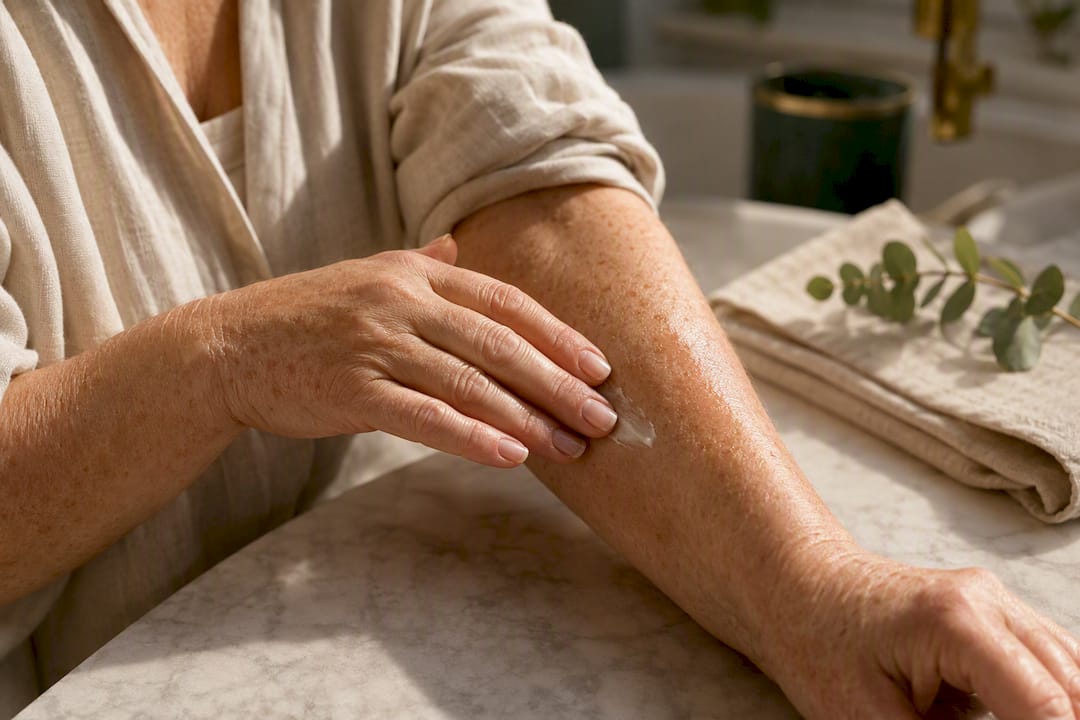
What tallow does not do is bind to or break down melanin. Sun spots form because ultraviolet exposure triggers melanocytes to overproduce pigment in localized clusters. Fading that pigment requires either enzymatic inhibition, exfoliation that speeds cell turnover, or procedures that specifically target the pigmented cells. Tallow’s fatty acids don’t do any of those three things. What they do is restore smoother surface texture, and smoother, better-hydrated skin scatters light more evenly, which can make a spot look slightly less stark by contrast.
There’s a practical side effect of occlusion worth knowing about: because tallow seals the surface, it can extend how long other leave-on ingredients sit against your skin. Applying it over an active ingredient can increase that ingredient’s contact time, according to a WebMD summary of tallow’s uses, which cuts both ways. It might improve penetration of something like a vitamin C serum, but it can also trap irritation from a strong active if you’re not careful about layering order.
Pro Tip: If you’re combining tallow with an active ingredient, apply the active first, let it absorb for a few minutes, then seal with tallow. Applying tallow first blocks the active from reaching skin at all.
The bottom line on mechanism: tallow is a structural support for skin, not a pigment intervention. It fixes the environment pigment sits in without touching the pigment itself.
How Do You Use Tallow for Sun-Damaged Skin Safely?
Getting a real benefit out of tallow skin care means using it consistently and pairing it with the right actives, not applying it randomly and hoping for pigment correction. Here’s a routine that reflects what the evidence actually supports.
- Patch test first. Apply a small amount of tallow to your inner forearm or behind your ear. Wait 48 hours. Watch for redness, itching, or small bumps, which can signal a comedogenic reaction or a sensitivity to residual proteins in the tallow.
- Introduce it at night, not in the morning. Tallow’s occlusive weight suits an overnight barrier-repair role better than a daytime routine where you also need sunscreen to absorb properly.
- Cleanse first. Sun-damaged skin often carries a mix of dead skin cells and environmental residue. Applying tallow over unwashed skin traps that layer underneath it.
- Apply actives before tallow, not after. If you’re using a vitamin C serum or a retinoid, let it fully absorb, typically 10 to 15 minutes, before sealing with tallow.
- Space out exfoliants. Chemical exfoliants (glycolic or salicylic acid) and tallow shouldn’t go on in the same application. Use the exfoliant on alternating nights, or in the morning, and reserve tallow for nights you’re not exfoliating.
- Use a mineral or broad-spectrum sunscreen every morning, no exceptions. Tallow provides zero UV protection on its own. Daily broad-spectrum SPF is the single most important habit for preventing sun spots from getting darker or new ones from forming.
- Reassess at four weeks, then again at eight to twelve. Track texture and hydration changes on your phone with photos taken in the same lighting. Don’t expect pigment change on this timeline. Expect smoother, calmer skin.
Pro Tip: Take your progress photos in natural window light, same time of day, same distance from the camera. Inconsistent lighting is the number one reason people think a product “isn’t working” when it actually is.
Who should skip tallow entirely, or use it with caution? If you have active acne or oily, congestion-prone skin, tallow’s richness can worsen breakouts. WebMD’s consumer guidance points out that lighter oils may serve oily skin types better than an occlusive as heavy as tallow. If you notice new bumps, clogged pores, or increased breakouts within the first two weeks, stop use and reassess.
What Can’t Tallow Do, and What Actually Fades Sun Spots?
Tallow’s job is cosmetic comfort: softer texture, less flaking, a calmer barrier. Fading an actual sun spot requires an ingredient or procedure that interrupts pigment production or physically removes pigmented cells, and tallow doesn’t do either.
If pigment correction is your real goal, these categories carry the strongest evidence:
- Topical vitamin C interferes with melanin synthesis and offers antioxidant protection against further UV damage; visible change typically takes 8 to 12 weeks of consistent use.
- Retinoids speed cell turnover, pushing pigmented cells to the surface faster; expect a similar 8 to 12 week timeline, sometimes longer for deeper spots.
- Hydroquinone is one of the more potent depigmenting agents available, but it’s regulated, requires a prescription at higher concentrations in the United States, and needs dermatologist supervision due to irritation risk.
- Chemical peels (glycolic, lactic, or trichloroacetic acid) accelerate exfoliation in a single in-office session, though multiple sessions are usually needed for visible fading.
- Laser and light-based treatments target pigment directly and can produce faster results than any topical, but they carry higher cost and a real risk of post-inflammatory pigmentation if your skin isn’t a good candidate.
Clinical guidance generally places measurable pigment improvement in the 8 to 12 week range for topical actives, with in-office procedures moving faster but carrying more risk if done without professional supervision.
See a dermatologist if a spot changes shape, color, or size, or if it doesn’t respond to any consistent topical routine after three months. Self-treating what might be a lentigo versus something that needs a biopsy isn’t a call to make from a skincare aisle. Pigment correction, unlike basic moisturizing, is a place where professional oversight actually changes outcomes.
How Lord’s Love Butter Formulates for Sun-Damaged, Sensitive Skin
Lord’s Love Butter builds every product around one job: repairing and supporting the skin barrier without synthetic fillers. The company uses grass-fed tallow rendered without chemical processing, which matters if you’re the kind of ingredient-minded person reading labels before buying anything.
That philosophy shows up in how the product line is structured for different needs:
- Daytime, sun-exposed skin: a mineral-forward balm formulated with zinc oxide, meant to sit on top of skin as physical sun protection rather than as a pigment treatment.
- Nighttime barrier repair: Manuka honey blended into whipped tallow, combining the humectant and anti-inflammatory qualities of honey with tallow’s occlusive strength for overnight recovery.
- Whole-body application: every formula is designed to work on the face and body alike, useful for anyone managing dry patches beyond just facial sun spots, including eczema-prone or psoriasis-prone areas.
[Author credentials and formulation testing details to be added in copy-editing.]
None of this changes the core truth from earlier in this article: no tallow product, from any brand, chemically reverses established pigmentation. What a well-formulated tallow balm can do is keep the skin around that spot calm, hydrated, and less reactive while you pursue an actual pigment strategy elsewhere.
Grass-Fed Tallow vs. Conventional: Does the Source Matter?
Grass-fed tallow carries a different fatty-acid and micronutrient profile than tallow from grain-finished cattle. Grass-fed sources tend to have higher levels of conjugated linoleic acid and fat-soluble vitamins like A and E, both of which show up in the fat itself, not just the meat. For skin care, this matters less as a pigment intervention and more as a quality signal.
Conventional tallow isn’t unsafe for topical use, but its fatty-acid ratios often skew differently depending on feed, and processing methods vary widely between suppliers, some of which use chemical deodorizing agents to strip smell before selling it as a cosmetic ingredient. That processing can strip out some of the naturally occurring vitamin content along with the odor.
If you’re chasing barrier repair and comfort for sun-exposed skin, source consistency probably matters more than most marketing suggests. A tallow that’s rendered the same way every batch, without solvent extraction or synthetic fragrance masking, is more likely to deliver a consistent occlusive effect and a consistent tolerance profile for sensitive or sun-irritated skin. It won’t fade a spot faster. It will likely feel gentler and more predictable on skin that’s already stressed from UV exposure, which is a real, if modest, advantage worth paying for.
Tallow vs. Other Natural Remedies for Sun Spots
Stack tallow against the other “natural” contenders people reach for, and the picture gets clearer fast. Manuka honey brings genuine anti-inflammatory and humectant properties, and it shows up in the multi-ingredient serum trial mentioned earlier with real brightening results, though Vogue’s coverage of manuka honey in skincare is careful to note it’s not a direct pigment lightener on its own either. It works best in combination, same as tallow.
Aloe vera calms inflammation and supports healing after sun exposure, but has no meaningful evidence for reversing existing pigmentation. Rosehip oil contains some vitamin A derivatives and gets cited often for scarring, though evidence specific to sun spots is limited. Licorice root extract has actual research behind mild tyrosinase inhibition, putting it closer to a real pigment-targeting natural ingredient than tallow, honey, or aloe.
Rank them by what the evidence supports for pigment specifically, and licorice root extract edges out the rest. Rank them by what’s best for calming and hydrating stressed, sun-damaged skin while you use something else for pigment, and tallow and manuka honey both perform well. That’s the honest comparison: none of these natural options replace a dermatologist-grade active for pigment correction, but tallow and manuka-based balms are genuinely useful for the comfort and barrier side of sun damage, which matters more than people expect once a spot has already stopped getting darker.
Recommended Formulations for Tallow Plus Pigment-Fading Ingredients
If you want the barrier benefits of tallow without giving up on pigment correction, look for formulations that pair tallow with an ingredient that actually has evidence behind melanin control, rather than relying on tallow alone and hoping.
Vitamin C is the most practical pairing. It’s stable enough to formulate into an oil-based balm, and it has real research behind interrupting melanin synthesis, unlike tallow itself. A tallow balm built around vitamin C gives you the occlusive comfort of tallow layered with an ingredient that’s doing actual pigment work, rather than two products fighting for space in your routine.
Squalane is a useful third ingredient to look for. It’s lightweight relative to pure tallow, which can offset some of the heaviness that concerns people with combination or acne-prone skin, while still supporting the barrier.
For daytime, the pairing that matters most is zinc oxide, not a pigment actives, since sun protection is the single non-negotiable step in any sun spot strategy. A sun balm stick built with zinc oxide covers that base while still delivering tallow’s moisturizing qualities underneath the mineral shield. Look for formulations honest about what each ingredient contributes instead of vague “brightening” claims with no active ingredient behind them.
How Do Sun Spots Actually Form on Skin?
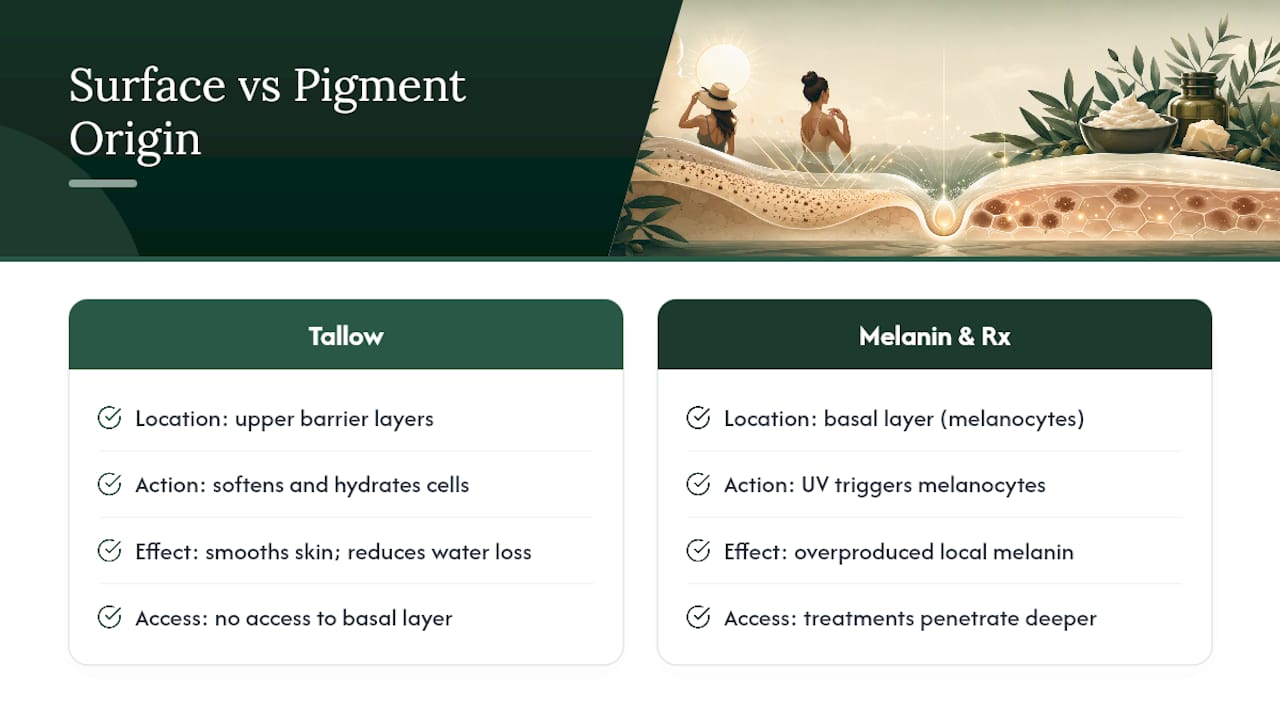
Sun spots, medically known as solar lentigines, form when ultraviolet radiation triggers melanocytes, the pigment-producing cells in your skin’s basal layer, to overproduce melanin in a localized area. Repeated UV exposure over years causes melanocytes to cluster and become more active in specific spots, usually on the face, hands, shoulders, and other areas with the most cumulative sun exposure.
Unlike a tan, which fades as skin cells turn over and shed within weeks, established sun spots involve melanocytes that have become semi-permanently more active in that location. That’s why sun spots persist for years without professional intervention, and why hydration alone can’t undo them. The melanin is already synthesized and deposited in the skin cells above the basal layer, sitting there until either natural, extremely slow turnover clears it or an active ingredient interrupts the process directly.
This is the context that makes tallow’s actual role clearer. Tallow operates entirely on the skin’s surface and within the upper barrier layers, softening and hydrating cells that are already there. It has no access to the basal layer where melanocyte activity originates, and no mechanism for interrupting melanin synthesis once it’s underway. Ingredients that do influence sun spots, whether vitamin C, retinoids, or hydroquinone, work because they penetrate deeper or chemically interfere with the pigment-production pathway itself. Understanding that anatomical gap is the clearest way to see why tallow helps the skin around a sun spot without touching the spot itself.
My Take: Use Tallow for What It’s Actually Good At
The tallow trend gets oversold constantly, and I think that’s doing readers a disservice. Tallow is a genuinely good barrier-repair ingredient with a fatty-acid profile that plays well with skin. Pretending it fades sun spots sets people up to quit a product that’s actually working for the wrong reason, or worse, to skip sunscreen because they think a jar of tallow is handling pigment protection.
My honest recommendation: patch test any new tallow product, wear broad-spectrum sunscreen daily without exception, and give a routine 8 to 12 weeks before judging it. If pigment hasn’t budged in that window, that’s not the product failing. That’s tallow doing exactly what it was always going to do, which is texture and hydration, not pigment removal.
— Michael
Recommended Lord’s Love Butter Products for a Tallow Routine
This brand offers a grass-fed, chemical-free way to support sun-stressed skin without guessing what’s actually in the jar. Their formulas skip synthetic fillers and fragrance, which matters if your skin is already reactive from sun exposure or sensitive conditions like eczema.
For daytime, the Beef Tallow Sun Balm Stick with Zinc Oxide pairs mineral sun protection with tallow’s moisturizing base, a practical option if you want SPF and barrier support in one step. At night, the Whipped Beef Tallow Balm with Manuka Honey or the lighter Beef Tallow Balm Lite with Manuka Honey both bring honey’s calming properties into an overnight barrier-repair routine, with the Lite version suited to anyone wary of a heavier feel. Traveling or just want to try it first? The travel-sized whipped balm tin is a low-commitment way to test how your skin responds before committing to a full jar. If you’re also chasing pigment support alongside barrier repair, The Face Duo bundle pairs a vitamin C balm with the Lite formula.
Pick one product, patch test it this week, and give your skin the 8 to 12 week window this article keeps coming back to. That’s the honest way to find out if it earns a permanent spot in your routine.
Sources
- Clinical guidance needed as patients turn to tallow for skin conditions — Dermatology Times
- Investigating the Effects of a Manuka Honey, Royal Jelly, and Bee Venom–Derived Face Serum on Skin Health and Signs of Aging — PubMed
- Beef tallow: Benefits — should you use it? — MD Anderson Cancer Center

