

What Causes That Tight Skin Feeling on Your Body
Tight skin feels like your skin has shrunk a size too small. The sensation comes from moisture and lipid loss in the stratum corneum, the outermost skin layer, which causes it to contract and pull against the deeper layers beneath. Stanford University researchers confirmed this mechanism, showing that stratum corneum contraction generates mechanical strain that reaches sensory receptors below the epidermis, which then fire signals your brain reads as tightness. Most of the time, the cause is simple: dryness, dehydration, or a harsh cleanser. But persistent or worsening tightness, especially with skin hardening or color changes, can point to something more serious.
Main causes of tight skin at a glance:
- Moisture loss and barrier dysfunction from dryness or xerosis
- Environmental exposure: cold air, low humidity, indoor heating
- Harsh cleansers, hot showers, or overwashing
- Venous insufficiency, particularly in the legs
- Skin conditions like eczema and psoriasis
- Aging and declining sebum production
- Systemic diseases: scleroderma, hypothyroidism, diabetes
- Autoimmune-driven collagen overproduction
What are the most common causes of tight skin?
Dry skin is the leading cause of skin tightness. As the skin loses moisture, the stratum corneum contracts, and that mechanical pull is what you feel. Aging accelerates this because sebum production drops over time, leaving skin with less natural lubrication to hold water in.
Environmental conditions make everything worse. Cold air holds less moisture than warm air, and indoor heating strips humidity from rooms, creating a double hit on your skin barrier. Pollution compounds the problem by degrading the lipid layer that keeps moisture locked in.
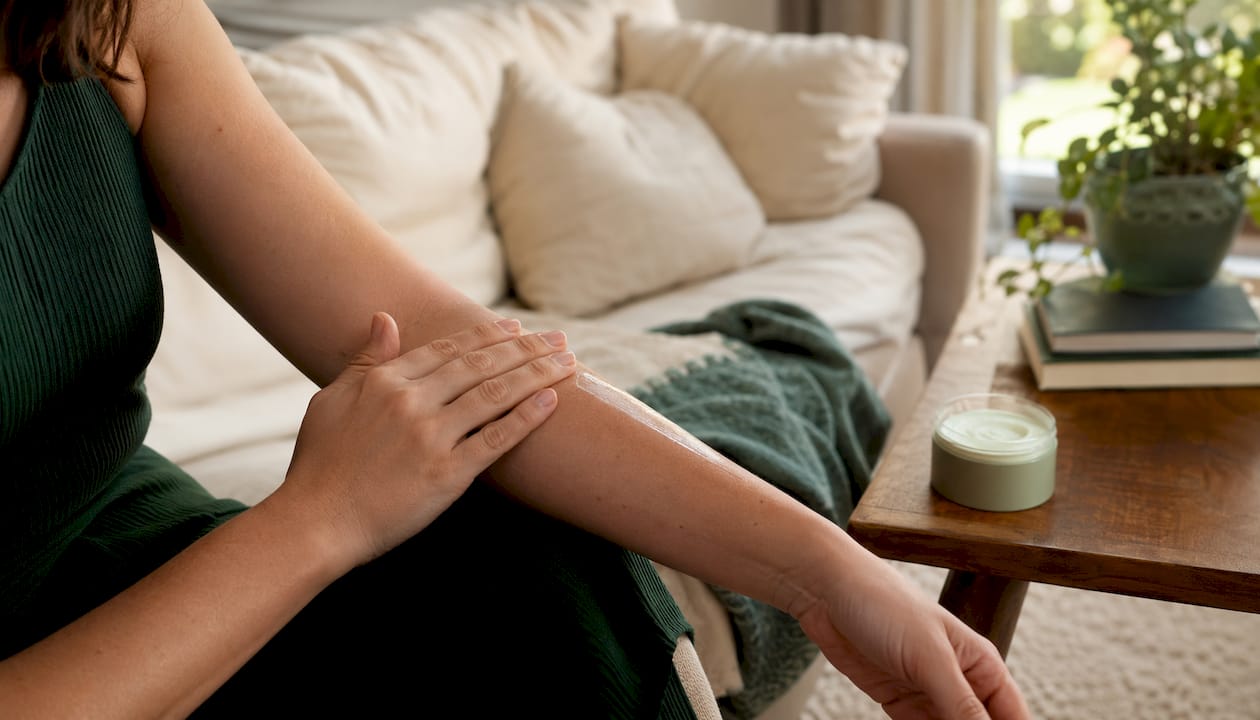
Lifestyle habits are often the hidden driver. Hot showers, antibacterial soaps, and overwashing all strip the skin’s protective lipids faster than the body can replace them. People who wash their face twice a day with a foaming cleanser and skip moisturizer are essentially repeating the damage cycle every 12 hours.
Localized tightness in the legs often signals venous insufficiency rather than simple dryness. Poor circulation reduces nutrient delivery to skin tissue, causing a stretched, uncomfortable sensation that worsens by the end of the day. Eczema and psoriasis also produce tightness, but through a different route: barrier dysfunction with lipid abnormalities reduces the skin’s water-holding capacity, leaving it rough, cracked, and prone to inflammation.
Common and localized causes summarized:
- Xerosis (chronic dry skin) from sebum decline and aging
- Cold, dry, or heated indoor air stripping moisture
- Overwashing or using harsh, foaming cleansers
- Hot baths or showers that dissolve skin lipids
- Venous insufficiency causing leg tightness and swelling
- Eczema and psoriasis disrupting the skin barrier
| Cause | Mechanism | Typical location |
|---|---|---|
| Xerosis | Moisture loss, sebum decline | Face, legs, arms |
| Environmental exposure | Low humidity, cold air, heating | Full body |
| Harsh cleansers | Lipid stripping, barrier disruption | Face, hands |
| Venous insufficiency | Poor circulation, fluid buildup | Lower legs |
| Eczema / psoriasis | Barrier dysfunction, inflammation | Patches anywhere |
| Overwashing | Repeated lipid removal | Face, hands |
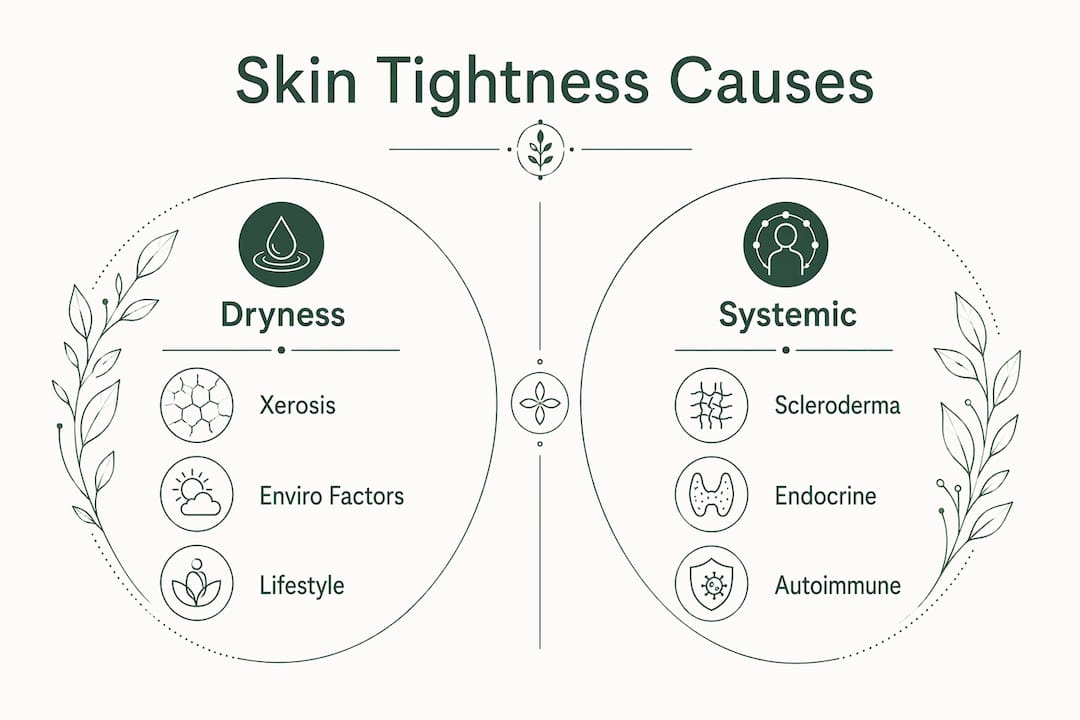
When tight skin signals a systemic disease
Some causes of skin tightness have nothing to do with dryness. Autoimmune and endocrine diseases can produce tightness that no moisturizer will fix, because the problem originates inside the body, not at the surface.
Scleroderma
Scleroderma is the autoimmune condition most closely associated with severe, chronic skin tightness. The immune system triggers fibroblasts to overproduce collagen, and that excess collagen accumulates in the skin and connective tissue, causing it to thicken and harden. According to the Mayo Clinic, the disease typically begins with swelling, itchiness, and shiny, thickened skin, most often in the fingers, hands, feet, and face. The National Institute of Arthritis and Musculoskeletal and Skin Diseases (NIAMS) describes two main localized patterns: morphea, which produces firm oval patches with a waxy appearance, and linear scleroderma, which causes lines of thickened skin running down a limb or across the forehead.

Systemic sclerosis, the more severe form, can extend fibrosis to internal organs including the lungs, heart, and kidneys. The tightness in this case is not a surface sensation but a structural change in the tissue itself.
Hypothyroidism and diabetes
Both conditions cause significant skin dryness and tightness, particularly on the feet. Hypothyroidism slows cell turnover and reduces sweat and oil gland activity, leaving skin thick, dry, and prone to cracking. Diabetes impairs circulation and nerve function, which together reduce the skin’s ability to retain moisture and repair itself.
Signs that suggest a systemic cause:
- Tightness that does not improve with moisturizing
- Skin hardening or a waxy, shiny texture
- Color changes: reddish borders, yellowish patches, or pallor
- Tightness spreading from fingers or face inward
- Joint stiffness or restricted movement alongside skin changes
- Fatigue, swelling, or other systemic symptoms
Pro Tip: If your skin feels tight specifically in your fingers and the sensation worsens in cold temperatures, that combination can indicate Raynaud’s phenomenon, which is commonly associated with scleroderma. Mention it to your doctor by name.
When should you see a doctor about tight skin?
Temporary tightness after washing your face or spending a day in dry winter air is normal. Persistent or progressive tightness is not. The key distinction is whether the sensation responds to moisturizing and lifestyle changes, or whether it keeps worsening regardless.
Seek medical evaluation when you notice any of the following:
- Tightness lasting more than a few weeks without an obvious cause
- Skin that feels hard or leathery rather than just dry
- Visible texture or color changes: shiny patches, reddish borders, or darkening
- Tightness that limits joint movement or facial expressions
- New tightness appearing on fingers, hands, or face without prior dryness history
- Accompanying symptoms: fatigue, joint pain, difficulty swallowing, or shortness of breath
A doctor will typically start with a physical exam, then order blood tests and skin biopsy to distinguish simple dryness from autoimmune or endocrine disorders. Allergy testing may follow if contact dermatitis is suspected. The location and progression of tightness matter clinically: tightness that begins in the extremities and moves centrally follows a different diagnostic path than tightness that stays localized to one patch.
Pro Tip: Before your appointment, photograph the affected areas over several weeks. Doctors find progression photos far more useful than verbal descriptions when evaluating skin changes.
What the science says about skin tightness and how to manage it
Stanford University researchers published a detailed model in PNAS Nexus showing exactly how mechanical forces in the stratum corneum travel through skin layers to reach mechanoreceptors below the epidermis. When a cleanser strips lipids, the stratum corneum contracts and the resulting strain propagates downward, triggering those receptors to signal tightness to the brain. A moisturizer reverses this by swelling the stratum corneum back outward, reducing the mechanical pull.
The practical implication is that moisturizer alone is not always enough. If you keep using a harsh cleanser, you are creating the problem faster than a moisturizer can fix it. Effective management requires both sides: gentle cleansing with lukewarm water and consistent barrier-supporting hydration. DermNet notes that compromised barrier integrity in older adults specifically raises the risk of inflammatory conditions and infections, not just discomfort.
For skin tightness rooted in autoimmune disease, no topical routine addresses the underlying cause. Scleroderma and similar conditions require specialist management, often involving immunosuppressants and disease-modifying therapies. Moisturizing helps with surface comfort but does not slow the fibrotic process.
Pro Tip: Switch to a cream or oil-based cleanser instead of a foaming formula. Foaming cleansers are almost always more stripping, regardless of how “gentle” the label claims. Pair it with a barrier-repairing moisturizer applied within two minutes of washing, while skin is still slightly damp, to maximize absorption.
For people whose tightness stems from dryness, a natural balm for dry skin can outperform water-based lotions because it creates an occlusive layer that slows transepidermal water loss rather than just adding surface moisture. If you want a full routine built around barrier repair, a chemical-free moisturizing routine is worth reviewing. For sensitive or reactive skin, science-backed strategies to soothe skin offer a solid starting framework.
Lordslovebutter can help when dryness is the culprit

When tight skin traces back to dryness and barrier disruption, the fix is a moisturizer that actually seals moisture in rather than evaporating off the surface. Lordslovebutter’s Whipped Beef Tallow Balm with Manuka Honey uses grass-fed beef tallow, a fat with a lipid profile close to human sebum, to restore the barrier layer that cleansers and cold air strip away. It absorbs without a greasy residue and works on the face, hands, legs, and anywhere else tightness shows up.
The veteran-owned brand keeps the formula free from synthetic chemicals, making it a practical choice for people with eczema, psoriasis, or reactive skin who cannot tolerate conventional moisturizers. If you want to start with something lighter, the Original Beef Tallow Balm Lite gives you the same barrier support in a thinner texture.
Key Takeaways
Tight skin feeling is primarily caused by stratum corneum moisture loss, but persistent or progressive tightness with skin hardening or color changes requires medical evaluation to rule out systemic disease.
| Point | Details |
|---|---|
| Root mechanism | Stratum corneum contraction generates mechanical strain that mechanoreceptors signal to the brain as tightness. |
| Top common cause | Dryness and xerosis, worsened by aging, cold air, heating, and harsh cleansers, drive most cases. |
| Serious medical cause | Scleroderma causes collagen overproduction and skin hardening, starting in fingers, hands, and face. |
| When to see a doctor | Seek evaluation for tightness that does not respond to moisturizing, or that comes with hardening, color changes, or joint restriction. |
| Management approach | Combine gentle cleansing with barrier-repairing moisturization; topical care alone cannot address autoimmune-driven tightness. |

